
Deciding between the CBAP Vs CCBA certifications can feel confusing, especially if you want to grow your business analysis career. Both certifications are valuable, but they serve different experience levels and goals. Choosing CBAP or CCBA depends on your skills, years of experience, and career plans.
If you choose the right path, you can boost your confidence, improve your job prospects, and increase your earning potential.
In this blog post, you will learn the key differences, requirements, and benefits of each certification. By the end, you will clearly understand which option fits your journey and helps you move forward with confidence.
Let’s get started.
Key Takeaways
- Both certifications help business analysts grow, but target different career stages
- CBAP is for experienced professionals who lead complex projects and aim for strategic roles
- CCBA suits mid-level analysts who want to validate skills and move to advanced roles
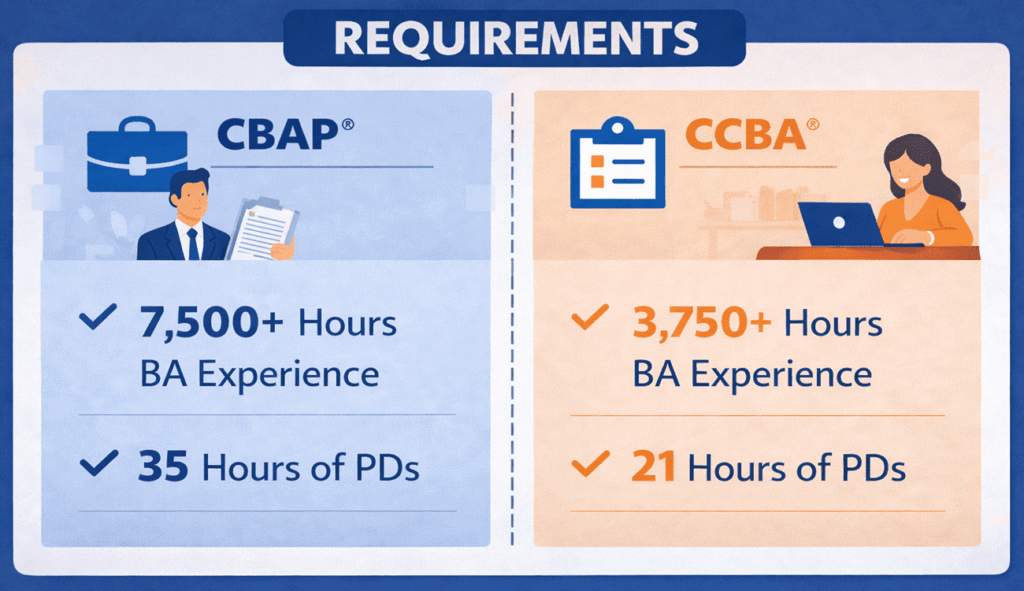
- CBAP requires 7,500 hours of experience and 35 professional development hours
- CCBA requires 3,750 hours of experience and 21 professional development hours
- CBAP offers a higher earning potential (about 13% more), so choose based on your goals
Understanding Business Analysis Certifications
The International Institute of Business Analysis (IIBA) oversees several certifications that mark different stages in an analyst’s career. The Entry Certificate in Business Analysis (ECBA) confirms foundational knowledge. The CCBA validates intermediate-level skills, and the CBAP recognizes advanced expertise and leadership. Each program follows the Guide to the Business Analysis Body of Knowledge (BABOK Guide) and aims to standardize best practices.
Earning a certification can help you stand out in job markets and connect you with a community of peers. It also signals commitment to professional growth and may increase your earning potential.
Let’s look at each credential in detail.
What is the CCBA?
The Certification of Capability in Business Analysis (CCBA) is meant for analysts who have been working for a few years and are ready to take on more responsibility. It is a mid-level credential that sits between entry-level and senior certifications. To qualify, you need 3,750 hours of business analysis work in the last seven years.
You must also complete at least 900 hours in two BABOK knowledge areas or 500 hours in four areas, accrue 21 hours of professional development within the past four years, and submit two professional references. The exam lasts three hours and includes 130 multiple-choice and scenario-based questions.
Those who hold the CCBA show that they can work on moderately complex projects and collaborate effectively with stakeholders. The certification also helps build confidence in industry best practices and prepares analysts for advanced positions.
Who Should Consider the CCBA?
Consider the CCBA if you have two to three years of business analysis experience and you regularly collect and document stakeholder requirements. It suits analysts who want to validate their skills and move into roles with more autonomy or leadership. You should be comfortable using techniques from the BABOK Guide and want to demonstrate that you follow recognized standards.
CCBA holders often work as project coordinators or mid-level business analysts. They use the credential to demonstrate to employers that they understand core analytical methods and can handle moderate complexity.
What is CBAP?
The Certified Business Analysis Professional (CBAP) is the highest-level credential offered by IIBA. It recognizes analysts who have led major initiatives, mentored others, and influenced organizational strategy. To apply, you need 7,500 hours of business analysis experience over the last ten years.
Within those hours, you must record at least 900 hours in four of the six BABOK knowledge areas, totaling at least 3,600 of the 7,500 hours. Candidates also need 35 hours of professional development in the past four years, two references, and must pass a 3.5-hour exam with 120 multiple-choice and case-study questions.
The CBAP is designed for senior analysts who guide strategy and help organizations make high-impact decisions. It signals mastery of advanced analysis techniques and leadership skills. Completing it shows that you can handle complex, high-stakes projects and mentor others.
Who Should Consider the CBAP?
You should pursue the CBAP if you have more than five years of experience, regularly lead teams, and want to move into senior or strategic roles. The certification is ideal for analysts who create organizational visions, influence decision-makers, and mentor colleagues. By earning the CBAP, you demonstrate thought leadership and commitment to excellence.
CBAP holders often become lead analysts, business analysis managers, or consultants. Their credentials signal to employers that they can drive cross-departmental transformation.
CABAP Vs CCBA
CBAP and CCBA differ mainly in experience level and career focus. CBAP targets senior business analysts who handle complex projects and lead strategic decisions. It requires 7,500 hours of experience and deeper knowledge of business analysis practices. CCBA suits mid-level analysts who want to validate their skills and grow in their careers. It requires 3,750 hours of experience and focuses on core concepts.
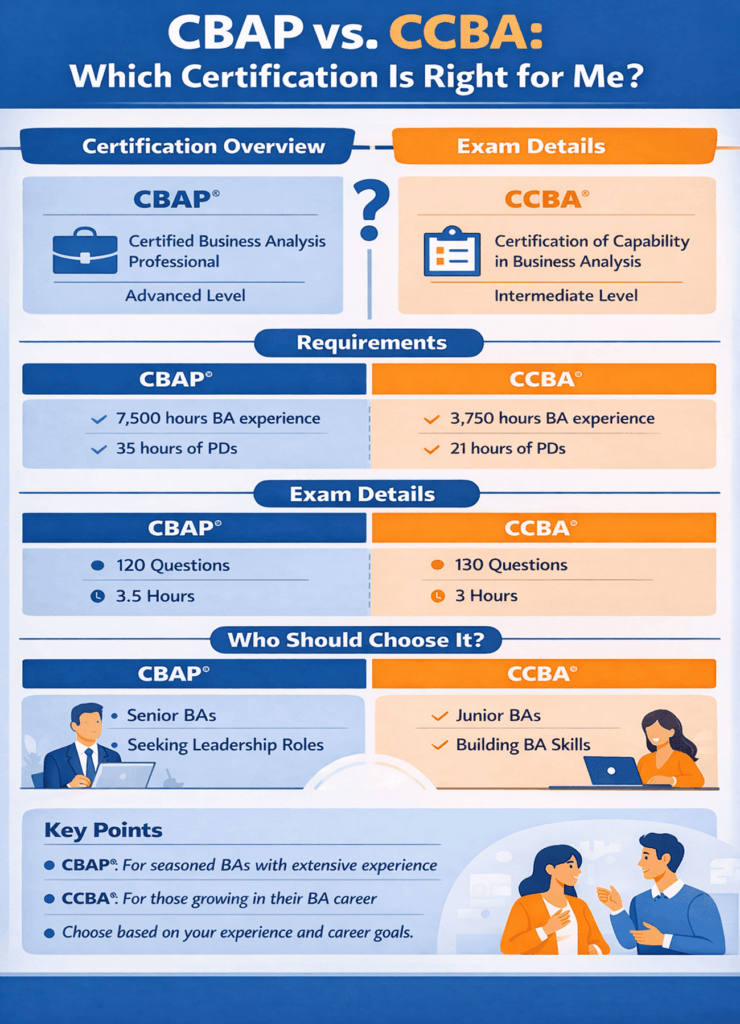
The CBAP exam is longer and more advanced, while the CCBA exam is slightly shorter and less complex. In simple terms, CCBA helps you move forward, while CBAP proves you are already an expert in business analysis.
Requirements at a Glance
For a quick comparison, the infographic below summarizes the key requirements and focus areas for each certification.
How to Choose the Right Certification
Selecting between the CCBA and CBAP starts with an honest self-assessment. Ask yourself:
- How much experience do I have? If you have two to three years of hands-on analysis experience, the CCBA may be the right step. If you have exceeded five years and have led teams, consider the CBAP.
- What are my career goals? Do you aim to lead strategic initiatives or influence organizational direction? The CBAP can help. Do you want recognition for your current skills and a pathway toward senior roles? Then the CCBA may suit you.
- How much time can I devote to preparation? The CBAP exam is longer and often demands more study. The CCBA still requires commitment but covers a narrower scope.
- Do I need a salary boost? If compensation is a key driver, remember that CBAP holders earn a noticeable premium.
Consider speaking with mentors, reviewing job postings, and reflecting on your long-term plans. There is no one-size-fits-all answer, so choose the certification that aligns with your current experience and future ambitions.
Beyond Salary: Other Benefits of Certification
Money is important, but certifications offer more than increased pay. They bring recognition and credibility. Hiring managers know that certified analysts follow industry best practices. Credentials also boost confidence; when you pass a rigorous exam, you know you can handle complex projects. Many certified analysts report that certification leads to broader responsibilities, exposure to senior leaders, and opportunities to mentor others.
Certification also connects you to a global network of professionals. IIBA chapters host workshops, webinars, and social events where you can meet peers and share knowledge. This network can lead to job leads, partnerships, and lifelong friendships. Professional development hours required for certification encourage continual learning, keeping your skills current and relevant.
FAQs
Q1. Is the CCBA easier than the CBAP?
Yes. The CCBA covers fundamental and moderate complexity. The exam is shorter and aimed at analysts with fewer years of experience.
Q2. How long should I prepare for the CBAP exam?
Most candidates spend two to three months studying. It depends on your familiarity with the BABOK Guide and your daily schedule.
Q3. Do I need both the CCBA and CBAP?
Not necessarily. Many analysts use the CCBA as a stepping stone. Others with extensive experience skip straight to the CBAP.
Q4. Will employers notice my certification?
Yes. Certifications signal that you follow global standards and are committed to your profession. They often come up in interviews and performance reviews.
Q5. Can certification help me change industries?
It can. The skills you learn are transferable. Earning a credential proves that you understand analysis techniques that apply across sectors.
Summary
Choosing between the CCBA and the CBAP comes down to where you are and where you want to go. Both certifications validate your skills and open doors. The CCBA is ideal if you are early in your career, while the CBAP signals mastery and prepares you for strategic roles. Certification requires dedication and time, but the rewards, such as higher pay, greater confidence, and broader opportunities, can be substantial. Look at your experience, think about your goals, and decide which path will help you grow.
References:

I am Mohammad Fahad Usmani, B.E. PMP, PMI-RMP. I have been blogging on project management topics since 2011. To date, thousands of professionals have passed the PMP exam using my resources.