Earning the Project Management Professional (PMP) certification can be one of the most rewarding steps for a project manager. It signals that you understand the discipline and are ready to lead complex projects. Many people still ask, “Is it hard to get the PMP certification?”
The short answer is yes, the exam is challenging, but it is within reach when you prepare properly.
This blog post explains why the PMP exam feels tough, what has changed for 2026, and how you can build a study plan that works. You will see concrete facts, updated statistics, and expert advice. By the end, you will have a clear path forward.
Is it Hard to Get the PMP Certification?
The PMP exam is designed to verify that you can apply project management principles rather than simply recall terms. It covers three domains: people, process, and business environment, and uses a psychometric scoring model. According to estimates from training providers, fewer than 70 percent of candidates pass on their first attempt. PMI stopped publishing official pass rates, but this figure shows that many applicants underestimate the effort required.
To sit for the exam, you must also meet strict prerequisites: at least 36 months of project management experience with a bachelor’s degree or 60 months without one, plus 35 contact hours of formal training. Those requirements alone can deter some applicants.
Scenario-Based Questions and Time Pressure
The PMP exam includes 180 questions to be completed in 230 minutes. Five of those questions are unscored pretest items. Many questions present long scenarios with plausible but subtly different answers. You cannot guess your way through; you need to identify the best response based on PMI’s preferred practices. This format tests how you think. Managing time is essential because you have roughly one minute and 16 seconds per question.
Psychometric Scoring
Unlike many certification exams, the PMP does not have a fixed passing score. PMI uses a psychometric approach that weights your performance based on each question’s difficulty. Getting difficult questions right can help you pass even if you miss some easier ones. This method keeps the exam fair, but it also makes it hard to predict how well you will do. Many candidates say they felt confident during practice tests but rushed during the actual exam.
PMP Exam Structure and Domains
Understanding the structure of the exam will help you plan your study sessions.
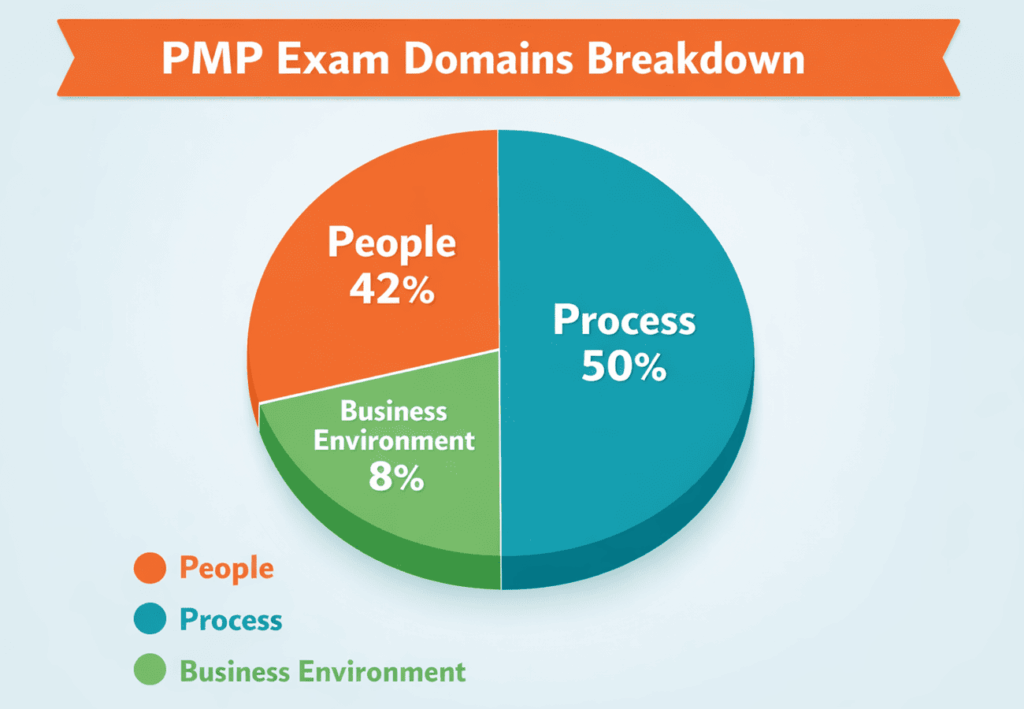
The three domains: people, process, and business environment carry different weights.
- People (42%) – This domain focuses on leadership, communication, conflict resolution, and team performance. You need to know how to engage stakeholders and motivate cross-functional teams.
- Process (50%) – This is the core of project management: planning, executing, monitoring, and controlling. It includes risk, cost, schedule, and scope management.
- Business Environment (8%) – This domain covers strategy, compliance, and governance. Questions may involve aligning projects with organizational goals and understanding external influences.
Within these domains, you will encounter tasks such as stakeholder management, change control, critical path analysis, earned value calculations, and risk responses. The exam tests your ability to combine these skills in realistic situations.
What’s New for 2026: The PMBOK Guide 8th Edition and Exam Updates
PMI has released the PMBOK Guide Eighth Edition. This update responds to feedback that the seventh edition was too open-ended. The new guide draws on more than 48 thousand data points. It provides clearer guidance for everyday projects while keeping the flexibility to handle agile, predictive, and hybrid environments.
Six Principles
The eighth edition simplifies the overarching principles from twelve to six. These principles include adopting a holistic view, focusing on value, embedding quality, being an accountable leader, integrating sustainability, and building an empowered culture. Each principle guides behavior across all project types. For example, focusing on value means measuring success by outcomes that matter to stakeholders rather than simply finishing on time.
Focus Areas and Performance Domains
The PMBOK Guide 8th edition reintroduces Process Groups as Focus Areas. These five areas: initiating, planning, executing, monitoring, and controlling, and closing, describe the flow of every project. Unlike prescriptive processes, Focus Areas are adaptable and can be applied to predictive, agile, or hybrid projects. The guide also introduces seven Project Management Performance Domains: governance, scope, schedule, finance, stakeholders, resources, and risk. These domains group related tasks and encourage integrated thinking.
Impact on the PMP Exam
The updated PMP exam will launch on July 9, 2026. While the three-domain structure remains, the new exam places greater emphasis on value creation, stakeholder engagement, sustainability, and systems thinking. It aligns closely with the principles, Focus Areas, and performance domains discussed above. Candidates who plan to take the exam after July 9 should familiarize themselves with PMBOK 8 and review the updated exam content outline.
Benefits of Earning the PMP
Why endure such a demanding process? The credential has tangible career benefits. PMI’s 2025 Salary Survey found that PMP holders earn 17 percent higher median salaries than non-certified professionals across 21 countries. In the United States, PMP-certified respondents reported a median salary of $135,000, compared with $109,157 for non-certified project managers, a nearly 24 percent difference. Over time, the gap grows. These findings highlight how the certification delivers long-term value.
The credential is also increasingly popular. PMI’s 2024 Annual Report notes that more than 2.5 million PMP certifications have been awarded since 1984. The organization has more than 1.7 million active certification holders across its various credentials. As businesses continue to invest in digital transformation and AI, the need for skilled project managers will only increase.
Steps to Getting Your PMP
It helps to view the certification process as a series of steps rather than a single hurdle.
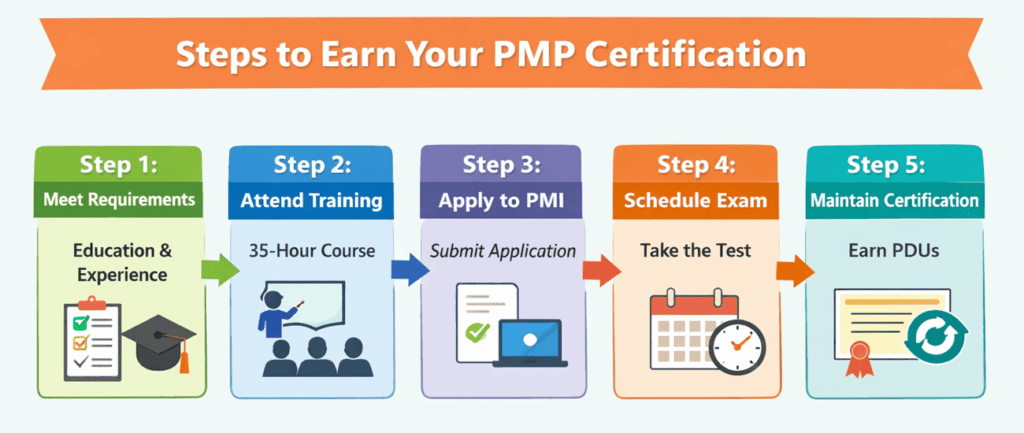
The following infographic outlines the journey:
- Verify your eligibility. Confirm that you meet the experience and education requirements. If you hold a four-year degree, you need at least 36 months of project management experience. Without a degree, you need 60 months.
- Complete 35 contact hours. Enroll in a PMI Authorized Training Partner program, such as the PMP Certification Training or another approved course. This training provides the 35 hours of formal education required to apply.
- Submit your application. Create an account on PMI’s website and document your experience and training. Once your application is approved, pay the exam fee. PMI may randomly audit your application, so be honest and organized.
- Schedule your exam. Choose between an in-person test center or a remote proctored session. Pick a date that allows enough time to finish your studies. You must pass within one year of your application approval.
- Maintain your certification. After you pass, you will need to earn 60 Professional Development Units (PDUs) every three years to keep your credential active. PMI offers online courses, webinars, and community events to help you meet this requirement.
Effective Study Strategies
Make a Study Plan
Everyone learns at a different pace. Experienced project managers may need only six to eight weeks of focused study, while newer practitioners often spend three to six months reviewing materials. Map out your available time and plan weekly study sessions. Break the material into manageable chunks: one week for each domain, one week for formulas, one week for mock exams, and so on.
Use Quality Resources
Select study guides and courses that align with the current exam content outline. The PMBOK Guide is essential, but supplement it with practice exams, flashcards, and interactive tools. Official practice questions from PMI Authorized Training Partners mirror the style and tone of the real exam. Be wary of free online quizzes that may be outdated.
Practice Time Management
Take full-length practice exams in a quiet space. Use a timer to simulate the real exam’s 230-minute limit. If you tend to dwell on difficult questions, practice skipping them and coming back to them later. Many test takers find it useful to read the last sentence of each question first to understand what is being asked before parsing the scenario.
Join a Boot Camp or Study Group
Structured boot camps can accelerate your preparation. Authorized Training Partners often provide instructors, mock exams, and guidance on tricky topics. Study groups offer accountability and different perspectives. If you prefer self-study, consider joining online forums to ask questions and share tips.
Take Care of Yourself
Mental endurance is key. Get enough sleep, stay hydrated, and take breaks during study sessions. On exam day, arrive early, bring appropriate identification, and dress in layers. If you are testing remotely, prepare your workspace to avoid distractions. A calm, well-rested mind will help you recall what you have learned.
Personal Reflections
When I prepared for my own PMP exam, I underestimated how draining four hours of intense concentration would be. My first practice exam left me exhausted. I learned to pace myself: I wrote down formulas at the start, marked long questions for later, and took short breaks during scheduled pauses. I also discovered that understanding PMI’s perspective is more important than memorizing every definition. If you think like a project manager, such as balancing scope, time, cost, and stakeholder needs, you will find many answers flow naturally.
FAQs
Q1. How long does it take to get ready for the PMP exam?
Most experienced project managers study for 6–8 weeks, while newcomers spend 3–6 months. Your background and schedule will determine the exact timeline.
Q2. What happens if I fail the PMP exam?
You may retake the exam up to three times within one year of your application approval. Use your score report to focus on weak areas before attempting again.
Q3. Do I need to know formulas for the new exam?
Yes. While the 2026 exam focuses more on value and outcomes, you should still be comfortable with earned value management and critical path calculations.
Q4. Should I wait for the 2026 exam update?
If you are ready now, take the current exam. If your study plan extends past July 9, 2026, review the PMBOK 8 changes and adjust your preparation accordingly.
Q5. Do employers value the PMP certification?
Absolutely. The PMP shows you can lead complex projects and speak the language of business. Many employers require or prefer this credential for senior project roles.
Summary
Earning the PMP certification is challenging, but it is achievable with the right preparation and mindset. By understanding the exam structure, studying the PMBOK principles, and practicing real exam scenarios, candidates can greatly improve their chances of success. The certification not only validates your project management skills but also opens doors to better career opportunities and higher earning potential. With a clear study plan and consistent effort, you can confidently overcome the PMP exam challenge.

I am Mohammad Fahad Usmani, B.E. PMP, PMI-RMP. I have been blogging on project management topics since 2011. To date, thousands of professionals have passed the PMP exam using my resources.