Getting the Project Management Professional (PMP) certification is a rewarding milestone for many project managers. But many people still wonder about the PMP exam difficulty and what makes the test feel intense. You might even ask yourself, how hard is the PMP exam compared to other professional tests.
In this blog post, I will explain why the exam has a strong reputation for being tough and break down the main factors behind PMP exam difficulty. You’ll learn about eligibility requirements, expected study time, and the benefits that come with earning this respected credential.
I include simple steps and clear examples, so you understand what the exam covers and how to build a study plan that works. When you know what to expect, you can manage your time better and enter the test with more confidence. This post offers practical insights to help you prepare, stay focused, and move closer to your certification goal.
What the PMP Exam Covers
The PMP exam is designed to test your knowledge across the entire spectrum of project management, including predictive, agile, and hybrid methods. The PMP exam runs 230 minutes and includes 180 questions with various question types—multiple-choice, multiple responses, matching, hotspot, and fill-in-the-blank. The questions draw on the PMP exam content outline and A Guide to the Project Management Body of Knowledge (PMBOK).

Questions are grouped into three domains:
- Process (50%): Planning, executing, risk management, quality control, and scope management
- People (42%): Leadership, team management, conflict resolution, and stakeholder engagement
- Business environment (8%): Governance, compliance, and alignment with organizational strategy.
Half of the exam emphasises predictive project management methods, while the other half covers agile and hybrid approaches. You can take the test online or at a test center.
Note: The old five process groups are gone.
PMP Exam Difficulty: Why the PMP Exam Feels Hard
Many candidates describe the PMP exam as challenging because it’s not a memorization test. Instead, you’ll need to apply project management concepts to real-world situations. The the difficulty stems from scenario-based questions, the 230-minute duration, a psychometric scoring system with no fixed pass percentage, and the pressure of managing time across 180 questions.
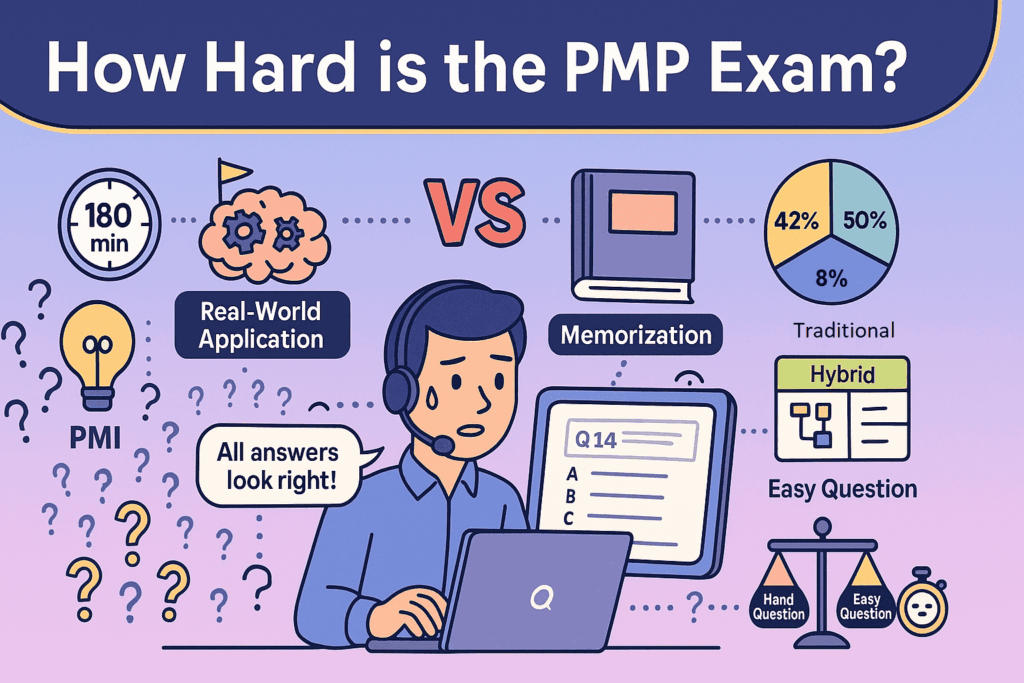
Test-takers often report that several answer options appear plausible, and success hinges on understanding “the PMI way” of thinking. In other words, you need both theoretical knowledge and practical judgment.
Other factors contribute to the exam’s complexity:
- Broad Scope: The exam covers 35 tasks across the three domains, ranging from leadership and communication to earned value management (EVM) and critical path method (CPM) calculations. You’ll need to be comfortable with predictive, agile, and hybrid methods, as well as stakeholder, risk, and change management.
- Psychometric Scoring: PMI uses psychometric analysis to determine how many questions you must answer correctly. Harder questions carry more weight, so two candidates with similar raw scores may receive different results.
- Time Management: Completing 180 scenario-based questions in 230 minutes requires stamina and efficient time allocation. Many people feel rushed even after extensive practice.
Common Mistakes to Avoid During the PMP Exam
Don’t rely on outdated materials or focus solely on waterfall approaches. The latest exam features a significant number of agile and hybrid scenario questions. Balance your study across all three domains and practice multiple question types. Neglecting leadership and people skills or failing to simulate exam conditions during practice can hinder your performance.
PMP Pass Rates and Scoring
A frequent question is, “What score do I need to pass?” PMI stopped publishing a fixed passing score after 2005, when it briefly shared a 61% passing mark. Today, the organization keeps its scoring criteria confidential and uses a psychometric model to evaluate each candidate’s performance. As a result, there is no officially released pass rate.
Industry estimates provide some insight:
- According to training providers and exam analysts, roughly 60 – 65% of first-time test-takers pass the PMP exam, meaning about 4 out of 10 candidates may fail due to insufficient preparation.
- Some unofficial estimates suggest 40 – 50% of first-time candidates don’t pass, highlighting the exam’s difficulty.
Because PMI evaluates exams psychometrically, answering more difficult questions correctly can outweigh a lower total number of correct answers. Therefore, focus on understanding concepts deeply rather than aiming for a specific percentage score.
PMP Exam Eligibility and Prerequisites
Before you can schedule your exam, you must meet PMI’s education and experience requirements. Candidates with a bachelor’s degree need 36 months of project management experience, while those with a high-school diploma require 60 months. Everyone must complete 35 hours of formal project management education—usually through a PMI-approved course or boot camp.
Once these prerequisites are satisfied and PMI has approved your application, you’ll be able to register for the exam.
The 36/60 months must be non-overlapping and within the last 8 years.
What to Study and How to Study
Core materials
The cornerstone of your preparation is the PMP Exam Content Outline, which outlines principles, domains, and models relevant to modern project management. Don’t limit yourself to this outline alone; augment your learning with:
- The PMBOK Guide: This PMI document explains processes and procedures for each domain.
- PMP Handbook: It details application procedures, exam policies, and scheduling information.
- Additional texts and courses: Books by experienced PMP-certified authors, online videos, and practice exams can provide varied perspectives and help clarify tricky concepts.
PMP Study Strategies
- Create a realistic study plan: Break your preparation into manageable chunks—such as one domain per week—and set daily study goals. Notify family members or colleagues so they respect your study time.
- Use up-to-date resources: Ensure your materials reflect the latest exam outline, including agile and hybrid methodologies.
- Practice with mock exams: Full-length practice tests build endurance and help you identify weak areas. Review incorrect answers to understand gaps in your knowledge.
- Join study groups or local PMI chapters: Discussing concepts with peers can clarify doubts and keep you motivated.
- Balance across domains: Avoid focusing solely on process-oriented tasks; devote equal attention to people- and business-environment questions.
- Develop situational judgment: Read the final sentence of each question first to identify what the exam is really asking, then apply PMI-recommended practices to choose the best answer.
Materials to Avoid for the PMP Exam Preparation.
Avoid old question banks or study guides that focus only on predictive methods. These resources don’t match the current PMP exam, which now blends agile, hybrid, and leadership concepts. Using outdated material can confuse you and slow your progress. Choose updated guides that reflect the latest exam trends and real project scenarios. This helps you study smarter and understand what the exam truly expects.
How Long Does the PMP Exam Preparation Take?
Study time varies, but many successful candidates report studying 2–3 months, averaging around 100–120 hours. If you’re working full-time, aim for 8–10 hours of study per week, including time spent on practice exams. Students with less experience may need more time to master the concepts and build situational awareness. Remember, consistent, focused study is more effective than last-minute cramming.
Benefits of Being PMP-Certified
Beyond boosting your confidence and validating your expertise, the PMP certification has tangible career benefits. PMI’s 2023 salary survey found that PMP-certified project managers earn about 33% higher median salaries than non-certified peers across 21 countries. The same study reported that 66% of respondents enjoyed a compensation increase during the previous year, and a majority said their PMP credential was extremely valuable for career growth.
These figures underscore how the certification can open doors to more senior roles and higher pay.
Earning the credential also demonstrates dedication to professional development, making you more attractive to employers seeking skilled project leaders. Many organizations require or prefer PMP-certified managers for high-profile projects.
FAQs
Q1. Is the PMP exam hard to pass?
Yes. The exam is a demanding test of your ability to apply project management concepts in real-world situations. With good preparation and practice, it’s definitely achievable.
Q2. What is the pass rate for the PMP exam?
PMI doesn’t publish an official pass rate. Training providers estimate that about 60–65 % of first-time test-takers pass.
Q3. How long should I study for the PMP exam?
Most candidates study 2–3 months, dedicating around 100–120 hours to reading, practice exams, and review sessions. More experience may reduce the time you need.
Q4. Do I need a degree to sit the PMP exam?
No. You can qualify with either 36 months of project experience and a bachelor’s degree or 60 months of experience and a high-school diploma.
Q5. What’s the main benefit of getting PMP certified?
PMI’s salary survey shows that PMP-certified professionals earn 33% higher median pay and see faster compensation growth.
Summary
The PMP exam is hard to pass, but its difficulty should motivate rather than discourage you. The test’s rigour ensures that those who pass have a comprehensive understanding of modern project management and can apply it to complex, real-life situations. With the right strategy, up-to-date resources, and consistent study habits, you can join the growing community of PMP-certified professionals. As the data shows, the effort pays off—not only with a respected credential but also with higher earning potential and career mobility.
Ready to begin your PMP journey? Start planning your study schedule today and take the first step toward advancing your project management career.
References:

I am Mohammad Fahad Usmani, B.E. PMP, PMI-RMP. I have been blogging on project management topics since 2011. To date, thousands of professionals have passed the PMP exam using my resources.