
Projects rarely run exactly as planned. Every project carries uncertainty, and teams must estimate how likely events are to occur. This is where the probability of occurrence becomes important. In project risk management, the probability of occurrence helps you measure the likelihood that a risk event will occur.
When project teams understand the probability of occurrence, they can evaluate risks more clearly and plan better responses. This concept uses simple logic to compare favorable outcomes with all possible outcomes.
By applying the probability of occurrence in risk analysis, you can prioritize threats, allocate resources wisely, and make smarter decisions throughout the project lifecycle.
Understanding Probability in Project Management
Probability is the chance that a specific event will occur. In project management, probability helps us estimate how likely a risk is to occur and guides the allocation of resources to mitigate it. A risk might produce a positive outcome, such as finishing early, or a negative one, like a schedule slip or cost overrun.
The probability of occurrence is not a guess; it is an assessment based on data, expert judgement, and sometimes historical records. For example, an experienced team might look at past projects to estimate the likelihood of a software integration error. When data is scarce or events are unique, probability becomes more subjective.
Probability of Occurrence Formula and a Coin Toss Example
The probability of occurrence formula is as follows:
Probability of occurrence = (Number of favorable events) ÷ (Total number of possible events).
To see this in action, imagine flipping a fair coin. There are two possible outcomes, heads or tails. If heads is the desired result, the number of favorable outcomes is 1, and the total number of outcomes is 2. Plugging these values into the formula gives:
Probability = 1 ÷ 2 = 0.5 or 50%.
This simple example illustrates how probability quantifies chance. It also reminds us that the formula works only when we can identify all possible outcomes and know how many are favorable. In many projects, the “coin” is not so fair: data might be incomplete, and certain outcomes may have different weights. Careful risk identification helps ensure that the calculation is meaningful.

The Probability and Impact Matrix
Probability alone tells us how likely a risk is, but it does not reveal how severe the consequences might be. That is where the probability and impact matrix comes in. This matrix plots each risk on a grid based on its likelihood (low, medium, high) and its potential impact (low, medium, high). Risks in the upper-right corner, which are high-probability and high-impact, demand immediate attention and contingency planning. The matrix helps prioritize risks and communicate those priorities to stakeholders.
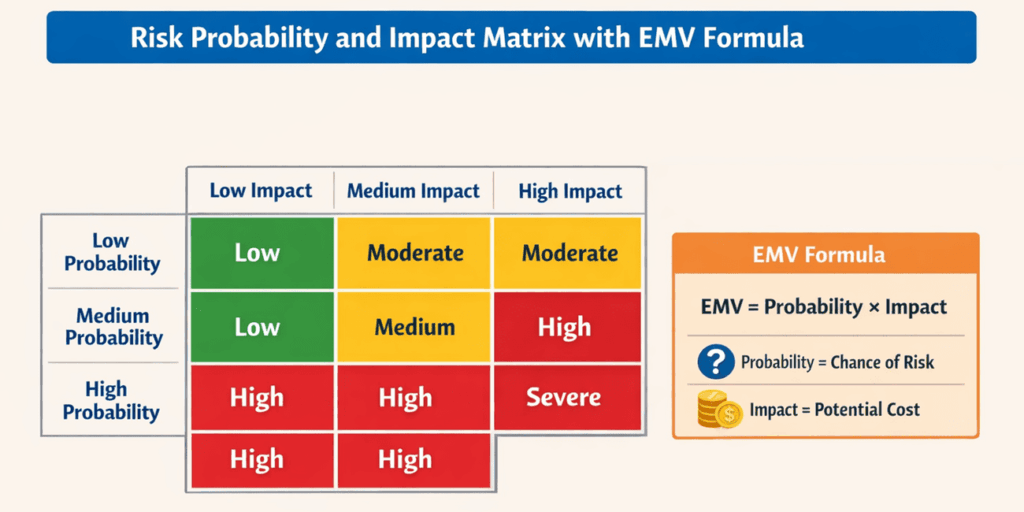
The matrix also serves as the basis for qualitative risk analysis questions on the PMP exam. By plotting and classifying risks, project managers can decide which to address first. Low-probability, low-impact risks may simply be monitored, while high-probability, high-impact risks might require mitigation or acceptance strategies.
Estimating Monetary Impact: Expected Monetary Value (EMV)
Once risks are identified and prioritized, project managers often quantify their financial impact using Expected Monetary Value (EMV). EMV is a statistical tool that combines probability with cost to estimate how much a risk might affect the budget. The basic formula is:
EMV = Probability X Impact.
Here, probability represents the likelihood that a risk will occur, expressed as a number between 0 and 1. Impact represents the monetary cost or gain associated with that risk.
For example, if there is a 40% chance that a design change will cost $100,000, the EMV is 0.4 × $100,000 = $40,000. In practice, project managers calculate EMV for each risk and then sum them to determine the contingency reserve.
To calculate EMV for a list of risks, follow these steps:
- Assign a probability of occurrence to each risk.
- Assign a monetary impact value to each risk.
- Multiply probability by impact for each risk to obtain the individual EMV.
- Add all EMV values to determine the total contingency budget.
Challenges in Risk Assessment
Calculating probabilities is straightforward on paper, but real projects present complexities. The PMI paper Describing Probability: The Limitations of Natural Language highlights several challenges:
- Uniqueness: Each project has unique elements, and many risks lack historical data. This makes it difficult to assign accurate probabilities.
- Lack of actuals: Even when similar risks have occurred before, data is often missing because project closure processes do not capture “risk actuals”.
- Unknown risks: Some risks are inherently unknowable because they depend on external factors or pure chance. In such cases, teams rely on expert judgement and qualitative assessments.
These challenges remind us that probability calculations are estimates, not guarantees. Biases can creep into assessments, and assumptions should be documented. As you evaluate risks, consider whether you have enough data, what unique factors are at play, and how external forces might influence outcomes.
Probability and Impact on the PMP Exam
The PMP® exam tests your ability to apply probability, impact, and EMV concepts rather than derive probabilities from scratch. For instance, an exam question might present a list of identified risks with assigned probabilities and impacts. You could be asked to compute the EMV or prioritize the risks using a matrix.
The following is a practice question:
Your team has identified two risks. Risk A has a 40% probability and an impact of $20,000. Risk B has a 20% probability and an impact of $50,000. Which risk should you prioritize based on EMV?
To answer, calculate EMV for each: Risk A EMV = 0.4 × $20,000 = $8,000; Risk B EMV = 0.2 × $50,000 = $10,000. Risk B has a higher EMV and therefore deserves greater attention.
If you’re preparing for the PMP exam, practicing with realistic questions and scenarios is essential.
FAQs
Q1. What does the probability of occurrence mean?
It describes the chance that a specific risk will happen. Project teams calculate probability by dividing the number of favorable outcomes by the total number of possible outcomes.
Q2. Why is probability important in project management?
Knowing the likelihood of risks helps allocate resources wisely. High-probability risks may require contingency plans and budget reserves, while low-probability risks may be monitored.
Q3. How do I create a probability and impact matrix?
List your risks, assign each a probability and an impact rating (low, medium, high), and plot them on a grid. Prioritize risks in the high-probability/high-impact quadrant.
Q4. What is Expected Monetary Value (EMV)?
EMV multiplies a risk’s probability by its financial impact to estimate its average cost. Summing EMV values gives a project’s total contingency reserve.
Q5. How often should risk probabilities be updated?
Review probabilities regularly, especially after major project milestones or when new information becomes available. Risk probabilities can change as the project progresses and as external conditions evolve.
Summary
Understanding the probability of occurrence helps you deal with uncertainty in a clear and structured way. By using the probability-of-occurrence formula, you can measure risk, prioritize issues, and plan effective responses. When combined with tools like the probability and impact matrix and EMV, it supports better decision-making. In today’s fast-changing risk environment, applying the probability of occurrence helps ensure that projects stay on track and outcomes remain predictable and under control.

I am Mohammad Fahad Usmani, B.E. PMP, PMI-RMP. I have been blogging on project management topics since 2011. To date, thousands of professionals have passed the PMP exam using my resources.