Qualitative risk analysis is a key risk management concept that you must understand, especially when preparing for the PMP exam. It helps teams identify and prioritize risks based on their probability and impact.
In project risk management, qualitative risk analysis plays a critical role in guiding better decisions and improving project outcomes. By using tools like the risk probability impact matrix, you can focus on the most important risks first.
This blog post explains qualitative risk analysis in a simple way, helping you apply it effectively in real projects and succeed in the PMP exam with confidence and clarity.
What is Qualitative Risk Analysis?
Qualitative risk analysis is a systematic approach to prioritizing risks based on their likelihood and potential impact. Unlike quantitative methods, which assign numerical values, qualitative analysis uses expert judgement and team discussions to classify risks as high, medium, or low. It helps project teams decide where to focus limited resources. By identifying and ranking threats and opportunities early, managers can plan responses that safeguard project objectives.
Both threats and opportunities count as risks. A threat is a risk that negatively affects your project’s cost, schedule, or scope, while an opportunity is a positive risk that could improve outcomes. Recognizing opportunities encourages proactive thinking about what can go right as well as what might go wrong.
Why Qualitative Risk Analysis Matters
Qualitative risk analysis is essential because it helps you quickly identify and prioritize risks based on their likelihood and impact. By using qualitative risk analysis, you can focus on the most critical threats and opportunities without complex calculations. This approach improves decision-making by directing resources toward high-priority risks that could affect project success.
Qualitative risk analysis also enhances communication among stakeholders by providing a clear and simple view of risks. It supports proactive planning, allowing teams to respond early rather than react late.
For PMP aspirants, understanding qualitative risk analysis is crucial, as it is a core part of project risk management and helps answer scenario-based exam questions effectively.
The Qualitative Risk Analysis Process
The process involves four interconnected steps: identifying risks, evaluating their probability and impact, categorizing and prioritizing them, and documenting and communicating the results.
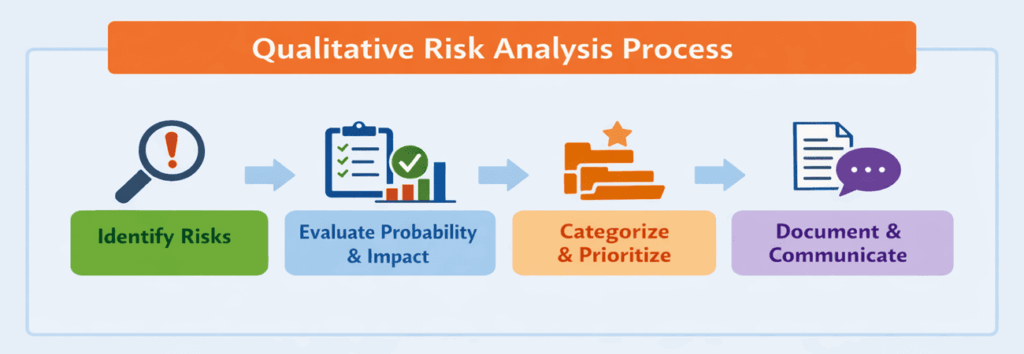
The following infographic summarizes these steps.
1. Identify Risks
Begin by collecting as many risks as possible. Consult your project management plan, project charter, team members, and subject-matter experts. Include both threats (e.g., resource shortages, regulatory changes) and opportunities (e.g., cost savings from new technology). Use brainstorming, interviews, and checklists to ensure broad coverage.
2. Evaluate Probability & Impact
Each risk should be assessed for its likelihood of occurring and the severity of its effect on the project’s objectives. The assessment can be simple (e.g., high, medium, or low) or use scales tailored to your organization. Factors to consider include timing, detectability, and stakeholder tolerance. Encourage experts to justify their ratings with evidence or past experience.
3. Categorize & Prioritize
Group risks into categories, such as technical, schedule, cost, or external, to spot patterns. Then prioritize them based on their combined probability and impact scores. High-priority risks require immediate attention; opportunities with high benefit should also be planned for. Visual tools such as probability-impact matrices help teams quickly identify which risks need action.
4. Document & Communicate
Record findings in the risk register and update related documents, including the assumptions log and risk report. Communicate results to stakeholders and assign owners for monitoring. Regular updates keep the team aligned and ensure new risks are captured over the project’s life cycle.
When and How Often to Perform Qualitative Risk Analysis
Perform the first qualitative risk analysis during project planning. Early analysis helps you build a baseline and plan risk responses while there is still time to adjust the schedule or budget. However, risks evolve: team members leave, new technologies emerge, and market conditions shift.
Revisiting your analysis at regular intervals keeps your risk register relevant. In highly uncertain contexts, such as projects that incorporate generative AI or operate in volatile markets, it is wise to reassess risks at each major milestone.
Inputs for Qualitative Risk Analysis
Qualitative risk analysis relies on various documents and environmental factors:
- Project management plan: especially the risk management plan, cost management plan, schedule management plan, and scope baseline. These provide context and criteria for assessing risks.
- Project documents: risk register (list of identified risks), assumption log (catalogue of assumptions and constraints), and stakeholder register (information about stakeholder roles and risk tolerances).
- Enterprise environmental factors (EEFs): industry studies, market conditions, and regulatory environment. For example, current data privacy laws or geopolitical tensions may introduce new risks.
- Organizational process assets (OPAs): templates, lessons learned, process guidelines, and historical data from past projects. Consulting OPAs helps teams avoid repeating previous mistakes and adapt successful strategies.
Tools and Techniques
Several tools assist with qualitative risk analysis. Each tool serves a specific purpose and is often used in combination:
- Expert judgment: Seek input from experienced individuals within or outside your organization. Experts can provide insights into complex technical or external risks and help interpret subjective assessments.
- Data gathering: Brainstorming, interviews, and meetings encourage diverse viewpoints and surface risks that might otherwise be overlooked.
- Data analysis: Techniques such as risk data quality assessments and risk probability and impact assessments ensure that the information you use is reliable and that ratings are consistent across risks.
- Interpersonal and team skills: Facilitation and conflict management techniques help align stakeholders and reach consensus on risk rankings.
- Risk categorization: Use a risk breakdown structure to group similar risks and identify where most threats originate. Categories may include internal vs. external, human vs. technological, or phase-specific risks.
- Data representation: The probability-impact matrix is a standard tool that plots the likelihood of a risk event against its potential impact. A risk matrix uses two intersecting axes: likelihood and impact, to visualize risks and classify them as high, medium, or low. Color-coded cells help teams quickly see which risks require immediate action.
Probability-Impact Matrix
Use the matrix by plotting each risk’s probability and impact. For example, a risk with a high probability and high impact falls in the red zone, requiring immediate mitigation.

A low-probability, low-impact risk belongs in the green zone; monitor it, but do not allocate many resources. The matrix supports quick decisions and helps justify priorities to stakeholders.
Case Example: Launching a Mobile App
Imagine you are managing the launch of a new mobile app. During risk identification, your team notes the following threats and opportunities:
- Resource constraint: Only one skilled mobile developer is available. If that person leaves unexpectedly, delivery could be delayed.
- User adoption opportunity: Early adopters may share positive reviews on social media, creating viral marketing.
- Data privacy regulation change: New privacy legislation may require additional security features.
During qualitative analysis, the team rates the resource constraint as high probability and high impact because turnover is common, and delays would push the release date. This risk appears in the red zone of the matrix, so you decide to cross-train another developer and create a backup plan.
The user adoption opportunity has a medium probability but high impact; if leveraged properly, the app could gain a loyal user base. You assign a marketing lead to prepare a referral program. The data-privacy regulation change has a low probability but high impact; you monitor regulatory announcements and schedule a monthly review meeting.
This example shows how qualitative risk analysis helps teams decide which risks to act on now, which to exploit, and which to monitor. It also demonstrates that opportunities deserve as much attention as threats.
Qualitative Vs Quantitative Risk Analysis
The PMP exam expects you to know the differences between these two approaches. The table below compares them:
| Parameter | Qualitative Analysis | Quantitative Analysis |
| Objective | Prioritize risks by relative probability and impact | Numerically estimate the effect of risks on project objectives |
| Data | Subjective assessments, expert judgement | Statistical models, numerical data, simulation |
| Use cases | Applies to all projects; quick and cost-effective | Used for large or complex projects with sufficient data |
| Output | Ranked list of risks, categories, and risk urgency | Expected monetary value, contingency reserves, probability of meeting objectives |
| Effort | Low to moderate | Moderate to high |
Qualitative analysis is always performed, while quantitative analysis is optional. For example, building a skyscraper may require quantitative methods, such as Monte Carlo simulation, to calculate schedule buffers. In contrast, smaller projects or early phases rely on qualitative methods to quickly rank risks. Understanding both approaches helps you decide when to apply each during the PMP exam and in real projects.
Tips for PMP Exam Preparation
- Master the inputs and outputs: Know which documents feed into qualitative risk analysis (risk management plan, risk register, assumptions log, stakeholder register) and which documents are updated as outputs.
- Learn tools and techniques: Familiarize yourself with expert judgement, data gathering, data analysis, and risk categorization. Visualize how to use a probability-impact matrix.
- Practice scenario questions: PMP exam questions often describe a project situation and ask you to determine the correct process or next step. Practice with sample questions to strengthen situational judgement.
- Link concepts: Understand where qualitative risk analysis fits in the broader risk management process and how it feeds into quantitative analysis and risk responses.
- Stay updated: Familiarize yourself with emerging trends and risks (e.g., AI, geopolitical tensions, climate risks) to contextualize exam content and apply your knowledge to modern scenarios.
FAQs
Q1. What is qualitative risk analysis?
It is the process of assessing and prioritizing risks based on their likelihood and impact, using expert judgement rather than precise numerical calculations.
Q2. When should you perform qualitative risk analysis?
Perform it during project planning and repeat it regularly, especially after major changes or when new risks arise.
Q3. How does a probability-impact matrix help?
A matrix plots each risk’s likelihood against its impact, using colors to indicate severity. It helps teams quickly see which risks require immediate attention.
Q4. What is the main difference between qualitative and quantitative analysis?
Qualitative analysis ranks risks subjectively; quantitative analysis assigns numerical values and calculates potential outcomes.
Summary
Qualitative risk analysis is a vital skill for every PMP candidate and project manager. By applying qualitative risk analysis, you can identify, assess, and prioritize risks effectively using tools such as the probability-impact matrix. This approach helps you focus on high-priority risks and make better decisions. Mastering qualitative risk analysis not only improves project success but also strengthens your PMP exam performance. Use this risk management process consistently to manage uncertainty and deliver successful project outcomes with confidence.

I am Mohammad Fahad Usmani, B.E. PMP, PMI-RMP. I have been blogging on project management topics since 2011. To date, thousands of professionals have passed the PMP exam using my resources.