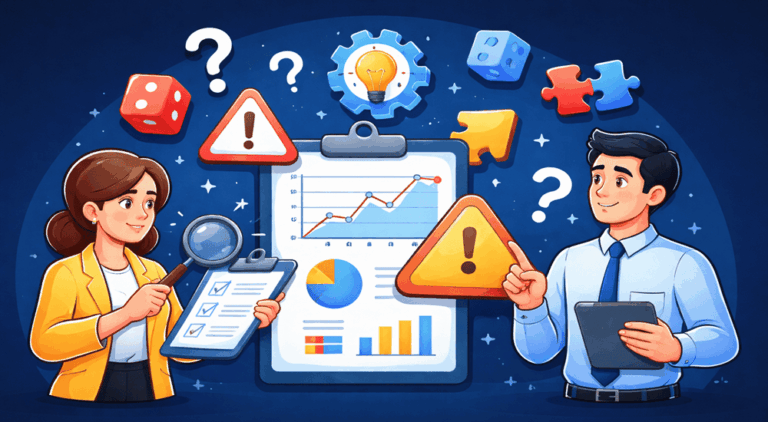
Every project faces uncertainties and risks. A small glitch in a delivery schedule or a security breach can throw off the best plans. That’s why project managers must be proactive. Risk management provides a framework for spotting problems early and keeping your team on track. It asks a simple question: what could go wrong, and what will we do if it does?
This blog post walks you through the risk management process step by step. You’ll learn why it matters more in today’s digital world and how to apply it to projects across industries.
What is Project Risk Management?
Project risk management is the set of activities used to identify, analyze, evaluate, treat, monitor, and communicate risks throughout a project’s life cycle. According to ISO 31000, risk management offers principles and a framework that help organizations anticipate threats and opportunities and allocate resources wisely.
In practice, risk can be negative (an obstacle) or positive (an opportunity). For example, a software team may discover that automation shortens a timeline, while a shipment delay might open a window to improve marketing. If a potential threat becomes reality, it turns into an issue. Your risk management plan should define how to respond to both types of risks before they become issues.
Positive and negative risks need different responses. Negative risks require mitigation: contingency plans, extra budget, or alternative suppliers. Positive risks call for exploitation: leveraging the early finish of a task to take on another project. Effective risk management keeps you agile by recognizing both sides of the equation.
Why Risk Management Matters Today
Risk management isn’t just a procedural exercise; it’s a response to an evolving landscape. Recent research shows the global risk management market was valued at USD 12.6 billion in 2022 and is projected to reach USD 52 billion by 2032, reflecting a compound annual growth rate (CAGR) of 15.4 percent. The growth comes from an explosion of data, rising regulatory pressure, and the surge in cyber threats. Cybercrime alone is expected to cost $13.82 trillion by 2028, up from $9.22 trillion in 2024.
As organizations become more connected, the potential for disruptions multiplies. From ransomware to supply-chain shortages, the stakes are higher than ever.
These figures underline an important shift: risk management isn’t optional. It’s a competitive advantage. With proper planning, you can turn uncertainties into strategic opportunities. You can also build trust with stakeholders by showing that your project team is prepared for unforeseen events.
Risk Management Process
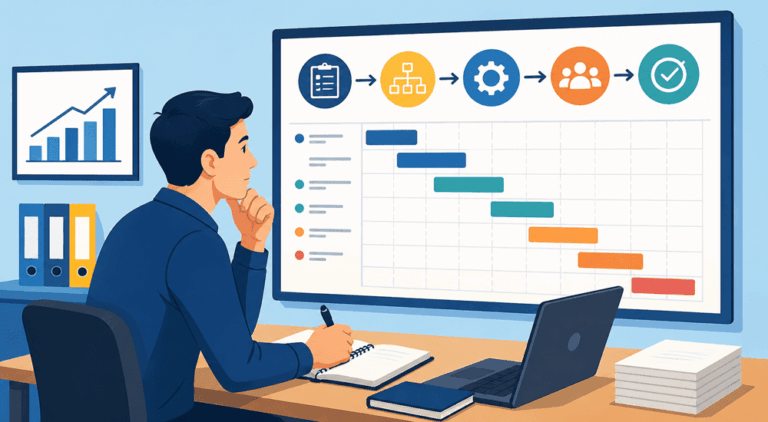
A robust risk management process includes the following six steps:
1. Identify the Risk
Begin by listing all potential risks that might affect your project’s scope, schedule, cost, or quality. Talk to your team, clients, and vendors. Review historical data and previous projects. Use brainstorming sessions and risk breakdown structures to surface less obvious risks. Document each risk in a risk register, a simple table where you capture the risk description, root cause, and potential impact.
2. Analyze the Risk
Not every risk deserves the same level of attention. Analyze the likelihood and impact of each item on your list. Use qualitative techniques such as expert judgment and probability scales to categorize risks as high, medium, or low. Quantitative techniques, such as Monte Carlo simulations or decision tree analysis, help estimate financial impact and schedule changes. If you’re new to these tools, start with a basic qualitative analysis and refine your approach as you gain experience.
3. Prioritize Risks & Issues
Once you’ve analyzed the risks, prioritize them. Focus first on those that could derail your project. Assign ratings or scores based on probability and severity. A risk matrix can help visualize this: place likelihood on one axis and impact on the other. High-probability, high-impact risks belong in the top right corner and should be addressed immediately. Low-probability, low-impact risks can be monitored with less urgency.
4. Assign an Owner
Every significant risk needs a champion. Assign a team member to each risk. Owners are responsible for tracking the risk, triggering contingency plans, and reporting updates to the team. Make sure the owner has the authority to act if the risk materializes. Clear ownership prevents confusion when a quick response is needed.
5. Respond to the Risk
After you prioritize a risk and assign an owner, choose the right response strategy. You might avoid the risk by changing the plan to remove the threat. You can mitigate it by lowering its chance or impact. You may transfer the risk to a third party, such as an insurer. Sometimes, acceptance makes sense when the impact is low and manageable.
You should also define escalation paths. If a risk exceeds the team’s control or tolerance levels, escalate it to senior management or key stakeholders for faster decision-making and support.
For positive risks, take a different approach. You can exploit the opportunity to gain maximum benefit. You may share it with partners to improve success. Enhancement helps increase the likelihood or value of the opportunity.
Always document each response and escalation trigger. Make sure everyone understands their responsibility and knows when to act.
6. Monitor the Risk
Risk management doesn’t end once plans are in place. Continuously monitor your risks throughout the project. Schedule regular risk review meetings to update the risk register, evaluate the effectiveness of your responses, and identify new risks. Use project management tools to set reminders and track progress. Keep communication channels open so that team members can report changes quickly. A transparent process helps everyone feel confident about the project’s direction.
Risk Management Across Industries
Risk management principles apply across industries, but the details vary. Let’s explore how different sectors handle risk.
Construction
Construction projects often face schedule risks due to material delivery delays, design changes, or bad weather. A practical strategy is to build realistic buffer time into the schedule and maintain open communication with suppliers. Contingency plans, such as alternative material sources and critical path analysis, can minimize the impact of delays. Safety risks also play a major role, so regular safety audits and training are essential.
Manufacturing
Manufacturing projects depend on reliable equipment and quality control. Equipment failure or downtime can result in missed deadlines and increased costs. Preventive maintenance programs reduce the chance of unexpected breakdowns. Training employees to spot early warning signs keeps production running smoothly. Quality control checks ensure products meet specifications and reduce the risk of costly recalls.
Information Technology
IT projects evolve rapidly and involve complex technical elements. Integration issues, technology failures, or performance problems can knock a project off course. Mitigation strategies include thorough testing before going live, phased rollouts, and maintaining a separate test environment. Engaging skilled technical resources early can prevent surprises. Contingency plans should address common issues such as server overloads or software conflicts.
Marketing
Marketing projects often hinge on audience perception. Launching a new campaign that misses the mark wastes time and resources. To manage this risk, teams conduct market research and creative testing before launching. Feedback loops during the development phase allow for adjustments based on real customer reactions. By involving stakeholders throughout the process, you can catch misalignments early and refine the strategy.
Tools and Templates for Effective Risk Management
Templates simplify the risk management process and promote consistency. Here are some useful tools to consider:
- Risk Register Template: A risk register captures each risk, its cause, impact, owner, and response plan. You can download a free risk register template here to keep all details in one place.
- Risk Assessment Template: If you need to record more granular information, such as likelihood, risk category, and affected stakeholders, use a risk assessment template. It helps you analyze each risk systematically and prioritize accordingly.
- Risk Matrix Template: A risk matrix organizes risks by likelihood and impact, making it easier to visualize priorities. It’s an excellent tool for team discussions.
FAQs
Q1. What’s the difference between a risk and an issue?
A risk is a potential event that may affect your project, while an issue is a risk that has already occurred and needs immediate attention.
Q2. How often should I update my risk register?
Review and update your risk register regularly, weekly for fast-moving projects or monthly for long projects, to capture new risks and track responses.
Q3. Can a risk be positive?
Yes. Some risks present opportunities, like completing a project early. Positive risks should be managed to maximize their benefit.
Q4. Do I need complex software to manage risks?
Not always. A spreadsheet or template works for small projects. Larger or more complex projects benefit from dedicated risk management tools that integrate with other project data.
Summary
Managing risk is both an art and a science. By identifying, analyzing, prioritizing, and monitoring risks, you can guide your team through uncertainty with confidence. The global surge in risk management and the sharp rise in cybercrime underscore the vital importance of these skills. The risk management process outlined above provides a clear roadmap that works across industries.
Are you ready to transform uncertainty into opportunity? Start by gathering your team and creating a risk register today. The sooner you begin, the more prepared you’ll be when challenges arise.

I am Mohammad Fahad Usmani, B.E. PMP, PMI-RMP. I have been blogging on project management topics since 2011. To date, thousands of professionals have passed the PMP exam using my resources.