The payback period is a simple financial metric that shows how long it takes to recover your initial investment from cash inflows. Businesses use it to compare projects, assess liquidity, and determine how quickly an investment can recoup the money spent. In its simplest form, the payback period is calculated by dividing the initial investment by the annual cash flow when cash inflows are even.
When cash inflows vary, you add the cash flows year by year until the full investment is recovered. A shorter payback period is generally preferred because it reduces risk exposure and accelerates cash recovery. A payback period calculator makes this process fast, easy, and less prone to manual errors.
Payback Period Calculator
Use this payback period calculator to find how long it will take to recover your investment.
Payback Period Calculator
How to Calculate Payback Period
You can follow these steps to calculate the payback period:
Step 1: Find the Initial Investment
This is the total amount you spend at the beginning of the project. It may include equipment cost, setup cost, installation, training, and other upfront expenses.
Step 2: Find the Annual Cash Inflow
This is the amount of money the project generates each year. Use net cash inflow, not just revenue.
Step 3: Apply the Payback Period Formula
Use this formula when annual cash inflows are equal:
Payback Period = Initial Investment ÷ Annual Cash Inflow
Step 4: Calculate the Result
Divide the initial investment by the annual cash inflow.
Example:
Initial Investment = 50,000
Annual Cash Inflow = 10,000
Payback Period = 50,000 ÷ 10,000 = 5 years
Step 5: Interpret the Result
A payback period of 5 years means you will recover your investment in 5 years.
Step 6: Compare Investment Options
If you have more than one project, compare their payback periods. In many cases, the project with the shorter payback period is more attractive because it recovers cash faster.
Payback Period Formula
The payback period formula is as follows:
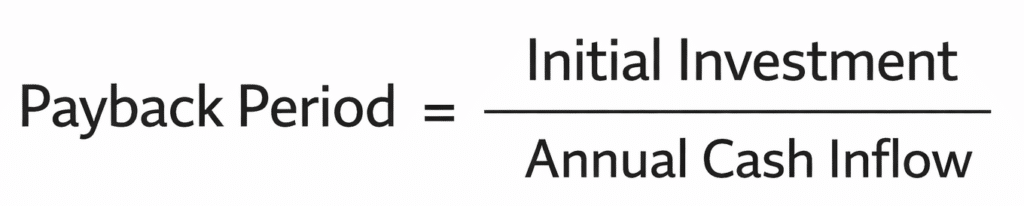
Where:
- Initial Investment = Total upfront cost of the project
- Annual Cash Inflow = Net cash generated each year
This simple formula works best when yearly cash inflows remain constant. If cash inflows vary from year to year, you must add them cumulatively until the total equals the original investment.
Payback Period Example
Imagine a company buys a machine for 80,000.
The machine generates a net cash inflow of 20,000 every year.
Now calculate the payback period:
Payback Period = 80,000 ÷ 20,000
Payback Period = 4 years
What does this mean?
It means the company will recover the full cost of the machine in 4 years. After that point, the cash inflows become a net gain, assuming the estimates stay accurate.
Importance of Payback Period
The payback period helps businesses understand how quickly they can recover invested money. It is easy to use, simple to explain, and useful for quick screening. Project managers, business owners, and investors often use it when liquidity matters, and risk must stay low. A short payback period can be attractive because it reduces the time your capital stays exposed.
Still, this metric has limits. It does not measure total profitability, and the basic method does not account for the time value of money. That is why many professionals use it alongside other tools, such as NPV, IRR, or the discounted payback period. Think of it as a quick first filter, not the full story.
FAQ
Q1. What is the payback period?
The payback period is the time needed for an investment to recover its initial cost from cash inflows.
Q2. How do you calculate the payback period?
For equal annual cash inflows, divide the initial investment by the annual cash inflow. For uneven cash inflows, add them year by year until the investment is recovered.
Q3. Why is the payback period important?
It helps you assess how quickly a project recoups cash. This makes it useful for quick investment screening and risk review.
Q4. What are the limitations of the payback period?
It ignores total profitability, and the basic method does not consider the time value of money.
Q5. What is a payback period calculator?
A payback period calculator is a tool that quickly estimates how long it will take to recover an investment based on your costs and cash inflows.
Summary
The payback period is one of the easiest ways to evaluate an investment. It shows how long it will take to recoup the original cost and helps you quickly compare options. A payback period calculator saves time, reduces errors, and gives instant results. Though it has limitations, it remains a useful starting point for investment decisions. Use it with other financial metrics when you need a deeper analysis.

I am Mohammad Fahad Usmani, B.E. PMP, PMI-RMP. I have been blogging on project management topics since 2011. To date, thousands of professionals have passed the PMP exam using my resources.