The Program Evaluation and Review Technique, or PERT, helps you estimate activity duration when there is uncertainty. Instead of using a single fixed number, PERT uses three estimates: optimistic, most likely, and pessimistic times. Then it applies a weighted average to find the expected duration. The standard PERT expected time formula is (O + 4M + P) / 6. This gives greater weight to the most likely estimate, making the result more realistic than a simple average.
The PERT Calculator is widely used in project management to quickly estimate task durations. It helps project managers plan schedules, reduce guesswork, and make better decisions in the presence of risk and uncertainty.
PERT Calculator
Use the calculator below to find the expected time for an activity using the PERT formula.
PERT Calculator
Formula: (O + 4M + P) / 6
How to Use the PERT Calculator
Step 1: Enter the Optimistic Time
Optimistic time is the shortest time needed to complete the activity if everything goes well. It reflects the best-case scenario.
Step 2: Enter the Most Likely Time
“Most likely” time is the duration you expect under normal conditions. PERT gives this value the highest weight in the formula.
Step 3: Enter the Pessimistic Time
Pessimistic time is the longest time the activity may take if problems or delays happen. It reflects the worst-case scenario.
Step 4: Apply the PERT Formula
The expected time is calculated with this formula:
PERT Expected Time = (O + 4M + P) / 6
Step 5: Review the Result
The result shows the expected activity duration based on all three estimates. This value provides a more balanced estimate than choosing a single number.
PERT Formula
The PERT formula is as follows:
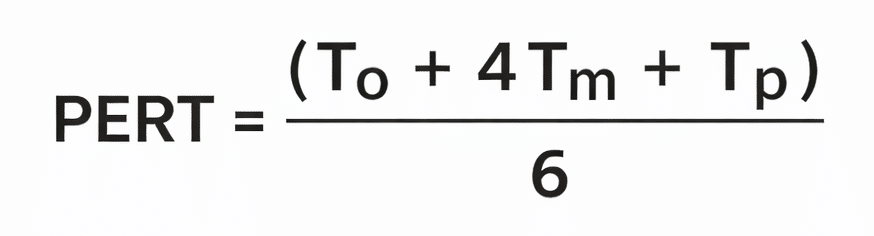
Here:
- TO = Optimistic Time
- TM = Most Likely Time
- TP = Pessimistic Time
Expected Time = Estimated duration for the activity
PERT Example
Let’s say you are estimating how long it will take to complete a project activity.
Optimistic Time = 4 days
Most Likely Time = 7 days
Pessimistic Time = 10 days
Now apply the formula:
Expected Time = (4 + 4 × 7 + 10) / 6
Expected Time = (4 + 28 + 10) / 6
Expected Time = 42 / 6
Expected Time = 7 days
So, the expected activity duration is 7 days.
Why Is PERT Useful?
PERT helps when you cannot confidently predict task duration. A single estimate can be too risky. PERT gives you a more balanced view because it includes the best case, the most likely case, and the worst case. That makes planning more realistic. It also helps teams discuss uncertainty early, which is always better than dealing with surprises later. Who likes schedule shocks?
PERT can also support better schedule analysis. In classic PERT, activities use three estimates, then planners can identify the critical path by summing expected times across project paths.
Standard Deviation in PERT
Some project managers also use PERT to measure uncertainty. A common formula for standard deviation is:
Standard Deviation = (P – O) / 6
This is optional for a basic PERT calculator, but it is useful if you want deeper schedule risk analysis.
FAQ
Q1. What is a PERT calculator?
A PERT calculator is a tool that estimates activity duration using optimistic, most likely, and pessimistic time values. It gives a weighted average result.
Q2. What does PERT stand for?
PERT stands for Program Evaluation and Review Technique. It is a project scheduling and estimating method used when activity durations are uncertain.
Q3. What is the formula for PERT?
The PERT expected time formula is:
Expected Time = (O + 4M + P) / 6
Q4. Why does the formula multiply the most likely estimate by 4?
The formula places greater weight on the most likely value because it is the most realistic estimate under normal working conditions.
Q5. Can I use PERT for cost estimates, too?
Yes. Three-point estimating can be used for both time and cost estimation. PERT is most often discussed in the context of schedule estimates, but the same idea can also support cost forecasting.
Summary
A PERT calculator is a simple but powerful project management tool. It helps you estimate activity duration when there is uncertainty. Using optimistic, most likely, and pessimistic values yields a more realistic result than a single-point estimate. This helps you plan better, manage risk, and improve schedule accuracy. If your project has uncertain activity durations, a PERT calculator can save time and support smarter decisions.

I am Mohammad Fahad Usmani, B.E. PMP, PMI-RMP. I have been blogging on project management topics since 2011. To date, thousands of professionals have passed the PMP exam using my resources.