
Scrum best practices help you deliver value faster, improve collaboration, and adapt to change with confidence. While the Scrum framework is simple, achieving consistent success requires more than following Scrum events and roles. You must adopt proven Scrum best practices that strengthen communication, increase transparency, and support continuous improvement.
Whether you are new to Scrum or looking to improve an existing Agile process, the right approach can help your team work more effectively and produce better results.
In this blog post, you will learn the most important Scrum best practices, how they improve team performance, and practical ways to apply them. By following these Scrum best practices, your team can stay aligned, reduce waste, and deliver high-quality products in every Sprint.
Key Takeaways
- Scrum is a simple framework. It defines a small team of a Product Owner, Developers, and a Scrum Master working toward a Product Goal. The framework encourages transparency, inspection, and adaptation.
- Adoption is widespread. About 63% of agile practitioners use Scrum as their team-level methodology, and 71% use agile practices in their software development lifecycle.
- Events and artifacts matter. Sprint Planning, Sprints, Daily Scrums, Sprint Reviews, and Retrospectives offer regular opportunities to inspect and adapt. Artifacts like the Product Backlog, Sprint Backlog, Increment, and Definition of Done create transparency.
- Collaboration drives success. Peer-to-peer communication, feedback loops, and a clear Product Backlog keep everyone aligned. Best practices focus on respect, openness, and courage.
- Tools help scale. Automation, digital boards, and road-mapping tools support large teams and hybrid work. They make it easier to share artifacts and visualize progress.
Understanding Scrum: Framework and Values
Scrum was created in the early 1990s by Ken Schwaber and Jeff Sutherland. It is a lightweight framework for developing and sustaining complex products. The official Scrum Guide says Scrum is a way to generate value through adaptive solutions. The guide defines three pillars: transparency, inspection, and adaptation, and five core values: Commitment, Focus, Openness, Respect, and Courage.
A Scrum Team is small and cross-functional. It consists of one Product Owner, one Scrum Master, and Developers. Team members decide who does what, when, and how. The team works toward a Product Goal and creates increments of value in short iterations.
Roles at a Glance
- Product Owner: Maximizes product value, orders the Product Backlog, and communicates goals and priorities.
- Developers: Turn backlog items into a usable increment each Sprint. They plan the Sprint, instill quality through a Definition of Done, and adapt the plan each day.
- Scrum Master: Serves the team by coaching them in Scrum, removing impediments, and ensuring that events are productive.
These roles work together as equals. There are no sub-teams or hierarchies. The Product Owner defines what matters, the Developers decide how, and the Scrum Master helps the team stay true to the framework.
Scrum Best Practices
Following the Scrum framework is necessary but not sufficient. Teams that excel go beyond the basics. They cultivate collaboration, make the most of events, create clear artifacts, and use tools to scale. The following are some best practices you can adopt today.
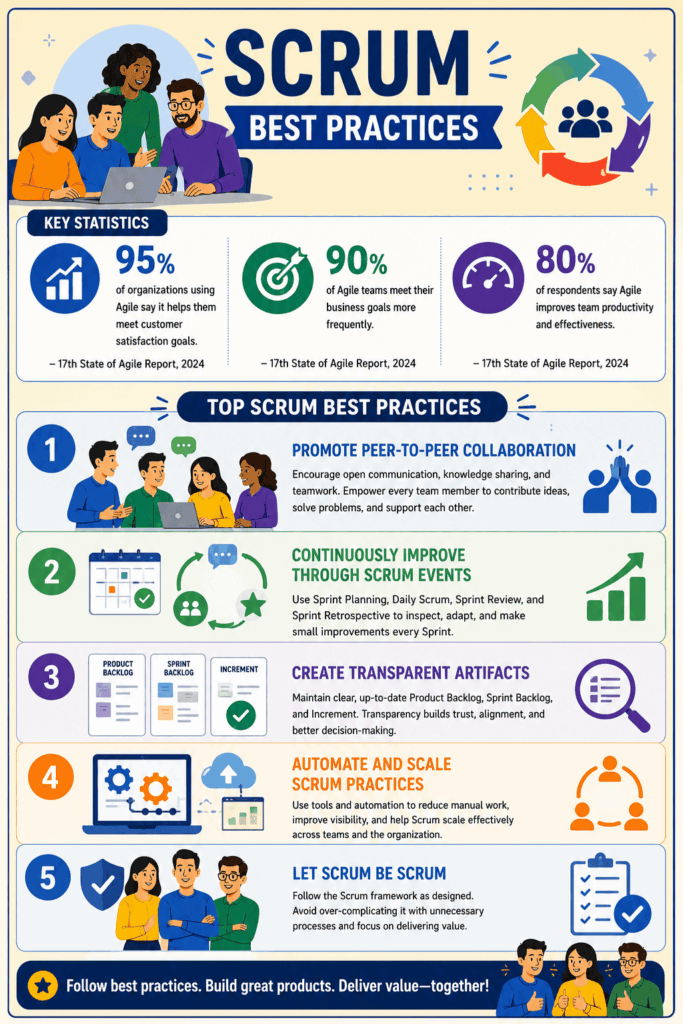
Promote Peer-to-Peer Collaboration
Respect among peers and transparency are pillars of Scrum. Encourage open communication and feedback loops so everyone understands customer needs and technical constraints. A collaboration platform or online whiteboard can serve as a central hub for User Stories, tasks, burndown charts, and comments. When everyone sees the same information, there are fewer bottlenecks.
The Product Owner serves as the voice of the customer and orders the Product Backlog by value. Developers bring the skills needed to turn backlog items into working software. The Scrum Master coaches the team and shields them from distractions. Remember that these accountabilities overlap. A strong team listens to each role and shares responsibility for delivering value.
Continuously Improve Through Scrum Events
Time-boxed events keep Scrum teams on track. To get the most out of them:
- Sprint Planning: Come prepared. Estimate effort realistically and agree on a Sprint Goal you can achieve. Encourage everyone to speak up if the scope seems unrealistic. Use Story Points as a relative measure of effort.
- Sprint Execution: Maintain focus. Do not extend the Sprint or change the goal. If new work emerges, negotiate with the Product Owner and adjust the backlog instead of derailing the Sprint.
- Daily Scrum: Hold it at the same time and place. Encourage brevity. Standing up helps keep the meeting short. Visual tools like a Kanban board help track progress and surface blockers.
- Sprint Review: Demonstrate working software, not slide decks. Read User Stories aloud and show how the increment meets the acceptance criteria. Invite stakeholders to ask questions and suggest changes.
- Sprint Retrospective: Ask tough questions. What slowed us down? How could we improve communication? Identify one or two actions to try in the next Sprint. Small improvements add up over time.
Create Transparent Artifacts
Scrum relies on artifacts to provide visibility. Build them together and keep them up to date:
- Product Backlog: The single source of truth for future work. Estimate effort, assign business value, and reorder items as priorities change. Collaboration when creating the backlog surfaces dependencies and builds trust.
- Sprint Backlog: A subset of backlog items the team commits to finish in one Sprint. Break each User Story into tasks. Once the Sprint starts, avoid adding or removing items unless the team agrees.
- User Stories: Simple, concise descriptions of features from the user’s perspective. A good User Story explains what the feature does, how it works, and why the user cares. Encourage everyone, not just the Product Owner, to write User Stories.
- Increment: The sum of all completed backlog items and the value delivered to date. Release it only when it meets the Definition of Done.
- Definition of Done: A shared agreement about what constitutes completion. Include quality criteria such as passing tests and meeting coding standards. By agreeing on the Definition of Done during Sprint Planning, you prevent rework later.
Automate and Scale Scrum Practices
Scrum can scale from one team to many. When multiple Scrum Teams work on the same product, frameworks like Large-Scale Scrum (LeSS), Scrum @ Scale, or the Scaled Agile Framework (SAFe) help coordinate efforts. The 17th State of Agile Report found that almost one quarter of organizations use SAFe, while more than one-fifth follow no mandated enterprise framework.
Automation and modern tools make scaling easier. Digital Scrum boards enable distributed teams to visualize work, track progress, and see priorities in real time. Road-mapping tools help plan incremental delivery and align Sprints with business goals. Metrics dashboards provide insights into velocity, cycle time, and value delivered. In our team, switching from a physical board to an online tool cut the time spent on status updates by half. We could see blockers instantly and resolve them faster.
Let Scrum Be Scrum
Scrum’s roles, events, artifacts, and rules are immutable. The co-creators caution that implementing only parts of Scrum is not Scrum. When you remove elements or alter them, you lose the transparency and feedback loops that make the framework effective. Resist the temptation to skip retrospectives, extend Sprints, or neglect the Definition of Done. Instead, be curious. Ask why a practice feels awkward, and experiment within the framework. Scrum is simple by design. Try it as written, see what works, and adapt thoughtfully.
Latest Trends and Data in Scrum Adoption
Keeping your practices current means understanding how teams use Scrum today. The 17th State of Agile Report surveyed 788 respondents in 2023 and shared several insights:
- Scrum remains dominant: 63% of agile users practice team-level Scrum. Engineering and R&D teams are the fastest-growing adopters, up 16% over the previous year.
- Agile permeates development: 71% of survey takers use agile practices in their software development life cycle.
- How success is measured is changing: 36% of teams are judged by velocity, 29% by value delivered, and 25% by Sprint burndown reports. This shift shows a growing emphasis on outcomes over pure output.
- Customer satisfaction is the top priority: In 2023, 43% of respondents ranked end-customer satisfaction as their primary goal, while 39% cited time to delivery.
These numbers suggest that Scrum is maturing. Teams are measuring success by the value they deliver and their customers’ satisfaction, not just by how much work they complete.
FAQs
Q1. What size should a Scrum Team be?
The Scrum Guide recommends small, cross-functional teams of 10 or fewer. Smaller teams communicate more effectively and adapt faster.
Q2. How long is a Sprint?
A Sprint lasts one month or less. Two-week Sprints are common because they balance feedback with enough time to deliver meaningful work.
Q3. Is Scrum the same as Agile?
Scrum is an agile framework. Agile is a broader philosophy of iterative, customer-focused delivery. Scrum implements agile values through defined roles, events, and artifacts.
Q4. What happens in a Daily Scrum?
Team members share what they did yesterday, what they will do today, and what is blocking them. This 15-minute meeting keeps everyone in sync and allows quick adjustments.
Q5. Can Scrum be used outside of software?
Yes. Teams in marketing, finance, and operations have adopted Scrum to manage complex work. The principles of transparency, inspection, and adaptation apply in many contexts.
Summary
Scrum is most effective when team members focus on collaboration, transparency, and continuous improvement. By promoting peer-to-peer communication, improving through Scrum events, maintaining transparent artifacts, leveraging automation, and following the framework as intended, project teams can deliver greater value with less waste. These Scrum best practices help build trust, improve alignment, and increase adaptability in a fast-changing environment. Start with small improvements, stay focused on customer value, and continuously inspect and adapt to achieve long-term success.

I am Mohammad Fahad Usmani, B.E. PMP, PMI-RMP. I have been blogging on project management topics since 2011. To date, thousands of professionals have passed the PMP exam using my resources.