Agile project management statistics show how rapidly modern organizations are adopting flexible and collaborative ways of working. The latest agile adoption trend highlights strong growth across software, healthcare, finance, and manufacturing industries.
Businesses now use Agile methods to improve delivery speed, customer satisfaction, team productivity, and adaptability to changing priorities. Hybrid Agile models and AI-supported workflows are also becoming more common in 2025 and 2026. As companies continue investing in digital transformation, Agile helps teams respond faster to market demands and manage projects more efficiently.
These trends show that Agile is no longer limited to IT teams and has become a key business strategy worldwide.
Key Takeaway
- Hybrid approaches dominate: A recent survey found that three-quarters of organizations mix Agile with traditional methods, while only a small share embeds Agile deeply across the business.
- Hybrid adoption keeps rising: PMI’s Pulse of the Profession report notes a 57% jump in the use of hybrid project approaches, with an average project performance rate of 73.8%.
- Positive experiences are widespread: Ninety-five percent of marketers in the latest State of Agile Marketing report say Agile has improved their work, reflecting broad satisfaction with iterative practices.
Understanding Agile Adoption
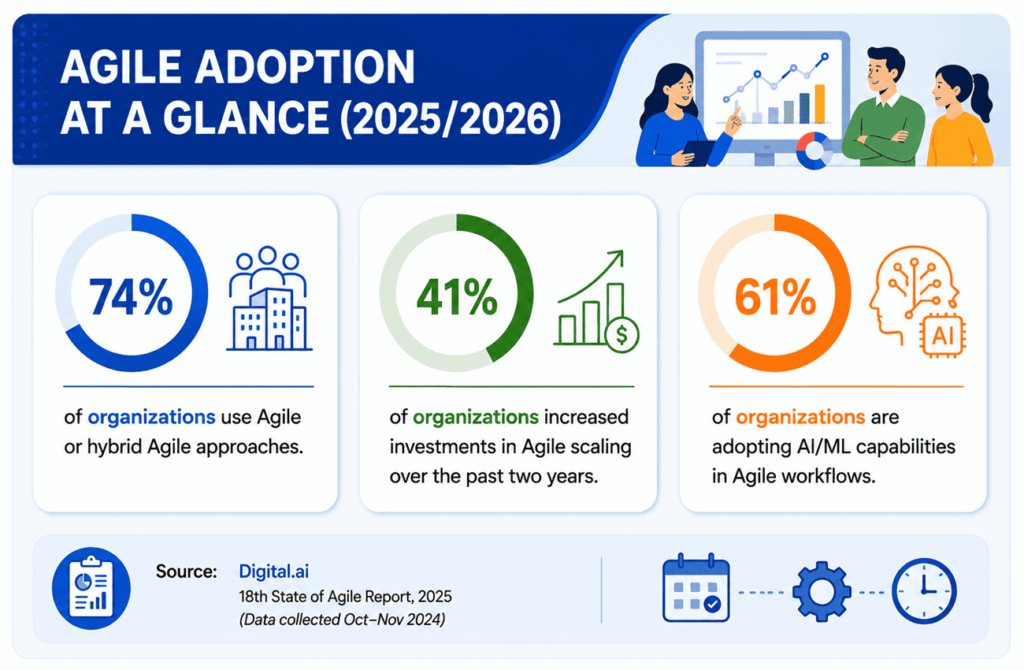
Agile adoption continues to grow across industries as organizations seek faster delivery, stronger collaboration, and greater flexibility. According to the Digital.ai 18th State of Agile Report 2025, 74% of organizations now use Agile or hybrid Agile approaches in their operations. This shows that Agile has become a mainstream business practice rather than a software-only method.
The report also reveals that 41% of organizations increased their investments in Agile scaling during the past two years. Companies are expanding Agile beyond single teams and applying it across departments to improve coordination and business performance. Another major trend is the rise of artificial intelligence within Agile environments. Around 61% of organizations are now adopting AI and machine learning capabilities in Agile workflows to support automation, planning, forecasting, and faster decision-making.
These findings highlight how Agile continues evolving to support modern digital transformation, innovation, and hybrid project delivery models in 2025 and 2026.
Primary source:
Industry-Wise Agile Adoption Trends
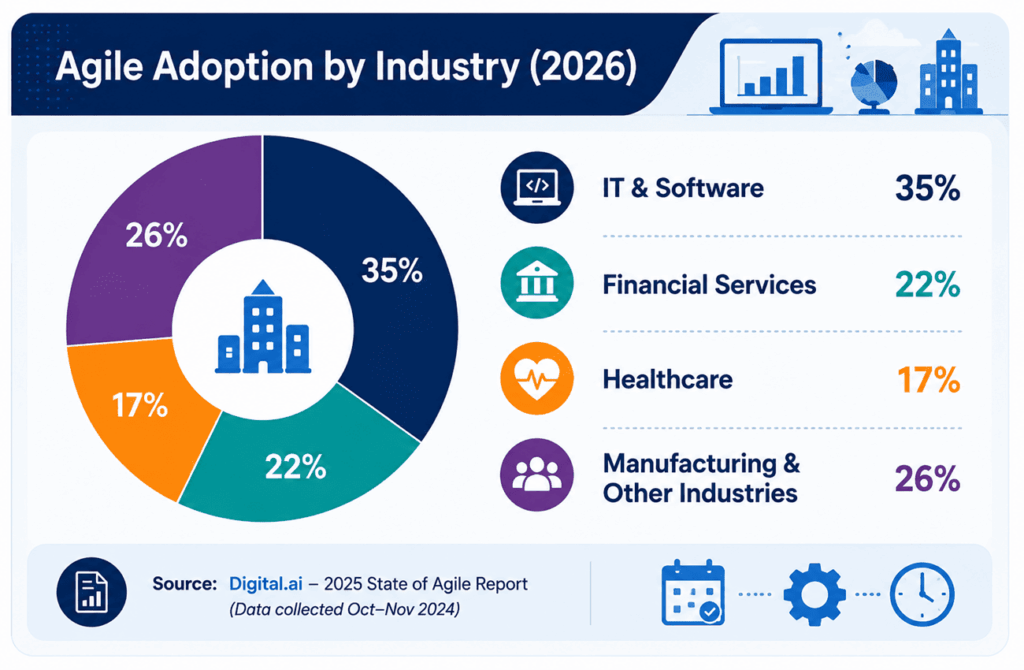
Agile adoption continues to expand across industries in 2026, with technology companies remaining the strongest users of Agile practices. According to the Digital.ai 2025 State of Agile Report, IT and software organizations account for 35% of Agile adoption. These companies rely on Agile to speed up software delivery, improve collaboration, and respond quickly to changing customer needs.
Financial services represent 22% of Agile adoption. Banks and financial institutions increasingly use Agile and hybrid delivery models to support digital transformation, improve customer experiences, and manage regulatory changes more effectively.
Healthcare organizations account for 17% of Agile adoption. Hospitals, healthcare providers, and health technology companies use Agile methods to improve operational efficiency, manage technology projects, and support innovation in patient care systems.
Manufacturing and other industries contribute 26% of Agile adoption. These sectors use Agile to improve product development, supply chain coordination, and business adaptability. The data shows Agile is now widely used far beyond traditional software environments.
Primary sources:
Top Reasons for Adopting Agile
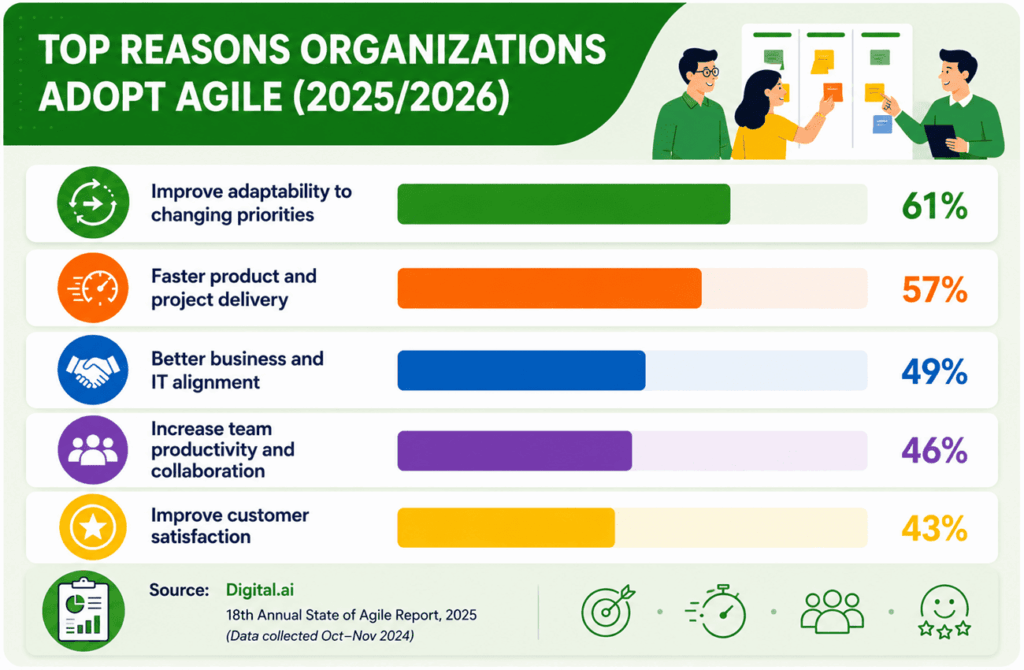
Organizations continue to adopt Agile in 2025 and 2026 because it helps them respond more quickly to changing business demands and improve overall performance. According to the Digital.ai 18th Annual State of Agile Report 2025, the leading reason for Agile adoption is improving adaptability to changing priorities, cited by 61% of organizations. Businesses need flexible teams that can quickly adjust to market shifts, customer feedback, and technology changes.
Faster product and project delivery is the second biggest driver, with 57% of organizations using Agile to accelerate development cycles and release value more quickly. Another 49% report that Agile improves business and IT alignment by helping departments collaborate more effectively and stay focused on shared goals.
Organizations also adopt Agile to increase team productivity and collaboration, identified by 46% of respondents. In addition, 43% say Agile improves customer satisfaction by enabling continuous feedback, better communication, and faster delivery of customer-focused solutions across projects and services.
Primary sources:
Data-Driven Decision Making
Agile thrives on transparency. Today’s teams use dashboards, analytics tools and automation to gather data on progress and risks. Predictive analytics can forecast delays and suggest resource adjustments before issues arise. AI-driven tools are increasingly helping teams prioritize backlog items based on value and effort. While technology supports decision-making, human judgment remains essential. Teams should interpret data within the context of business goals and user needs.
Challenges and Strategies for Successful Adoption
Implementing Agile can be transformative, but common hurdles include:
- Cultural resistance: Employees accustomed to traditional hierarchies may resist self-organizing teams. Leadership support and open communication help ease the transition.
- Lack of training: Many organizations adopt Agile without providing coaching or education. Investing in training equips teams with the skills to collaborate effectively.
- Governance and compliance: Regulated industries must reconcile Agile’s iterative nature with strict documentation requirements. Hybrid frameworks and stage-gate reviews can bridge this gap.
- Scaling issues: Coordinating multiple Agile teams requires careful planning. Frameworks such as Scrum@Scale or Disciplined Agile can help align large programs.
Real change starts with leadership commitment. When executives empower teams, allocate time for experimentation and celebrate small wins, Agile culture takes root.
The Future of Agile Project Management
Agile’s evolution continues. Digital.ai’s latest report suggests that hybrid and homegrown frameworks will remain the norm. Meanwhile, PMI’s data shows that hybrid approaches are expanding quickly. Teams are adopting AI tools to automate routine tasks and improve estimates, freeing people to focus on creative problem-solving.
As remote and hybrid work arrangements persist, Agile practices will support distributed collaboration. Digital workspaces, asynchronous stand-ups and virtual whiteboards make it easier to stay aligned despite time zones. Organizations are also investing in continuous learning to keep pace with evolving tools and frameworks. Expect to see more cross-functional roles and increased emphasis on outcome-driven planning.
FAQs
Q1. How widely is Agile used today?
Survey data shows that most organizations use some form of Agile, but only a small percentage fully embed it across their business. Hybrid frameworks are the most common approach.
Q2. Does Agile improve project performance?
PMI’s Pulse of the Profession report notes an average project performance rate of 73.8% and a 57% increase in hybrid adoption. These figures suggest that blending Agile and predictive methods can enhance outcomes.
Q3. How do marketers feel about Agile?
The ninth annual State of Agile Marketing report finds that 95% of marketers have a positive experience with Agile and cite higher productivity and lower stress.
Summary
Agile project management continues to shape how modern organizations deliver projects, manage teams, and respond to change. The latest Agile adoption trends show that businesses value flexibility, faster delivery, stronger collaboration, and improved customer satisfaction. Hybrid Agile models and AI-supported workflows are also becoming more common across industries. As organizations continue investing in Agile practices, teams that embrace continuous improvement and adaptability will remain better prepared for future challenges, innovation demands, and changing customer expectations in an increasingly competitive digital business environment.

I am Mohammad Fahad Usmani, B.E. PMP, PMI-RMP. I have been blogging on project management topics since 2011. To date, thousands of professionals have passed the PMP exam using my resources.