The Tuckman Ladder Model is a popular theory that explains the stages of group development, team dynamics, and performance. Developed by psychologist Bruce Tuckman in 1965, the model outlines four stages: (1) forming, (2) storming, (3) norming, and (4) performing. In 1977, he added the fifth stage, “adjourning,” to address what happens after the project ends and the team is disbanded.
Each stage represents a distinct phase of team growth, from initial formation and conflict resolution to peak productivity and disbandment.
Understanding these stages helps leaders and managers manage group challenges, improve collaboration, and enhance efficiency.
In this article, I will explain the Tuckman model, its relevance, and how it can be used in modern group or team development.
Forming, Storming, Norming, Performing, and Adjourning: The Tuckman Ladder Model

Bruce Tuckman identified five stages of team development: (1) forming, (2) storming, (3) norming, (4) performing, and (5) adjourning, collectively known as the “Tuckman stages of team formation.” In each stage, team members show different behaviors, and the manager is responsible for guiding the team through these phases. Managers can develop smoother team progression and better collaboration by using the relevant approach for each stage.
Let’s go through each stage of team formation and the role of the manager in team development.
Forming
In this stage, team members are new and unfamiliar with one another. They do not understand their roles and responsibilities and tend to work independently. To prevent confusion and maintain order, you should adopt an autocratic or directive leadership style, providing clear guidance and structure to help the team organize and establish a sense of direction.
Characteristics
- Team members are newly assembled and often unsure of their roles, responsibilities, or goals.
- Communication is polite but limited, and individuals tend to work independently.
- Team members rely heavily on the project manager for direction.
Challenges
- There is a lack of clarity on goals, roles, and processes.
- There is a risk of confusion or disorganization.
- There is uncertainty about how to collaborate effectively.
Storming
In the second stage, team members start to understand their roles and responsibilities and become more familiar with each other. However, conflicts and disagreements may arise as they assert their ideas, and alignment is still challenging. During this stage, you should shift from an autocratic approach to a coaching leadership style and guide while encouraging collaboration and addressing conflicts constructively to keep the team on track.
Characteristics
- Team members start to assert their ideas and opinions, thus leading to conflict and disagreements.
- Power struggles and competition for roles or influence may emerge.
- Frustrations arise as the team works to resolve issues and find alignment.
Challenges
- There are conflicts and tension between team members.
- There is difficulty in decision-making and establishing processes.
- There is resistance to collaboration or authority, thus slowing progress.
Norming
At this stage, team members have a solid understanding of their roles and responsibilities and begin collaborating effectively. They adjust their behaviors and work more cohesively, building stronger relationships. You can now adopt a more hands-off approach, stepping back from direct control. Instead, you should take on a facilitating leadership style, providing support when needed while allowing the team to self-manage and make decisions as they refine their working dynamics.
Characteristics
- Team members begin to understand and respect each other’s roles, strengths, and working styles.
- Relationships improve, and the team develops a sense of unity and trust.
- Roles, processes, and goals become clearer, thus leading to smoother collaboration.
Challenges
- The team may become complacent and avoid new challenges to preserve harmony.
- Overreliance on the project manager or more dominant team members may still persist.
- Some underlying issues may remain unresolved, which can potentially resurface.
Performing
At this stage, the team operates as a highly interdependent and well-adjusted unit. Members are aligned, collaborative, and capable of delivering high performance with minimal supervision. You can adopt a laissez-faire or delegating leadership style, stepping back and trusting the team to work independently. In this approach, you provide support when needed but generally allow the team the freedom to manage their tasks.
This leadership style is effective when team members are skilled, experienced, and capable of making decisions without constant oversight. “Laissez-faire” is a French term meaning “let go” or “don’t interfere.”
Characteristics
- The team is a cohesive, high-performing unit with clear roles and established processes.
- Team members are self-motivated and collaborative, and they work effectively with minimal supervision.
- The focus is on delivering high-quality results and meeting project objectives.
Challenges
- There is difficulty maintaining motivation and focus over time.
- There is potential burnout from sustained high performance.
- New challenges or changes may disrupt the established dynamic.
Adjourning
In this final stage, the project is completed, and the team disbands or transitions to new projects. You can continue with a laissez-faire approach, as the team members require minimal guidance during this phase. This phase often involves wrapping up final tasks, project documentation, and celebrating successes. It is an essential step for closure and acknowledging the team’s efforts.
Characteristics
- The project is completed, and the team disbands or transitions to new projects.
- Team members reflect on their achievements and contributions, often feeling a mix of pride and loss.
- Final tasks, documentation, and knowledge transfers take place.
Challenges
- There are emotional challenges as team members part ways.
- There is difficulty ensuring a smooth transition without losing momentum on closing tasks.
- There is a sense of uncertainty as team members move on to new roles or projects.
Leadership Style Changes Throughout the Group Development Stages
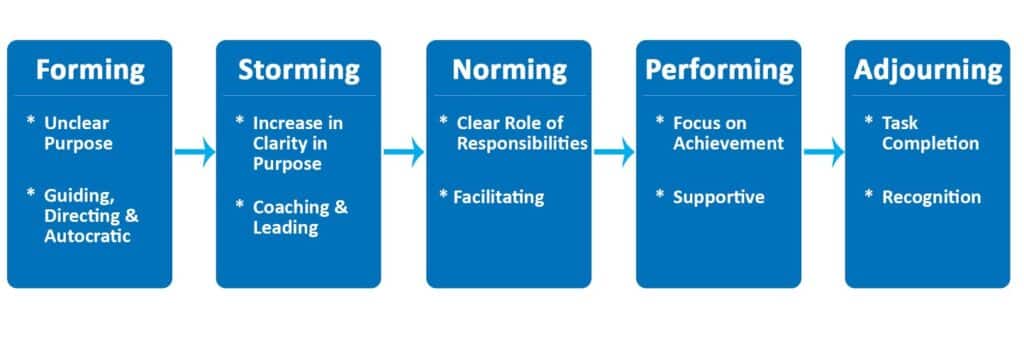
1. Forming
Leadership Style: Autocratic/Directive
During this stage, team members are new and unsure of their roles. The project manager should provide clear instructions and guidance to establish structure and set expectations.
2. Storming
Leadership Style: Coaching/Participative
As conflicts arise, the project manager should adopt a coaching style. Encouraging open communication helps team members express concerns and fosters collaboration.
3. Norming
Leadership Style: Facilitative
With improved dynamics, the project manager shifts to a facilitative approach. This style supports team cohesion, allowing members to take initiative while assisting as needed.
4. Performing
Leadership Style: Laissez-Faire/Delegating/Supportive
At this high-performing stage, the project manager adopts a laissez-faire style. Trusting team members to manage their responsibilities allows for innovation and autonomy.
5. Adjourning
Leadership Style: Recognition
As the project concludes, the project manager recognizes their role in achieving the project objectives. This includes recognizing achievements, facilitating reflections, and ensuring a smooth transition for team members.
Summary
A project team doesn’t begin performing at its best from day one. It takes time for members to get to know each other and gradually build up to working at their full potential. The Tuckman model outlines this process, describing how a group evolves from strangers into a cohesive, high-performing team. By understanding the Tuckman model, you can better support their teams through the forming, storming, norming, performing, and adjourning stages, helping them transition smoothly and perform at their best more quickly.
Further Readings:
- What is Leadership Styles?
- What is Management Styles?
- Leadership Vs Management Styles
- What is a Servant Leadership?
- Cynefin Framework: Leaders Framework for Decision-Making
References:
- Tuckman, B.W. (1965). “Developmental Sequence in Small Groups.”
- Stein, J. Using the Stages of Team Development.
This topic is important from a PMP exam point of view.

I am Mohammad Fahad Usmani, B.E. PMP, PMI-RMP. I have been blogging on project management topics since 2011. To date, thousands of professionals have passed the PMP exam using my resources.