Starting a career in business analysis can open many growth opportunities. If you want to stand out, understanding CCBA certification requirements is a smart first step. The CCBA certification proves that you have real experience and the ability to handle complex business problems. Many professionals pursue this certification to enhance their skills and secure better roles.
In this blog post, you will learn everything about CCBA certification requirements, including eligibility, application steps, and exam details. Whether you are new or have some experience, this article will help you plan your next move.
Let’s get started.
Key Takeaway
- CCBA certification proves your real-world business analysis skills and boosts your career credibility.
- You need 3,750 hours of experience and 21 hours of professional training to qualify.
- The exam includes 130 scenario-based questions and tests practical knowledge.
- Strong preparation and a solid understanding of the BABOK are key to passing on the first attempt.
- Certification helps you grow faster, earn more, and stand out in a competitive job market.
Why CCBA Matters
Business analysis has evolved from a supporting role into a strategic driver. Organizations rely on skilled analysts to uncover insights, shape strategy, and guide digital transformations. According to the U.S. Bureau of Labor Statistics, employment of management analysts – the category that includes many business analysts – is projected to grow 9 percent from 2024 to 2034, with roughly 98,100 job openings each year. The median annual wage for these roles was $101,190 in May 2024.
The International Institute of Business Analysis reports that certification can accelerate career growth. In its Global State of Business Analysis report, 95 percent of respondents recommended earning a certification such as CCBA or CBAP, and 81 percent saw benefits such as salary increases and greater confidence within a year. In the same study, 74% of organizations invested in professional development for business analysts. These figures show that employers value both experience and formal credentials.
What is CCBA?
The Certification of Capability in Business Analysis is a professional credential offered by the IIBA. It recognizes analysts with at least two to three years of practice who can apply the Business Analysis Body of Knowledge (BABOK) to real projects. CCBA sits between the entry-level ECBA and the advanced CBAP. Holders demonstrate understanding of core concepts such as elicitation, requirements management, and solution evaluation.
Earning this certification signals to employers that you have practical skills and a commitment to continuous learning.
CCBA Eligibility Requirements
To apply, you must meet several criteria relating to education, work experience, and professional development.
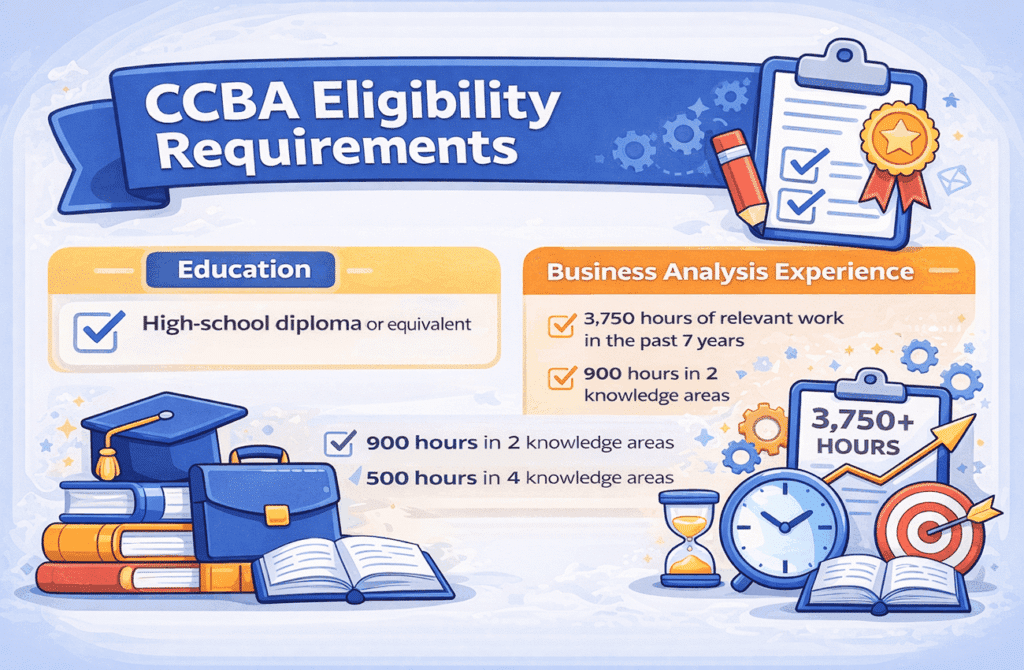
These requirements are outlined in the January 2026 CCBA Handbook.
Education and Work Experience
- Education: IIBA requires at least a high-school diploma or equivalent. A bachelor’s degree is not mandatory, although many candidates hold degrees in business, engineering, or information systems.
- Business analysis experience: You need 3,750 hours of business-analysis work within the last seven years, roughly equivalent to two years of full-time experience. These hours must align with the BABOK knowledge areas. You can meet this requirement by logging 900 hours in at least two knowledge areas or 500 hours in at least four knowledge areas.
Professional Development Hours
You must complete 21 hours of professional development in the four years before your application. Acceptable learning activities include instructor-led classes, workshops, online courses, and webinars that align with the BABOK. Training must feature measurable learning objectives, interaction with the material, and practice exercises. Courses from IIBA-endorsed training partners automatically qualify.
References
Two professional references are required. Your references should know you for at least six months and must be either a CCBA/CBAP holder, your direct manager, or a client. References confirm your work history and professional conduct. When listing them in your application, provide their business email addresses rather than personal accounts.
Agree to the Code of Conduct
All applicants must agree to the IIBA Code of Conduct and terms and conditions. This pledge shows that you will act ethically and uphold professional standards. Violations can result in disciplinary action or revocation of certification.
The CCBA Application Process
The application process involves several steps. While it may seem detailed, breaking it into smaller tasks makes it manageable.
- Create or update your IIBA account. Begin by joining the IIBA (membership is optional but offers discounts and access to resources). The membership fee is $125. You can learn more about membership benefits on the IIBA website.
- Log your work history and training hours. Use the IIBA portal to record your 3,750 hours of experience and 21 hours of training. Ensure each entry aligns with the BABOK knowledge areas and includes dates and descriptions.
- Purchase the application. Pay the application fee (US$145 for members or US$245 for non-members). This fee is non-refundable and grants access to the application form for one year. Complete all sections before your term expires.
- Enter your eligibility details and references. Provide information about your education, work experience, professional development, and references. Review for accuracy before submission.
- Submit your application and await approval. Once submitted, the IIBA will review your details. You may receive an audit notice asking for supporting documents. Upon approval, you will receive instructions for purchasing and scheduling the exam.
- Purchase the exam. The CCBA exam fee is US$305 for members or US$355 for non-members (amounts may vary by region). You have six months from the date of purchase to sit for the exam.
- Schedule your exam. Exams are delivered online via remote proctoring or at PSI test centers. Choose a date within your eligibility window and ensure your computer meets the technical requirements.
- Prepare and sit for the exam. Study the BABOK guide, practice with sample questions, and join a study group. Maintain a quiet testing environment and have acceptable government-issued identification on exam day.
Exam Structure and Content
The CCBA exam is a competency-based, multiple-choice test designed to assess your ability to apply business analysis concepts. The 2026 CCBA Handbook lists these details:
- Number of questions: 130 multiple-choice, scenario-based questions.
- Duration: 180 minutes (three hours).
- Format: Online remote proctoring or at PSI test centers.
- Knowledge areas: Questions are drawn from six BABOK knowledge areas, weighted as follows:
- Business Analysis Planning & Monitoring – 12 %
- Elicitation & Collaboration – 20 %
- Requirements Lifecycle Management – 18 %
- Strategy Analysis – 12 %
- Requirements Analysis & Design Definition – 32 %
- Solution Evaluation – 6 %
For a visual overview of this blueprint, see the infographic in this article. Each knowledge area covers different competencies, so plan your study time accordingly. A passing score is determined by psychometric analysis rather than a fixed percentage.
Preparing for the Exam
Preparation involves more than memorizing definitions. You need to understand how to apply concepts to real situations. Here are tips to help you succeed:
- Read the BABOK Guide thoroughly. Focus on understanding the purpose, inputs, outputs, and techniques for each knowledge area. Use the guide as your primary reference.
- Take a structured training course. Instructor-led courses can provide guidance, practice questions, and peer discussion.
- Join a study group. Collaborating with peers helps reinforce concepts and exposes you to different perspectives. IIBA chapters often host study sessions.
- Practice scenario questions. CCBA questions present realistic situations. Practicing these questions trains you to interpret requirements, identify stakeholders, and evaluate solutions quickly.
- Schedule your exam when ready. Don’t rush. Give yourself enough time to review all knowledge areas and take several practice exams. When you feel confident, choose a testing date that fits your schedule.
Maintaining Your CCBA Certification
Your CCBA credential remains valid for three years. To renew, you must report 60 Continuing Development Units (CDUs) during each cycle. CDUs can be earned through professional experience, continuing education, volunteer service, mentoring, and self-directed learning. Renewal also requires payment of a recertification fee and adherence to the IIBA Code of Conduct. Keeping your certification current shows employers that you stay engaged with evolving best practices.
Benefits of CCBA Certification
Many analysts pursue CCBA to stand out in a competitive job market. Certification demonstrates commitment, enhances credibility, and can lead to higher salaries. Employers value certified analysts because they bring structure and repeatability to business analysis activities. With digital transformation projects accelerating, organizations need professionals who can guide decision-makers through complex change.
The 2025 Global State of Business Analysis report highlighted several benefits: 76 percent of respondents said business analysis drives strategy, and certification remains a trusted tool for career growth. Earning CCBA signals that you can translate strategic goals into actionable requirements. Certified professionals also report improved confidence, stronger professional networks, and access to global communities of practice.
FAQs
Q1. What experience do I need for CCBA?
You must log 3,750 hours of business work within the past seven years. Activities must align with the BABOK knowledge areas.
Q2. How many training hours are required?
You need 21 hours of professional development within four years of application. Qualifying courses must be interactive and measurable.
Q3. Do I have to be an IIBA member?
Membership is optional, but it offers exam fee discounts and access to resources. The application process is the same whether you join or not.
Q4. How is the exam delivered?
You can take the exam online with a remote proctor or at an authorized PSI test center. You have six months after purchasing the exam to sit for it.
Q5. What happens if I fail?
If you don’t pass, you can purchase up to two rewrites within your one-year application term. Each rewrite incurs an additional fee. Prepare thoroughly to avoid retakes.
Q6. How do I maintain my certification?
Earn 60 CDUs every three years through work experience, education, volunteering, mentoring, or self-study. Submit a renewal application and pay the recertification fee.
Summary
Earning the CCBA certification shows that you have both hands-on experience and a solid grasp of industry standards. The process requires careful preparation, but the benefits are substantial. As demand for strategic business analysis grows, a CCBA credential can help you stand out, increase your earning potential, and contribute to successful projects.
References:

I am Mohammad Fahad Usmani, B.E. PMP, PMI-RMP. I have been blogging on project management topics since 2011. To date, thousands of professionals have passed the PMP exam using my resources.