Stepping into the world of professional certification can feel daunting. Are you a business analyst with a few years of experience who wants to stand out and take on larger projects? The Certification of Capability in Business Analysis (CCBA) is designed for professionals who have two to three years of hands-on experience and want recognition for their skills.
This blog post walks through what the CCBA Certification is, why it matters, how to qualify and prepare, and what it takes to keep your certification current.
Let’s get started.
Key Takeaways
- Recognition and career growth: CCBA certification signals that you can collaborate effectively, model business processes, and identify opportunities. IIBA’s 2025 report found that 95 percent of respondents recommend professional certification, and 81 percent saw benefits such as salary increases within a year.
- Competitive salary and return on investment: Salaries for business analysts continue to rise. The same report noted that average salaries climbed by nearly 4% to about USD 88,234. Certification can make you more competitive for higher-paying roles.
- Global recognition and transferable skills: CCBA is recognized worldwide. The knowledge areas it covers, such as planning, elicitation, and requirements management, apply across industries and countries.
- Validated experience and credibility: To earn the credential, you must demonstrate at least 3,750 hours of business analysis work and pass a rigorous exam. That validates your experience to employers.
- Structured learning and BABOK mastery: Studying for CCBA deepens your understanding of the Business Analysis Body of Knowledge (BABOK) and builds a systematic approach to solving business problems.
- Commitment to ongoing development: Certification requires 21 hours of professional development before applying and continuing education afterward. This encourages a learning mindset; 74% of organizations invest in professional development.
- Alignment with emerging trends: The profession is evolving. According to IIBA, 74% of analysts say artificial intelligence is positively impacting their careers. CCBA prepares you to apply core analysis skills even as technology changes.
What is the CCBA Certification?
The Certification of Capability in Business Analysis is an advanced credential offered by the International Institute of Business Analysis (IIBA). It sits between the Entry Certificate in Business Analysis (ECBA) and the Certified Business Analysis Professional (CBAP). While ECBA validates foundational knowledge and CBAP targets seasoned professionals with 5 or more years of experience, CCBA focuses on practitioners with solid real-world experience who may not yet lead large programs.
IIBA created the CCBA to recognize practitioners who can collaborate with stakeholders, model processes, and identify and evaluate opportunities for improvement. The credential demonstrates a working knowledge of the BABOK Guide and an ability to apply its techniques in practical settings. Unlike vendor-specific certifications, CCBA is industry-agnostic, so the skills you learn transfer across healthcare, finance, government, and technology.
Seven Reasons to Pursue CCBA Certification
1. Recognition and Career Growth
Certification offers more than a digital badge; it’s proof that you’ve invested in your profession. Employers use credentials as a signal of commitment and competence, and peers respect the knowledge they convey. The Global State of Business Analysis Report highlights that 95% of respondents recommend professional certification, and 81% see benefits such as salary increases and greater confidence within a year.
2. Competitive Salary and Return on Investment
Business analysts’ salaries are trending upward. The same IIBA report shows that average salaries rose by nearly 4% to about USD 88,234. That number may vary by region, but it illustrates steady demand for skilled analysts. Certification can amplify these gains by demonstrating advanced capability.
While the CCBA isn’t free, the potential for salary growth and faster career progression often offsets the costs within a year or two. Employers sometimes reimburse certification expenses, especially since 74 percent of organizations invest in professional development.
3. Global Recognition and Transferable Skills
CCBA is recognized worldwide, which means your credential doesn’t lose value if you move to another country or industry. The BABOK knowledge areas focus on universal concepts, such as planning and monitoring, elicitation, requirements life cycle management, strategy analysis, requirements analysis, and solution evaluation. Whether you work in manufacturing, banking, or non-profit sectors, the same structured thinking applies.
4. Validated Experience and Credibility
To apply for CCBA, you need at least 3,750 hours of business analysis work within the last seven years and evidence that you have practiced multiple BABOK knowledge areas. That requirement alone demonstrates your depth of experience. Passing the exam further proves you can apply the BABOK to real-world scenarios. When you present the CCBA credential on your résumé, employers know you have met both experience and knowledge benchmarks.
5. Structured Learning and BABOK Mastery
Preparing for the CCBA exam forces you to revisit the entire BABOK. Studying techniques such as stakeholder analysis, requirements modeling, and solution evaluation will help you approach projects with greater discipline. Instead of relying on ad hoc methods, you will develop repeatable practices that save time and reduce miscommunication.
The CCBA study process also improves vocabulary and equips you with frameworks that other analysts understand.
6. Commitment to Ongoing Development
Certification isn’t a one-time achievement. Before applying, you must complete 21 hours of professional development in the last four years. After you earn the credential, you need to renew it periodically by collecting Continuing Development Units (CDUs) through training, volunteering, or work experience.
This structure encourages you to keep learning. It also aligns with the IIBA finding that 74 percent of organizations invest in professional development. Companies value employees who keep their skills up to date.
7. Alignment with Emerging Trends
The world of business analysis is evolving. Automation and artificial intelligence are changing how analysts work, yet human skills like communication, critical thinking, and stakeholder engagement remain essential. In the 2025 survey, 74% of respondents said AI positively impacts their careers.
Earning the CCBA equips you with a solid foundation, enabling you to adapt to new tools without losing sight of stakeholder needs. It also shows that you can lead conversations about emerging technologies rather than be replaced by them.
CCBA Certification Eligibility and Prerequisites
You must meet several requirements before you can apply for the CCBA. These ensure that candidates have enough experience and training to benefit from the credential.
The infographic below summarizes the key eligibility criteria.
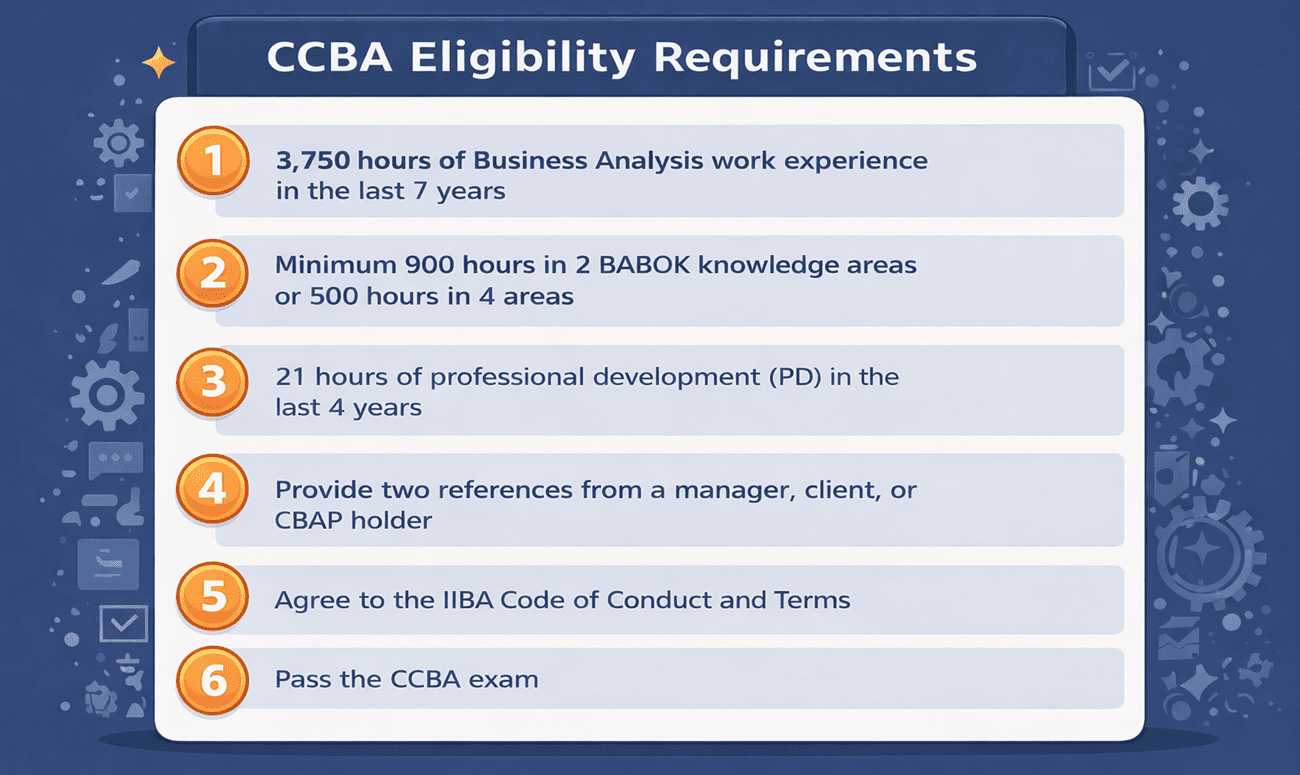
Experience: Accumulate a minimum of 3,750 hours of business analysis work in the last seven years. Within those hours, you must log at least 900 hours in each of two BABOK knowledge areas or 500 hours in each of four areas.
Professional development: Complete 21 hours of professional development (training or education) within the last four years. Approved courses include classroom courses, online training, and conferences. Self-study doesn’t count.
References: Provide two references from managers, clients, or CBAP-certified colleagues who can verify your work and skills.
Agreement and code of conduct: Agree to IIBA’s code of conduct and terms. Ethical behavior and professionalism are core to the certification’s credibility.
Exam: Submit your application and, once approved, schedule the exam. You have one year from the approval date to sit for the exam.
Exam Structure and Content
The CCBA exam assesses your ability to apply BABOK concepts to practical scenarios. It is computer-based and consists of 130 scenario-based multiple-choice questions to be completed in three hours. Questions are randomly selected from a large item bank, so each exam is unique. There is no penalty for incorrect answers, so it’s worth attempting every question.
The exam covers six knowledge areas with different weightings. The chart below illustrates the contribution of each area to the exam. Mastering the high-weight areas, such as Requirements Analysis and Design Definition, will improve your chances of success.
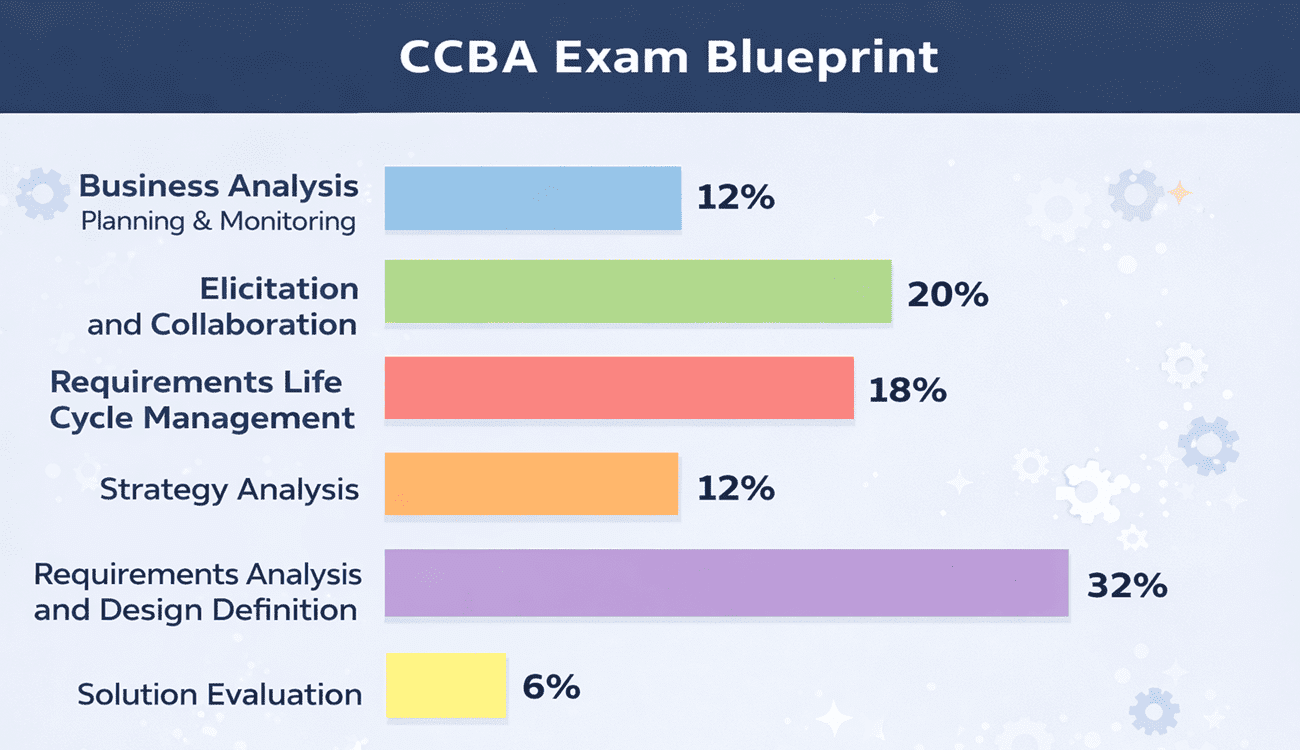
The CCBA exam blueprint weights each knowledge area as follows:
| Knowledge area | Weight in the exam |
| Business Analysis Planning and Monitoring | 12 % |
| Elicitation and Collaboration | 20 % |
| Requirements Life Cycle Management | 18 % |
| Strategy Analysis | 12 % |
| Requirements Analysis and Design Definition | 32 % |
| Solution Evaluation | 6 % |
Questions often describe a situation, such as a stakeholder misunderstanding or a missed requirement, and ask which technique or next step is appropriate. Studying sample questions helps you get used to this format. The Business Analysis Body of Knowledge (BABOK) is the primary reference; read it thoroughly and pay attention to the techniques, tasks, and underlying competencies.
Fees and Costs
As of April 2026, the CCBA has two main fees:
- Application fee: USD 145 (non-refundable). You pay this when you submit your application for review.
- Exam fee: USD 405 for non-members and USD 250 for IIBA members; both include a one-year IIBA membership. Membership offers access to resources, webinars, and discounts on future certifications.
If you need to retake the exam, the rewrite fees are USD 350 for non-members or USD 195 for members. Recertification, which you must complete every three years, costs USD 120 for non-members or USD 85 for members.
Prices may vary by region and are subject to change, so always check the IIBA certification fees page for the latest details.
How to Prepare for the CCBA Exam
- Assess your readiness: Review the eligibility criteria and confirm that you meet the experience and professional development requirements. Gather documentation and contact potential references early.
- Study the BABOK: The BABOK is your study foundation. Work through each knowledge area, practice techniques, and understand how tasks connect. Many candidates create flashcards or mind maps to consolidate terms.
- Use practice questions: Scenario-based questions can be tricky. Practice tests help you gauge your understanding and improve your timing. Focus on areas where you consistently score lower.
- Join study groups or courses: Many training providers offer CCBA prep courses that review key concepts and provide exam strategies. Webinars and peer study groups can also keep you accountable.
- Schedule your exam: Once your application is approved, you have one year to sit for the exam. Choose a date when you’ll have enough study time and minimal distractions. The exam is delivered online via remote proctor or at a PSI test center.
- Rest and review: In the final week, focus on reviewing notes and practicing self-care. A clear mind and steady pace are more helpful than last-minute cramming.
Maintaining Your Certification
Your CCBA credential remains valid for three years. To renew, you must earn 60 Continuing Development Units (CDUs) by participating in professional development activities such as workshops, webinars, mentoring, or work contributions. At least 35 CDUs must come from formal learning (e.g., courses or conferences). When you submit your recertification application, you also confirm adherence to IIBA’s code of conduct.
Staying active in the community, notably by volunteering, mentoring, or contributing to publications, can help you earn CDUs while giving back.
FAQs
Q1. What is the difference between CCBA and CBAP?
CBAP targets professionals with five or more years of experience; CCBA is for practitioners with roughly three years of experience and focuses on the practical application of BABOK concepts.
Q2. How many questions are on the CCBA exam?
The exam contains 130 scenario-based multiple-choice questions, and you have three hours to complete it.
Q3. Do I need to become a member of IIBA?
Membership is optional but reduces the exam fee and grants access to resources. The membership fee is included in the member exam fee.
Q4. How soon will I see benefits from certification?
According to IIBA’s 2025 survey, 81% of certified professionals experienced benefits, such as higher pay or greater confidence, within a year.
Q5. Can I retake the exam if I don’t pass?
Yes. You can rewrite the exam by paying a rewrite fee (USD 195 for members or USD 350 for non-members).
Summary
The CCBA certification bridges the gap between entry-level credentials and senior practitioner designations. Requiring real-world experience, structured learning, and a rigorous exam signals to employers that you are ready for more complex projects and leadership opportunities. If you’re a business analyst looking to enhance your credibility, expand your earning potential, and keep pace with industry trends, the CCBA may be the right step. Take the time to assess your eligibility, study the BABOK thoroughly, and invest in your professional development; the rewards will follow.
References:

I am Mohammad Fahad Usmani, B.E. PMP, PMI-RMP. I have been blogging on project management topics since 2011. To date, thousands of professionals have passed the PMP exam using my resources.