
Corrective and Preventive Action (CAPA) is a process used by organizations to identify, fix, and prevent problems. It is commonly used in healthcare, manufacturing, pharmaceuticals, and project management.
CAPA focuses on correcting issues to stop them from recurring (corrective) and taking steps to prevent them from happening in the first place (preventive). The goal is to improve quality, reduce risks, and ensure compliance with standards.
This process helps businesses operate smoothly, avoid costly mistakes, and build customer trust. A strong CAPA system is essential for any organization’s consistent performance and long-term success.
What is Corrective and Preventive Action (CAPA)?
Corrective and Preventive Action (CAPA) is a process that helps organizations solve problems and prevent them from happening again. It is commonly used in industries like healthcare, manufacturing, and pharmaceuticals. CAPA involves two key parts: corrective actions and preventive actions.
Corrective action focuses on fixing problems after they occur. When an issue is identified, the goal is to find the root cause and take steps to correct it. This ensures that the same problem does not happen again. For example, if a machine breaks down, corrective action involves fixing it and investigating why it failed.
Preventive action, on the other hand, focuses on stopping problems before they occur. It involves identifying potential risks and implementing measures to prevent them. For instance, preventive action would involve setting up a regular maintenance schedule if a machine breaks down due to a lack of maintenance.
Organizations can improve product quality, meet regulatory standards, and reduce costs by implementing CAPA. It also helps build customer trust by ensuring reliable products and services. A strong CAPA process is essential for continuous improvement and long-term success.
Examples of Corrective and Preventive Action (CAPA)
Imagine a pharmaceutical company that produces tablets. A batch of tablets is found to have a slight variation in weight, which could affect their effectiveness. The company uses Corrective and Preventive Action (CAPA) to resolve the issue.
- Corrective Action: The company investigated the cause of the weight variation. They found that a malfunctioning scale caused the issue. The scale was repaired, and the affected batch was recalled for rework. The immediate problem was fixed, and the tablet’s weight was corrected.
- Preventive Action: To prevent this from happening again, the company sets up a routine maintenance schedule for all equipment (e.g., scales). They also train staff to check the machine calibration more frequently. These preventive steps will help the company ensure that similar issues do not occur in the future.
Through CAPA, the company solves the immediate problem and improves its processes, ensuring better product quality and customer safety in the future.
In some industries, CAPA is a legal requirement for quality management in certain countries. For instance, in the USA, pharmaceutical companies must comply with CAPA regulations.
Failure to follow CAPA guidelines can result in pharmaceutical products being considered impure. The USA Food and Drug Administration (FDA) mandates that companies implement a CAPA process to ensure product quality and safety.
Corrective and Preventive Action Plan
According to ISO 9001, implementing CAPA involves a systematic approach that follows seven key steps to address and prevent problems.
- Define the Problem: Identify the problem and whether it pertains to a process issue or a deliverable. Ensure that the issue is real, and not just a perceived concern. Gather data to validate the problem’s existence.
- Define the Scope: Understand the issue’s context and impact. Analyze the problem in detail to determine its root cause and how it affects other processes or areas of the organization.
- Take Containment Actions: Immediately stop the problem from spreading or worsening. These actions should be temporary but effective enough to control the issue while you develop a permanent solution.
- Identify the Root Cause: Use problem-solving tools (e.g., a fishbone diagram, the 5 Whys, or fault tree analysis) to determine the problem’s underlying cause. Addressing the root cause is crucial to prevent reoccurrence.
- Plan the Action: Develop a realistic action plan to address the root cause. Set achievable deadlines and objectives. If the problem is significant, use a cost-benefit analysis to assess whether the investment required for the solution is justified.
- Take Action: Implement the corrective actions outlined in the plan. Ensure that all stakeholders are involved and that the necessary resources are allocated to resolve the issue effectively.
- Follow Up and Ensure That the Plan Worked: After implementation, evaluate the effectiveness of the corrective actions. Monitor the situation to ensure that the issue has been resolved, and similar problems will not occur. Adjust the plan if necessary to ensure long-term success.
CAPA Template
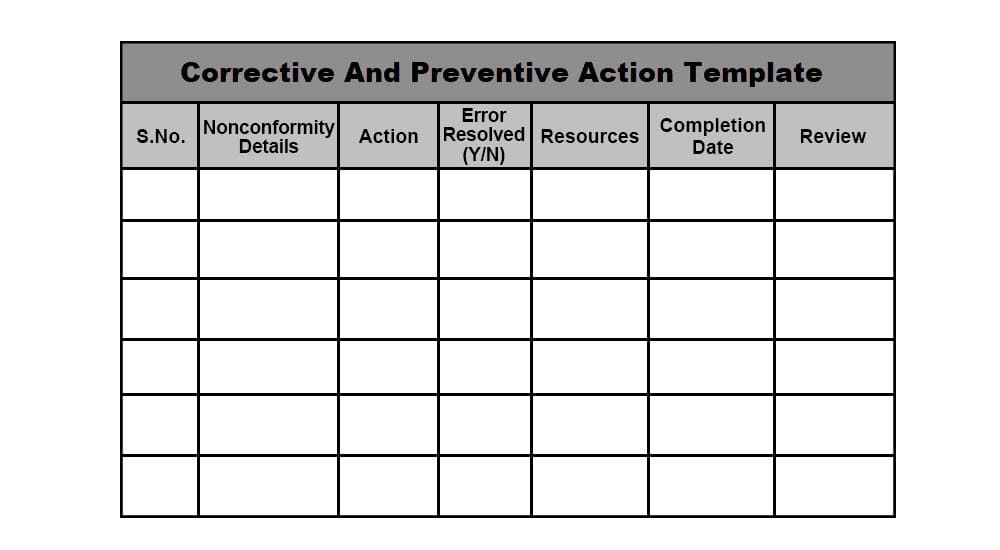
Summary
Corrective and Preventive Action (CAPA) is crucial for maintaining quality and preventing problems. While corrective and preventive actions involve similar steps, the triggers differ.
Corrective actions are taken when an unconformity occurs, requiring immediate measures to fix and prevent the problem from recurring. On the other hand, preventive actions are implemented in anticipation of a potential issue that has yet to occur, aiming to prevent it from occurring.
By addressing current and future risks, CAPA helps organizations improve processes, ensure compliance, and maintain high-quality standards.
Further Reading:
- What is Preventive Action?
- What is a Corrective Action?
- What is a Defect Repair?
- Control Charts vs. Run Charts
- Quality Control vs. Quality Assurance
References:

I am Mohammad Fahad Usmani, B.E. PMP, PMI-RMP. I have been blogging on project management topics since 2011. To date, thousands of professionals have passed the PMP exam using my resources.





It’s nice that you pointed out how corrective actions would remove the cause of nonconformity from a product. I was reading management guide last night and I learned a small bit about CAPA. From what I gathered, it seems there is corrective action software now too.