Every project manager faces one hard question when drafting a contract: Should you rely on liquidated damages or actual damages? The choice affects risk, cash flow, and dispute strategy. Liquidated damages set a fixed amount in advance. Actual damages require proof after a breach occurs. Each approach carries benefits and trade-offs. In construction, real estate, and infrastructure projects, delays and cost overruns can quickly escalate. A clear damage structure protects your budget and your schedule.
This blog post explains liquidated and actual damage, and helps you decide which model aligns with your project risk strategy.
Let’s get started.
Why This Matters
Contracts are the backbone of every project. They spell out responsibilities, deliverables, and remedies. A poorly drafted damages clause can leave you in litigation, drain your budget, and sour partnerships. Understanding the difference between pre-agreed damages and actual losses helps you choose the right tool for each situation.
Ready to find out how? Read on.
What Are Liquidated Damages?
Liquidated damages are a pre-agreed amount that the breaching party must pay if they fail to meet contractual obligations. Courts generally uphold these clauses when two conditions are met: at the time of contracting, it was difficult to determine actual damages, and the agreed sum is a reasonable forecast of the potential loss. If the sum is grossly disproportionate, courts may deem it a penalty and refuse to enforce it. In Massachusetts, the party challenging a liquidated damages clause bears the burden of proving that the clause is unenforceable.
Key Features
- Certainty: Liquidated damages provide a clear dollar amount. Parties know exactly what’s at stake.
- Efficiency: They avoid lengthy damage calculations, saving time and legal expenses.
- Risk Allocation: The clause allocates risk between parties. If the delay is within your control, you pay; otherwise, you may have defenses.
- Burden of proof: Challenging parties must show the clause is an unenforceable penalty.
- Sophisticated parties: Courts presume validity when experienced entities negotiate the clause.
What Are Actual Damages?
Actual damages compensate the injured party for proven losses. They aim to put the non-breaching party in the position they would have occupied had the contract been performed. To recover actual damages, you must demonstrate that the breach caused identifiable economic harm and provide evidence to support the amount. Expectation damages and consequential damages fall under this category, and courts avoid overcompensating by ensuring the award is reasonably certain.
Key Features
- Evidence required: You need records, invoices, and expert testimony to prove the extent of your loss.
- Time and cost: Litigation or arbitration may be necessary to quantify damages, increasing expenses.
- Flexibility: Actual damages can exceed the cap of a liquidated damages clause if the losses are large and proven.
- Mitigation: You must show that you mitigated damages by taking reasonable steps to reduce losses.
Comparing Liquidated and Actual Damages
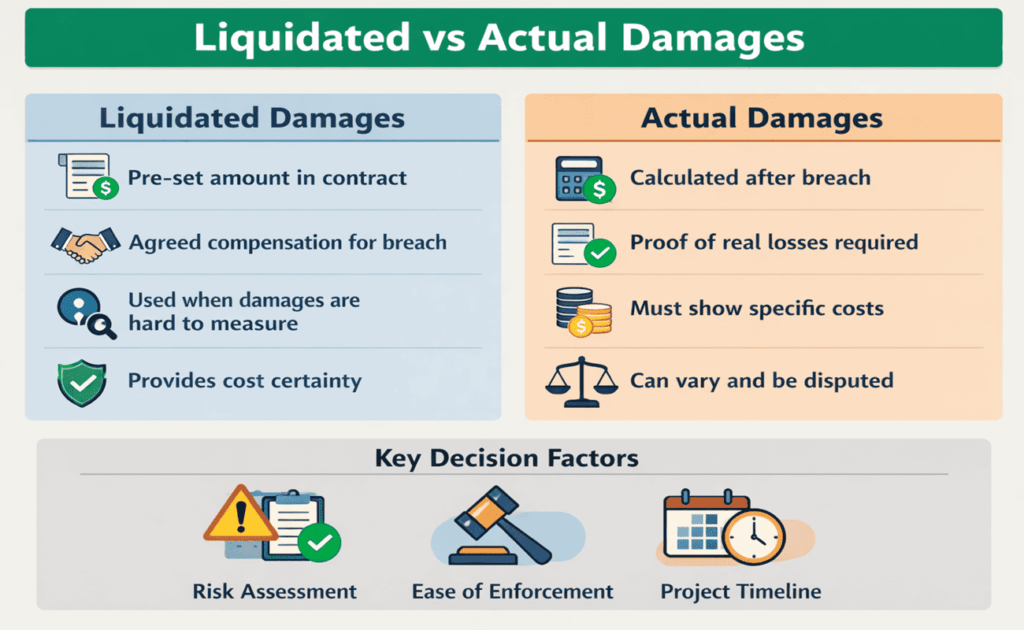
Choosing between liquidated and actual damages depends on several factors, including project size, the parties’ relationship, and the predictability of losses. The infographic below highlights the key differences and considerations for project managers.
When Do Courts Reject Liquidated Damages?
Courts strike down liquidated damages clauses that penalize rather than compensate. A 2024 Massachusetts case illustrates this point. In Mittas Early Learning, LLC v. MDC Properties, the lease provided that if the landlord failed to repair the HVAC system, it would pay the tenant its actual damages plus $500 per day.
The Appeals Court found this clause unenforceable because it added a penalty on top of actual damages. The decision reminds us that liquidated damages must replace actual damages, not add to them. Always ensure your clause isn’t double-counting losses.
Project Delay Statistics and Their Impact
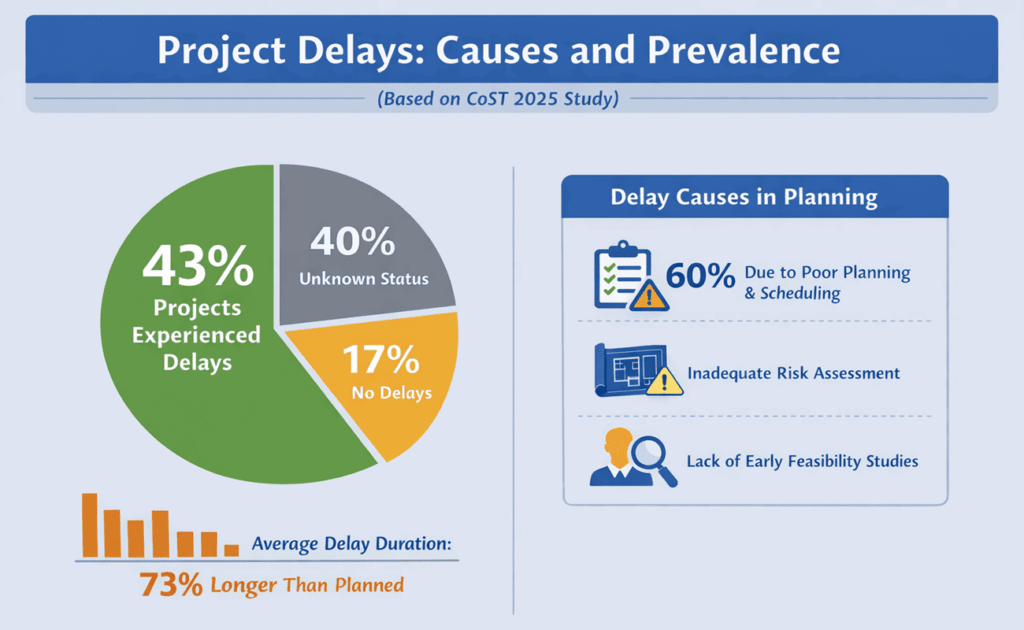
Damages clauses are tied closely to project delays. A study by the Infrastructure Transparency Initiative (CoST) analyzed 480 projects across Africa, Latin America, and Eurasia. The report found that 43% of projects experienced delays, 17% had no delays, and the remaining projects lacked sufficient data. After excluding missing data, roughly 70% of projects experienced delays, which extended the planned schedule by an average of 73%. Notably, 60% of delay drivers originated in the project preparation phase, not during tendering or execution. These numbers highlight the importance of planning and risk management.
The infographic below illustrates these findings and underscores the importance of early planning.
Project Management Perspective: Choosing the Right Clause
In project management, the decision to adopt a liquidated damages clause should be informed by the project’s complexity and the predictability of losses. Consider the following framework:
- Assess Predictability: Can you reasonably forecast the financial impact of a delay or breach? If the answer is yes, a liquidated damages clause may be appropriate. Difficult-to-quantify impacts (such as reputational harm) may require a broader clause or reliance on actual damages.
- Evaluate the Relationship: Liquidated damages can maintain goodwill by avoiding bitter disputes. However, if the relationship is new or contentious, leaving damages open may encourage better behavior.
- Balance Risk and Reward: Large infrastructure projects with tight schedules might benefit from a daily rate to motivate timely performance. Smaller or flexible projects might not need such rigid penalties.
- Align with Insurance: Not all delays are compensable. As the MDD article notes, delays caused by mismanagement may trigger liquidated damages, while delays due to external events could be covered by builder’s risk insurance. Align your contracts with your insurance policies to avoid gaps.
- Document Everything: Whether relying on liquidated or actual damages, maintain clear records of delays, costs, and communications. This documentation is essential for enforcing any damage claim.
Drafting Effective Liquidated Damages Clauses
- Define the Trigger: Specify which events trigger the clause (e.g., late completion, failure to meet milestones). Avoid ambiguous language.
- Set a Reasonable Amount: Base the amount on a good-faith estimate of potential losses. Keep in mind that courts look at whether the sum was a reasonable forecast at the time of contracting.
- Avoid Penalties: Do not include language that adds liquidated damages on top of actual damages. Use one or the other, not both.
- Include Mitigation Duties: Encourage the breaching party to act quickly by outlining mitigation steps. This preserves the clause’s enforceability.
- Tailor by Industry: In construction, consider daily rates that reflect labor and equipment costs. In software development, damages might reflect missed revenue or license fees. One size does not fit all.
Actual Damages: When to Rely on Them
Even well-drafted liquidated damages clauses may not cover every scenario. Situations where actual damages may be preferable include:
- Evolving Scope: If you anticipate scope changes, pre-agreed amounts may become outdated. Actual damages allow flexibility.
- Large Unknowns: High-risk ventures, such as complex R&D projects, may incur losses that far exceed early estimates. Actual damages capture full losses.
- Negotiation Leverage: Sometimes, leaving damages open can motivate parties to perform. The possibility of a large judgment encourages timely completion.
Examples
Example 1# Modular Housing Project: A municipal housing authority hired a contractor to deliver 100 modular units. The parties agreed that if the contractor missed the delivery date, it would pay $2,500 per day. Because the authority’s relocation costs were predictable and quantifiable (hotel stays for displaced residents and storage costs), the liquidated damages clause made sense. When supply chain issues delayed delivery, the contractor paid the agreed amount, and both sides avoided litigation.
Example 2# Software Implementation: A company contracted a developer to integrate new accounting software by the end of the fiscal year. The developer insisted on leaving damages open. The parties agreed that any delay would trigger actual damages based on documented overtime, lost productivity, and missed regulatory deadlines. When the project slipped two months, the company presented invoices and timesheets to support its claim. The developer ultimately settled.
Example 3# Infrastructure Rehabilitation: A public-private partnership undertook a bridge rehabilitation. The contract included a liquidated damages provision of $15,000 per day for delays, reflecting congestion costs and safety concerns. However, the clause also waived liquidated damages for force majeure events, including floods. When heavy rains washed out access roads, the contractor was granted relief, illustrating the need for clear exceptions.
FAQs
Q1. Why do some contracts include both liquidated and actual damages?
They shouldn’t. Courts treat liquidated damages as a substitute for actual damages. Adding a penalty on top of actual damages renders the clause unenforceable.
Q2. How do I determine a reasonable liquidated damages amount?
Start with a good-faith estimate of the potential loss and document your analysis. Use costs include rental fees, idle labor, and lost revenue. Courts look for a reasonable forecast.
Q3. Can I change the damages clause after the contract is signed?
Yes, but only if both parties agree to an amendment. Changes must be in writing and supported by consideration to be enforceable.
Q4. Are liquidated damages taxable income?
In most jurisdictions, they are treated as contract damages and may be taxable to the recipient as income. Always consult a tax professional.
Q5. Do liquidated damages apply during force majeure events?
Only if the contract says so. Most clauses exclude force majeure events; always define your exceptions clearly.
Summary
Choosing between liquidated and actual damages is a strategic decision. Liquidated damages provide predictability and can incentivize timely performance, while actual damages address unpredictable or extensive losses. The key is to align the clause with the project’s risks and objectives. Early planning and clear documentation reduce delays and disputes. As a project manager, you hold the pen: draft clauses that balance certainty with flexibility, allocate risk fairly, and uphold the trust that makes projects succeed.

I am Mohammad Fahad Usmani, B.E. PMP, PMI-RMP. I have been blogging on project management topics since 2011. To date, thousands of professionals have passed the PMP exam using my resources.