Contracts set the rules for modern commerce. When one party breaks a promise, the other may suffer real losses. To discourage breaches and compensate injured parties, many agreements include a penalty clause. These clauses specify an amount of money payable if a party fails to meet an obligation.
Used wisely, they can protect businesses, prevent disputes, and encourage timely performance. Used carelessly, they may be struck down by a court.
This blog post explains what penalty clauses are, why they matter, how they work in different contexts, and how to draft them to withstand legal scrutiny.
Let’s get started.
What is a Penalty Clause?
A penalty clause is a contract provision that requires the breaching party to pay a fixed sum to the other party when a specific obligation is not met. This sum is agreed when the contract is formed. It provides certainty about potential losses and deters non-performance. The clause must be written clearly and included in the final contract.
A simple example: if a supplier fails to deliver goods by a certain date, the buyer may be entitled to receive $5,000 for each day of delay. The clause is triggered by the breach, not by actual proof of loss.
Penalty clauses differ from indemnity clauses or expense recovery clauses. They also differ from liquidated damages clauses, which aim to pre-estimate actual losses rather than punish the breaching party. The next sections explore the distinctions.
Why Use Penalty Clauses?
Penalty clauses serve several important functions:
- Deterrence: Knowing that a breach will trigger a financial penalty can encourage parties to meet deadlines. For example, a contractor may work diligently to avoid costly penalties for late completion.
- Certainty: The parties can budget for potential risks. A fixed amount reduces arguments about damages and avoids lengthy litigation over the value of lost time or profit.
- Negotiation leverage: If a breach occurs, the innocent party has a clear remedy. This can encourage settlement and preserve relationships.
- Risk allocation: Businesses can allocate risk where it belongs. A penalty clause shifts the cost of non-performance to the party in the best position to control the risk.
Types of Penalty Clauses
Penalty clauses appear in many industries. Their design depends on the nature of the contract and the risks involved.
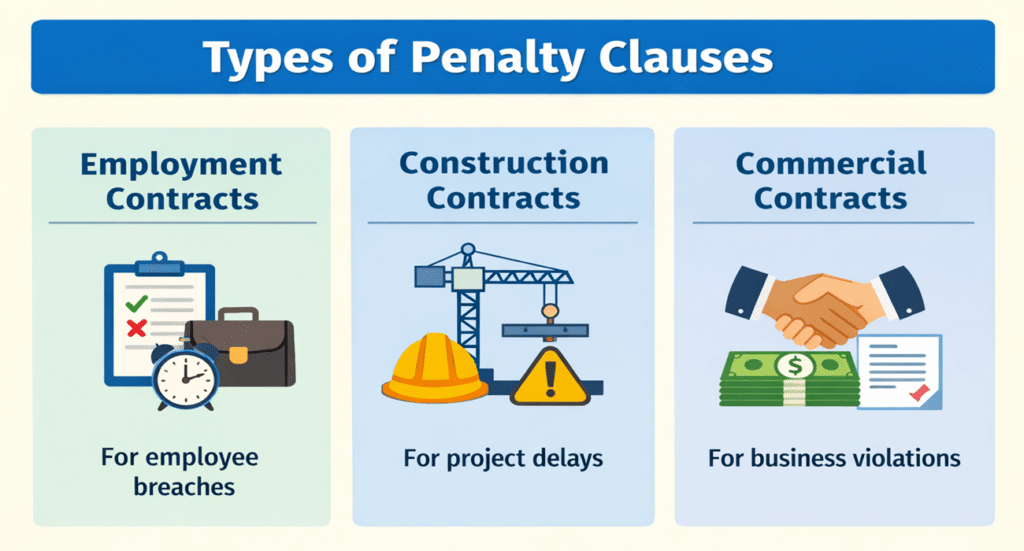
Employment Contracts
Employers sometimes include penalty clauses in fixed-term employment contracts. The clause may require an employee to pay compensation if they resign before the end of the contract or disclose confidential information. An example might be a sports coach agreeing not to leave mid-season or pay a specified sum to cover the club’s costs. Courts will closely review the amount to ensure it is not oppressive.
A well-drafted clause links the payment to the employer’s legitimate interest, such as the cost of training or hiring a replacement.
Construction Contracts
Large construction projects face schedule risks. Late completion can lead to lost revenue, financing costs, and reputational damage. Contractors may agree to pay a penalty for each day they exceed the completion date. In 2024, a report by Rabbet found that slow payments in the U.S. construction sector increased costs by $280 billion, equal to 14% of total construction spending. The same survey revealed that 95% of general contractors and 75% of subcontractors had to float payments while waiting for developer disbursements.
Penalty clauses can help parties recover some of these costs, but the amount must be proportionate to the anticipated harm.
Commercial Contracts
Many business agreements, such as shareholder agreements, franchise agreements, or supply contracts, use penalty clauses to enforce key obligations. For example, a shareholder who sells their shares during a lock-up period may incur a penalty. In franchise agreements, a franchisee who uses the brand outside the licensed territory may be required to pay a fixed sum. These clauses protect the licensor’s brand and goodwill. The penalty should reflect the legitimate business interest rather than serve as a windfall.
Penalty Clause Vs Liquidated Damages
A penalty clause is designed to punish a party that breaches a contract. It sets a high amount to discourage non-performance. Courts often view it with caution. If the amount feels excessive or unfair, a judge may reduce it or refuse to enforce it.
Liquidated damages work differently. They aim to compensate, not punish. The parties agree in advance on a reasonable estimate of the potential loss in the event of a breach. Courts are more likely to enforce liquidated damages because they reflect a genuine effort to predict harm.
The key difference lies in intent and fairness. A penalty clause focuses on deterrence. Liquidated damages focus on compensation. Ask yourself this: Does the amount reflect a real loss, or does it scare the other party into compliance?
Penalty Clause vs Liquidated Damages: Comparison Table
| Parameter | Penalty Clause | Liquidated Damages |
| Main purpose | Punish the breaching party | Compensate the non-breaching party |
| Basis of amount | Often excessive or fixed to deter breach | Reasonable pre-estimate of likely loss |
| Court treatment | May be reduced or ruled unenforceable | Usually enforceable if reasonable |
| Link to actual loss | Weak or none | Closely linked to expected loss |
| Common use | High-risk or poorly drafted contracts | Well-drafted commercial contracts |
| Legal risk | High risk of challenge | Lower risk if properly drafted |
Legal Framework and Enforceability
Common Law Test for Enforceability
Courts in many common-law jurisdictions follow the principles set out by the UK Supreme Court in Cavendish Square Holding BV v Makdessi. When deciding whether a clause is an unenforceable penalty, judges consider three questions:
- Secondary obligation: Is the clause triggered by a breach of a primary obligation? Penalty rules apply only if the payment is linked to a breach.
- Legitimate interest: Does the clause protect a legitimate business interest? The injured party must show that the clause relates to something of real importance, such as timely delivery or protection of confidential information.
- Proportionality: Is the sum exorbitant or unconscionable in comparison with that interest? The court will not enforce an amount that goes beyond a reasonable pre-estimate of loss.
If the clause answers these questions favourably, it is likely to be enforceable. If not, the court may interpret the clause as an unenforceable penalty and award only actual damages.
Other Jurisdictions
Different jurisdictions take varied approaches. In many U.S. states, courts distinguish between liquidated damages and penalties. A clause is enforceable if the harm is difficult to estimate at the time of contracting and the amount is reasonable relative to anticipated damages. In civil-law jurisdictions like France and Germany, courts similarly allow “clause pénale” or “Vertragsstrafe” but may reduce penalties deemed excessive. Understanding local law is essential when drafting cross-border agreements.
Drafting an Enforceable Penalty Clause
An enforceable clause should be fair, clear, and tailored to the contract’s needs. Consider these steps when drafting:
- Identify the obligation: Specify the exact obligation whose breach triggers the payment. Vague clauses increase the risk of unenforceability.
- Explain the purpose: Briefly describe the legitimate interest the clause protects (for example, timely delivery, protection of trade secrets, or completion of a project).
- Calculate a reasonable amount: Use past projects, market data, or industry reports to estimate potential losses. Document this rationale. Courts may reduce amounts that seem arbitrary or punitive.
- Expressly state the clause: Place the penalty clause prominently in the contract and ensure both parties acknowledge it. Hidden or ambiguous clauses are easier to challenge.
- Consider bargaining power: A court may scrutinize a clause more closely when there is an imbalance of power. Fair negotiation and legal advice can help demonstrate that the clause was freely agreed upon.
- Review jurisdictional rules: Check local statutes and case law. Some jurisdictions may void penalty clauses altogether or require specific language.
- Include mitigation measures: Consider adding requirements, such as a notice period or a penalty cap. This signals that the clause aims to compensate rather than punish.
Example
Imagine a technology company hiring a software developer on a one-year contract to build a critical platform. The contract includes a clause requiring the developer to pay $15,000 if they leave within six months. The company documents that it spends $10,000 on onboarding, training, and lost productivity for a replacement. The clause explains that the payment covers these costs.
When challenged, the court sees that the amount is close to the estimated loss and enforces the clause. If the company had set the payment at $50,000 without justification, a court may view it as punitive and reduce it.
Modern Trends and Business Implications
Penalty clauses must adapt to changing business realities. Digital transactions, global supply chains, and evolving payment practices have increased the complexity of enforcing contracts. Slow payments, particularly in construction, illustrate why clear clauses matter. The 2024 Rabbet survey reported that 82% of contractors experienced payment delays over 30 days.
Such delays force contractors to rely on personal funds and can trigger penalties if they breach financing obligations. A well-drafted clause can provide immediate relief when one party’s failure to pay causes cascading delays.
Another trend is the growing scrutiny of unfair contract terms. Regulators and courts closely scrutinize clauses that impose an unreasonable burden on consumers or small businesses. Transparent drafting and balanced amounts help avoid allegations of unfairness.
FAQs
Q1. What is the main difference between a penalty clause and liquidated damages?
Liquidated damages aim to compensate the innocent party for anticipated losses, while a penalty clause is designed to deter by imposing a sum that may exceed actual damages.
Q2. Can a penalty clause be enforced if it is not linked to a breach?
No. Penalty rules apply only when a payment is triggered by a breach of a primary obligation. Payments for early termination fees or buy-out rights may fall outside this rule.
Q3. How can I ensure a penalty clause is not considered unconscionable?
Document the rationale behind the amount, ensure the clause protects a legitimate interest, and avoid sums that far exceed the estimated loss.
Q4. Do penalty clauses apply to consumers?
Many consumer protection laws limit or prohibit penalty clauses in consumer contracts. Always check local statutes and consult a lawyer before including such provisions.
Summary
Penalty clauses play an important role in contracts, but they require careful use. They aim to deter breaches, while liquidated damages aim to fairly compensate for real loss. The difference matters because courts focus on intent, fairness, and proportionality. A poorly drafted clause can fail when you need it most. By understanding how these clauses work and drafting them with care, parties can reduce disputes, manage risk, and protect their contractual rights with greater confidence.

I am Mohammad Fahad Usmani, B.E. PMP, PMI-RMP. I have been blogging on project management topics since 2011. To date, thousands of professionals have passed the PMP exam using my resources.