Project accountability is the backbone of every successful project. When people know what they own, work moves faster and problems get solved early. But when roles are unclear, delays, confusion, and blame quickly follow. Many teams struggle not because of skill gaps but because of a lack of ownership.
So how do you fix this? You create clarity from the start and support it throughout the project.
In this blog post, you will learn how accountability in project management works and why it matters. You will also explore simple tools like the RACI matrix and Work Breakdown Structure that help define roles, improve teamwork, and ensure every task has a clear owner.
Key Takeaways
- Clear accountability prevents chaos – When responsibilities are assigned at the start, tasks don’t fall through the cracks and deadlines aren’t missed.
- Role-definition tools drive ownership – Frameworks like the RACI matrix and the Work Breakdown Structure (WBS) turn vague responsibilities into specific assignments.
- Measurement improves success rates – Projects that define success criteria, measure progress and track performance nearly double their success scores.
- Clarity and vision matter – Teams with a clearly defined project vision achieve a Net Project Success Score of 41, compared with 18 for those without one.
- Adoption of accountability practices is low – Only 7 percent of project professionals consistently practice the M.O.R.E. framework; yet doing so raises success scores to 94.
Why Accountability Matters for Projects
Accountability in project management ensures that every task has a clear owner. When people know they are responsible, they focus more and deliver better results. It reduces confusion, avoids duplication of work, and keeps projects on schedule. Teams communicate more clearly because roles are defined from the start.
Accountability also improves trust. Team members rely on each other to complete work on time. Leaders can track progress easily and step in when needed. This helps solve problems early before they grow bigger.
It also drives performance. People take pride in their work when they own outcomes, not just tasks. This leads to higher-quality results and better team morale.
Without accountability, projects face delays, missed deadlines, and blame. With it, teams stay aligned, focused, and productive, which increases the chances of project success.
Defining Roles: Tools That Create Clarity
Projects often bog down when no one knows who is responsible. To cut through confusion, project managers use role-definition tools that map responsibilities to people. Two of the most powerful are the RACI matrix and the Work Breakdown Structure.
RACI Matrix: No More “I Thought You Were Handling That”
The RACI matrix clarifies four roles for each task: Responsible (the doer), Accountable (the owner), Consulted (those giving input) and Informed (those kept in the loop). By listing team members down one side and tasks across the top, the matrix makes it obvious who owns each piece of work. Imagine a software project with deliverables like requirements, design, coding and testing.
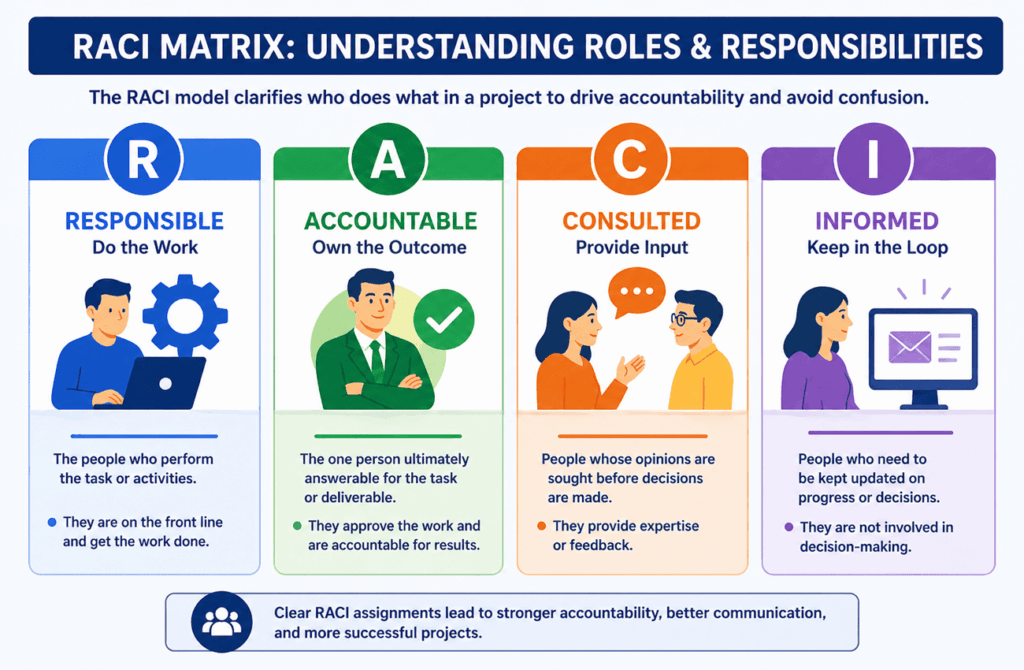
In the RACI matrix, the software engineer might be responsible for coding, while the product manager is accountable for ensuring it meets user needs. Stakeholders who must review requirements are consulted, and executives are informed about progress. With roles spelled out, there are no gaps or overlaps.
Work Breakdown Structure: Breaking Big Projects into Manageable Pieces
Large projects can be intimidating. A Work Breakdown Structure (WBS) helps by breaking a complex goal into smaller deliverables and tasks. Think of it as a family tree: at the top is the project objective; below that are the major deliverables; under each deliverable are the tasks required to complete it. This hierarchy clarifies scope and prevents anything from being forgotten.
For example, if you’re launching a new product, major deliverables might include product design, manufacturing, marketing and distribution. Breaking each of these into tasks makes assignment and tracking straightforward.
The basic process looks like this:
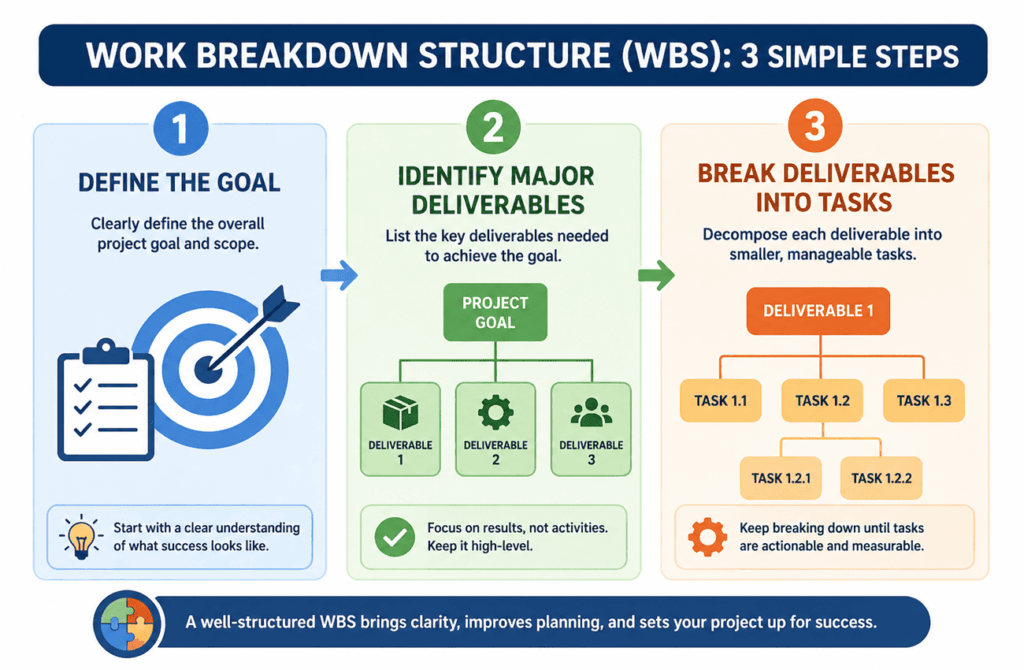
When you break work into smaller parts, accountability becomes actionable. Team members can be assigned to specific tasks, deadlines are realistic and progress can be tracked more easily.
Building Accountability into Your Culture
Accountability isn’t just about assigning tasks; it’s about creating an environment where people feel ownership and trust. Micromanagement erodes trust, while empowerment breeds engagement.
The following are a few ways you can build accountability into your culture:
Empower People Instead of Micromanaging
People take responsibility when they have autonomy. Set clear expectations, provide the tools they need and then step back. Offer support and remove obstacles rather than dictating every step. For example, when launching a marketing campaign, define the outcome – a certain number of qualified leads – and let your marketing team choose the tactics. When team members have the freedom to innovate, they are more likely to own the outcome.
Psychological Safety: Encourage Honesty
Accountability thrives in a safe environment. Encourage people to speak up about risks, mistakes or obstacles without fear of punishment. Leaders can set the tone by focusing on solutions instead of blame. When a critical bug appears in software testing, a culture of psychological safety means the developer reports it immediately, the team fixes it and everyone learns from the process. Silence kills projects; openness saves them.
Continuous Feedback Loops
Regular check-ins make accountability part of everyday work. Weekly status meetings, one-on-one conversations and sprint retrospectives provide opportunities to celebrate wins, identify bottlenecks and adjust plans. Ask questions like “What’s going well?”, “What’s blocking progress?” and “What’s next?” These conversations aren’t about catching mistakes but about continuous improvement.
Agile Practices for Daily Accountability
Agile methods embed accountability into the workflow. Teams hold daily stand-ups where each person states what they did yesterday, what they will do today and what obstacles they face. This simple ritual keeps everyone aware of progress and encourages peer accountability.
Sprint planning sessions define what work will be done in the next iteration and who is responsible, while retrospectives at the end of each sprint create space for reflection and improvement. Sharing ownership and commitments regularly keeps accountability front and center.
Tracking Progress: KPIs and Dashboards
Even with clear roles and a supportive culture, you still need to see if the project is on track. Key Performance Indicators (KPIs) translate goals into measurable metrics. For example, a website redesign might track metrics such as the percentage of pages completed, adherence to deadlines and user satisfaction scores. Transparent dashboards give everyone visibility into these metrics. When teams see that a deliverable is behind schedule or a quality metric is slipping, they can act quickly.
The PMI research emphasizes that projects with established measurement systems, performance tracking and risk monitoring achieve much higher success scores. Visibility isn’t about micromanagement; it’s about enabling timely course corrections.
Steps to Build Accountability Today
If your team struggles with accountability, start with simple steps:
- Set a clear vision and goals. Ensure everyone understands why the project matters and what success looks like. Use language that resonates with your audience.
- Document roles and tasks. Create a RACI matrix and a Work Breakdown Structure. Share them with the team and revisit them as the project evolves.
- Establish regular check-ins. Hold weekly meetings or daily stand-ups to discuss progress, obstacles and next steps. Encourage honest conversation.
- Use shared tools. Choose a project management tool that tracks assignments, deadlines and metrics. Make it accessible to the entire team.
- Recognize ownership. Celebrate when team members take initiative and deliver on their commitments. Positive reinforcement encourages accountability.
Each small step builds momentum. You don’t need to implement everything at once; even adopting one practice can make a noticeable difference.
FAQs
Q1. How does the RACI matrix improve accountability?
The RACI matrix assigns one responsible person and one accountable owner to every task. It reduces confusion, eliminates duplication of effort and ensures that no activity slips through the cracks.
Q2. Can accountability exist without micromanaging?
Yes. Provide clear goals and resources, then trust your team to deliver. Check progress at agreed intervals, offer help when needed and focus on outcomes rather than controlling every step.
Q3. What is the M.O.R.E. framework?
M.O.R.E. stands for Manage perceptions, Own success, Relentlessly reassess and Expand perspective. It encourages project professionals to take broad accountability for delivering value, not just executing tasks.
Q4. Why is defining project vision important?
Projects with a defined vision score higher on success metrics because everyone understands the purpose and desired outcomes. A shared vision guides decisions and keeps teams aligned.
Q5. How can leaders encourage psychological safety?
Leaders can model vulnerability by admitting mistakes, focusing on problem-solving rather than blame and rewarding honest reporting. When people feel safe, they take ownership and speak up early.
Summary
Project accountability turns ideas into results. When roles are clear, teams move faster and avoid confusion. Tools like RACI and WBS give structure, while regular check-ins keep progress on track. Strong leaders build trust, not fear, and encourage ownership at every level. When people understand their responsibility, they deliver better work. Start small, stay consistent, and build accountability into your daily workflow. Over time, this simple habit leads to smoother projects and stronger outcomes.

I am Mohammad Fahad Usmani, B.E. PMP, PMI-RMP. I have been blogging on project management topics since 2011. To date, thousands of professionals have passed the PMP exam using my resources.