Agile practices continue to transform how organizations deliver projects and products. As more companies adopt Agile frameworks, professionals are seeking certifications that prove their expertise. Understanding the PMI-ACP requirements is the first step for anyone planning to earn the PMI Agile Certified Practitioner credential.
These PMI-ACP certification requirements outline the education, Agile experience, and training hours candidates must complete before applying for the exam. Learning about these eligibility requirements helps you prepare effectively and avoid delays in your application.
In this blog post, you will explore the PMI-ACP eligibility criteria, exam details, costs, and the step-by-step process needed to achieve this respected Agile certification.
What is PMI-ACP Certification?
The PMI Agile Certified Practitioner (PMI-ACP) designation is offered by the Project Management Institute (PMI) for professionals who work with Agile frameworks such as Scrum, Kanban, and Lean. Agile teams value frequent feedback, short iterations, and rapid response to change. PMI created this credential to validate both practical experience and knowledge of agile principles.
According to the PMI exam outline, the certification assesses how well practitioners apply agile tools across the mindset, leadership, product, and delivery domains. Candidates answer multiple-choice, multi-response, and drag-and-drop questions to demonstrate real-world understanding of agile concepts.
Why PMI-ACP Matters Today
The PMI-ACP certification is important because it validates your ability to work with Agile practices and lead teams in fast-changing environments. Organizations increasingly use Agile frameworks such as Scrum, Kanban, and Lean to deliver products quickly and respond to customer feedback.
The PMI-ACP credential proves that a professional understands these methods and can apply them in real projects. It also demonstrates knowledge of Agile principles, team collaboration, value delivery, and adaptive planning. Employers value this certification because it confirms both experience and training in Agile project management.
Earning the PMI-ACP can strengthen career opportunities, improve credibility with stakeholders, and help professionals stand out in competitive job markets where Agile skills are in high demand.
PMI-ACP Requirements
Meeting the PMI-ACP eligibility requirements ensures that candidates have both education and hands-on experience.
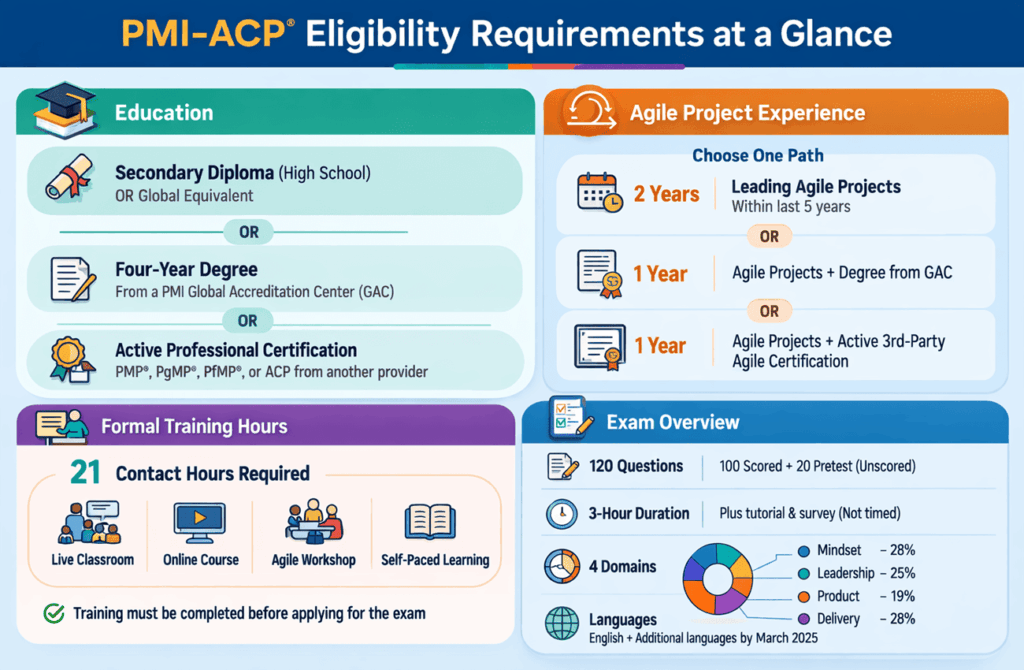
The following are the key requirements for the PMI-ACP certification exam:
Education
You need at least a secondary diploma, high school diploma, GED, or global equivalent. Candidates with higher degrees also qualify; the credential focuses on proof of agile experience rather than academic level.
Agile Project Experience
PMI requires 2 years of agile project experience within the last 5 years. If you have an active Project Management Professional (PMP) certification, you meet this project experience requirement.
Candidates can also substitute one year of agile experience plus a degree from a PMI Global Accreditation Center (GAC) program or one year of agile experience plus a valid third-party agile certification earned more than a year ago. Those certifications include Scrum Master and SAFe credentials, which demonstrate you already understand agile methods.
Formal Training in Agile Practices
Every applicant must document 21 hours of formal training in agile practices, frameworks, or methodologies. Training must include experiential exercises and an assessment with a certificate of completion. PMI recommends using authorized training providers and practice exams to confirm readiness. Note that the current exam guide says that exam eligibility also includes at least 28 hours of formal learning aligned with the exam content outline. Many candidates exceed the minimum to ensure comprehensive preparation.
PMI-ACP Exam Details and Structure
Question Count and Duration
The PMI-ACP exam consists of 120 questions, including 100 scored questions and 20 pretest items that do not affect the score. Candidates have three hours to complete the examination. After the first 60 questions, there is a 10-minute break; once you start the break, you cannot revisit earlier responses. A brief tutorial precedes the exam, and a survey follows it; neither counts toward the three-hour time limit.
Domains and Weightings
The exam questions align with four domains: Mindset (28 percent), Leadership (25 percent), Product (19 percent), and Delivery (28 percent). Within each domain, tasks focus on agile principles, stakeholder engagement, product management, and value delivery. Understanding the relative weight of each domain can help you allocate study time effectively.
Languages and Format
PMI offers the exam in English, and additional languages will be available by March 2025, including Arabic, Brazilian Portuguese, French, German, Japanese, Korean, Simplified Chinese, Traditional Chinese, and Spanish. You can choose to take the exam in person at a Pearson VUE test center or online via proctoring. Online exams require system tests and a check-in process, so plan extra time.
Exam Costs and Membership
PMI Membership and Exam Fees
Joining PMI is optional, but it can reduce exam costs. An individual PMI membership costs around $139 per year plus a $10 application fee. This first-year investment of about $149 gives you access to PMI resources and reduces the exam fee by roughly $60. PMI members pay about $435 for the PMI-ACP exam, while non-members pay around $495. The price difference means that membership often pays for itself in the first year.
Candidates who need to retake the exam pay a lower fee: approximately $335 for members and $375 for non-members. Exam fees remain valid for one year from the date of application approval, giving candidates 12 months to schedule and complete the test. Payment options include major credit cards; some regional chapters offer scholarships or group discounts.
Training Costs
PMI requires formal training to meet the 21-contact-hour requirement. Costs vary widely based on format. Instructor-led courses typically range from $1,500 to $3,000 and provide comprehensive coverage with practice exams. Virtual instructor-led programs cost about $1,200 to $2,500 and eliminate travel expenses. Self-paced online courses cost between $300 and $1,000, offering flexibility but less instructor interaction. Candidates often invest in additional study materials, such as practice exams, question banks, and guides, which can add $100 to $300 to their preparation costs.
Application Process
Navigating the PMI-ACP application requires planning, but the steps are straightforward. The following process reflects PMI guidance and best practices:
- Decide on PMI Membership: Determine whether joining PMI makes sense based on exam fee savings and access to resources.
- Complete Your 21 Contact Hours: Enroll with an authorized training provider and obtain a certificate verifying at least 21 hours of agile training.
- Gather Experience Documentation: Compile records of your agile project work covering two years, or the equivalent combination if you have a GAC degree, third-party certification, or active PMP.
- Submit the Online Application: Create or update your PMI account, fill out the PMI-ACP application, and list your education, training hours, and project experience.
- Pay the Exam Fee: Once PMI approves your application, pay the exam fee based on your membership status.
- Schedule the Exam: Choose a date within the one-year eligibility window and decide whether to take the exam in person or online. Build in extra time for system checks if selecting the online option.
- Take the Exam: Follow the tutorial, answer the 120 questions within three hours, and use the 10-minute break after question 60.
- Maintain Your Certification: After passing, you will enter a three-year certification cycle. To renew, you must earn 30 Professional Development Units (PDUs) during each cycle.
FAQs
Q1. What qualifies as agile project experience?
Agile project experience includes working on Scrum, Kanban, Lean, or hybrid teams. You need 2 years of agile experience in the past 5 years, or a qualified substitution.
Q2. Do I need a four-year degree to apply for PMI-ACP?
No. A secondary diploma, high school diploma, GED, or equivalent is sufficient. Higher degrees are welcome but not required.
Q3. How many questions are on the PMI-ACP exam, and how long is it?
The exam has 120 questions, 100 scored, and 20 pretest questions. You have three hours to complete the exam, with a 10-minute break after question 60.
Q4. How much does it cost to take the PMI-ACP exam?
Members pay about $435, and non-members pay around $495. PMI membership costs roughly $149 for the first year, so joining can offset exam fees.
Q5. What counts as formal agile training?
Formal training must align with PMI’s exam content outline and include experiential learning. Courses should provide at least 21 contact hours and end with an assessment and certificate.
Q6. Can I take the PMI-ACP exam online?
Yes. PMI offers online proctored exams through Pearson VUE, but you must complete system checks and meet the technical requirements. In-person testing is also available.
Q7. How do I maintain my PMI-ACP certification?
You need to earn 30 PDUs every three years. PDUs can come from additional training, webinars, professional work, or involvement in the agile community.
Summary
Earning the PMI-ACP certification demonstrates your dedication to agile principles and your ability to guide teams through change. By meeting the eligibility requirements, completing formal training, and documenting your agile experience, you lay a strong foundation for success. Understanding the exam structure and costs helps you plan effectively, and following the application steps ensures a smooth path to certification. As agile adoption grows and more organizations embrace hybrid models, PMI-ACP holders will stand out as flexible and knowledgeable leaders.
Reference:

I am Mohammad Fahad Usmani, B.E. PMP, PMI-RMP. I have been blogging on project management topics since 2011. To date, thousands of professionals have passed the PMP exam using my resources.