Project management offices help organizations manage projects efficiently, but many leaders still ask about the difference between PMO and EPMO. Understanding PMO vs EPMO is important because each structure supports project delivery differently. A traditional PMO focuses on improving project execution within a department, while an
Enterprise Project Management Office (EPMO) aligns projects with the company’s strategy. Choosing between PMO and EPMO depends on organizational size, project complexity, and strategic goals.
This blog post explains how PMO and EPMO structures work, their key differences, and when organizations should use each model to improve project success and strategic alignment.
What is a Project Management Office?
A Project Management Office (PMO) is a department that supports projects within a business. Its mission is to help project teams finish work on time and within budget. A PMO sets standards, trains people, allocates resources, and monitors progress.
Think of a PMO as the control tower for project work. It provides templates and guidance, watches timelines and budgets, and helps managers solve problems. For example, in a software firm launching a new app, the PMO might assign a project manager, provide a risk checklist, and track weekly milestones. It also meets with the team to adjust plans as issues arise.
PMOs live within a department or business unit. They report to mid-level management, such as a director of engineering or a vice president of marketing. Their scope is narrow: they focus on making sure their department’s projects succeed rather than looking across the entire company.
What is an Enterprise Project Management Office?
An Enterprise Project Management Office (EPMO) operates at the highest level of an organization. Unlike a PMO, which looks after a single department, an EPMO oversees all projects, programs, and portfolios. Its goal is to align every initiative with the company’s strategy and to maximize return on investment.
An EPMO reports to the C-suite and interacts with executives. It helps leaders decide which projects to start, how to allocate resources across departments, and when to adjust strategy. If a business has several product lines and wants to ensure that every new initiative supports long-term goals, an EPMO acts as a compass. It creates standard processes and provides data so decision-makers can see how each project contributes to the company’s vision.
This enterprise-wide focus sets the EPMO apart. Instead of managing one project at a time, it looks at the full picture: strategy definition, execution, and long-term value realization. A good EPMO bridges gaps between departments and helps everyone move toward the same North Star.
PMO Vs EPMO
Are these just different names for the same thing? Not at all. A PMO and an EPMO serve related but distinct purposes.
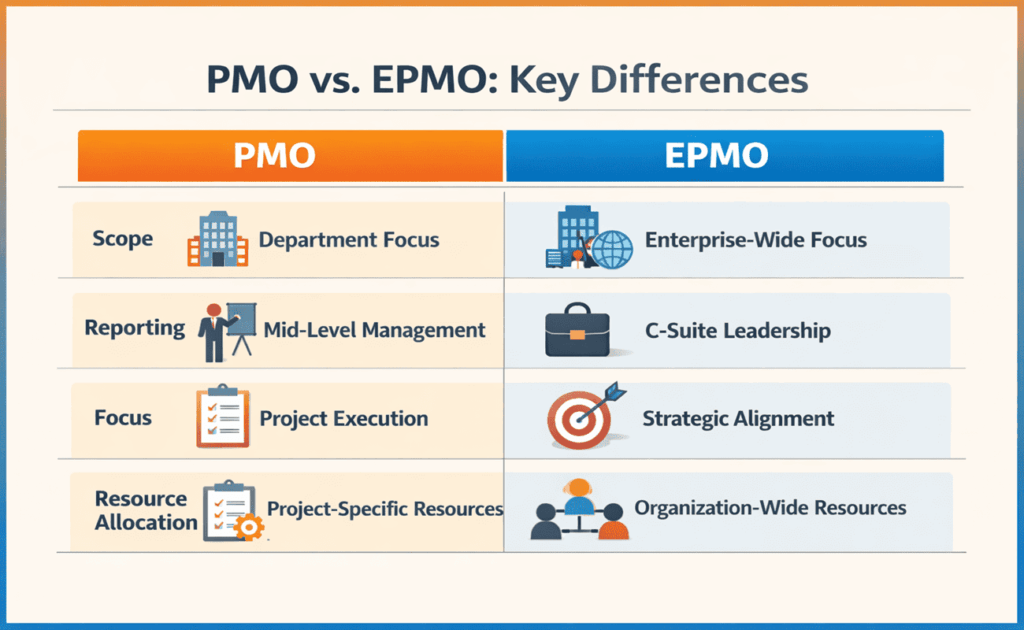
The following are the major differences:
- Scope – A PMO focuses on projects within one department, such as IT or marketing. An EPMO looks across the entire enterprise, coordinating multiple portfolios.
- Reporting – PMOs usually answer to mid-level managers, while EPMOs report directly to the C-suite. That proximity gives them more influence over strategy.
- Focus – PMOs are tactical. They help teams execute tasks and meet deadlines. EPMOs are strategic. They align portfolios with long-term goals and advise leaders on where to invest.
- Resource allocation – A PMO manages resources within its department. An EPMO allocates people and budgets across the whole company, resolving conflicts and optimizing capacity.
Benefits of a PMO
Why bother creating a PMO? A well-run PMO delivers many benefits:
- Budget control – PMOs monitor spending to ensure projects stay within their approved budgets. They provide rules and templates for cost tracking so team members know how much they can spend.
- Better scheduling – A PMO develops realistic timelines and milestones. It closely monitors progress and works with teams to adjust schedules as needed.
- Improved communication – By acting as a liaison between project managers, executives, and other departments, a PMO reduces confusion and increases transparency. Clear communication helps projects move smoothly.
- Higher customer satisfaction – When projects finish on time and deliver promised features, customers feel valued. PMO processes ensure that teams meet quality and timing commitments.
- Fewer errors – Planning and risk analysis reduce surprises. PMOs forecast potential issues, allocate resources wisely, and choose methods that avoid delays.
These advantages make PMOs valuable to departments that manage many projects. They free up project managers to focus on delivering results rather than creating processes from scratch.
Benefits of an EPMO
An EPMO provides all the advantages of a PMO and adds strategic oversight. Key benefits include:
- Executive alignment – Because an EPMO reports to the C-suite, it aligns every project with the company’s vision. Leaders get a clear view of which initiatives support long-term goals.
- Standardization and governance – An EPMO creates enterprise-wide policies and procedures. Teams follow the same templates and reporting rules, making cross-department collaboration easier.
- Resource optimization – The EPMO allocates people and budgets across all portfolios. This high-level view prevents teams from fighting over resources and ensures that critical projects receive priority.
- Strategic decision support – Using data and scenario planning, the EPMO helps executives decide which projects to start, continue, or stop. It measures benefits and tracks return on investment even after projects finish.
- Risk management across portfolios – By overseeing many projects, the EPMO spots patterns and systemic risks that individual teams might miss. It develops mitigation plans to address them.
In short, an EPMO turns project management into a strategic tool. It ensures that time and money flow to projects that drive the most value.
When to Use a PMO Vs an EPMO
Choosing between a PMO and an EPMO depends on your organization’s size, complexity, and goals. Here are some guidelines:
- Small or focused departments – If your projects are limited to one area, a PMO is often sufficient. It standardizes processes and keeps teams on track without adding excessive bureaucracy.
- Growing or diverse portfolios – When multiple departments are running projects that compete for resources, an EPMO can provide coordination. It ensures alignment with the company strategy and resolves conflicts.
- Strategic misalignment – If projects start without a clear link to business goals or if leaders complain about wasted effort, an EPMO can help. It evaluates proposals, prioritizes work, and makes sure that only worthwhile projects move forward.
- Lack of visibility – When executives cannot see how projects are performing across departments, an EPMO provides dashboards and reports. It makes performance and risks visible to the whole leadership team.
- Resource conflicts and rapid change – An EPMO is valuable when teams compete for the same people or when business conditions change quickly. It reallocates resources and adjusts plans based on capacity and strategy.
Still unsure? Ask yourself: Does our current structure let us see the big picture? Do we know if our projects support our strategy? If the answer is no, an enterprise approach may be the next step.
FAQs
Q1. What are the main differences between a PMO and an EPMO?
A PMO manages projects within one department and reports to mid-level leaders. An EPMO coordinates all projects across the company and reports to the C-suite.
Q2. When should a company adopt an EPMO?
Consider an EPMO when projects span multiple departments, compete for resources, or lack clear alignment with corporate strategy. A mature enterprise needs centralized oversight.
Q3. What does an EPMO director do?
The director aligns portfolios with business goals, oversees governance, and advises executives on resource allocation. This role ensures that projects deliver strategic value rather than just outputs.
Summary
Choosing between a PMO and an EPMO depends on how an organization manages projects and aligns them with strategy. A PMO focuses on improving project delivery within a department, while an EPMO provides enterprise-level oversight and strategic alignment across portfolios. Both structures help standardize processes, improve resource management, and increase project success. As organizations grow and projects become more complex, many transition from a PMO to an EPMO to gain better visibility, stronger governance, and clearer alignment between projects and business goals.

I am Mohammad Fahad Usmani, B.E. PMP, PMI-RMP. I have been blogging on project management topics since 2011. To date, thousands of professionals have passed the PMP exam using my resources.