New York City never sleeps. Neither does the demand for skilled project managers. Businesses from Wall Street to Silicon Alley rely on professionals who can deliver projects on time and on budget. The Project Management Professional (PMP) credential remains the gold standard, and earning it requires 35 contact hours of formal education. If you’re a New Yorker or work in the region, you might wonder whether to attend a traditional boot camp or invest in an online course.
This article explains the benefits of PMP certification, shows how it can boost your career prospects and salary, and introduces a flexible training option — the PM Sprout 35-Contact-Hour PMP Training Program. Unlike expensive boot camps, this online program fits your schedule and budget while meeting all PMI requirements.
Does PMP Certification Really Increase Earnings?
A recent salary survey by the Project Management Institute (PMI) shows that PMP-certified project managers in the United States earn a median salary of $135,000, while their non-certified peers earn about $109,157. That’s a difference of roughly 24 percent. The survey also found that experienced PMPs—those certified for more than 10 years—earn a median salary of $173,000, illustrating the long-term payoff of certification.
The U.S. Bureau of Labor Statistics reports that the median annual wage for project management specialists was $100,750 in May 2024. This figure dwarfs the median wage for all U.S. occupations ($49,500), highlighting the financial advantage of entering this profession. Better yet, the BLS projects 6 percent job growth between 2024 and 2034, with about 78,200 job openings per year.
These numbers demonstrate that PMP certification doesn’t just look good on your résumé—it significantly improves your earning potential and job security.
Why Online Training Beats the Boot Camp Model
Traditional PMP boot camps often promise a pass guarantee, but they come with drawbacks. In-person classes are expensive, require travel, and pack days of intensive study into a short window. Online courses, by contrast, let you learn at your own pace without sacrificing quality.
The PM Sprout 35-Contact-Hour PMP Training Program offers:
- 100 percent online access: Study anywhere in New York—on your commute, during lunch, or at home.
- Video and text lessons covering the latest exam content outline (applicable in 2026) with clear explanations of predictive, adaptive, and hybrid methodologies.
- Hundreds of practice questions and a mock exam updated for the PMBOK Guide, Seventh Edition.
- A comprehensive formula guide with more than 85 examples to help with math-based questions.
- True/false statements and flashcards to reinforce key concepts.
- One-year access to the course portal, so you can review material as often as needed.
- Dedicated support: Ask questions in the forum or by email and get quick, personalized responses.
Many students choose online courses because they’re flexible and affordable. You control your pace and revisit lessons until you’re comfortable with the material. Even busy professionals working in Manhattan or remote employees across New York State can find time to meet the 35-hour requirement.
Aligning the Course with PMI’s Requirements
To take the PMP exam, you must document 35 contact hours of project management education. The PM Sprout program is delivered in partnership with PMSimplify, a PMI-Approved Authorized Training Partner. This means PMI recognizes your completion certificate, and the course content aligns with the latest exam content outline.
The training covers six major domains:
- PMI mindset and frameworks—Understanding how PMI defines project work and agile approaches.
- Building high-performing teams—Learning to define roles, establish ground rules, and empower team members.
- Initiating projects—Choosing the right methodology, planning scope, budget, schedule, and quality.
- Executing projects—Managing risks, delivering business value, and maintaining communication.
- Keeping teams on track—Developing leadership styles, managing conflicts, and promoting collaboration.
- Understanding business environment—Ensuring compliance, delivering benefits, and supporting organizational change.
This structure mirrors PMI’s exam blueprint, ensuring that nothing important is overlooked.
Salary Differences Among Project Managers
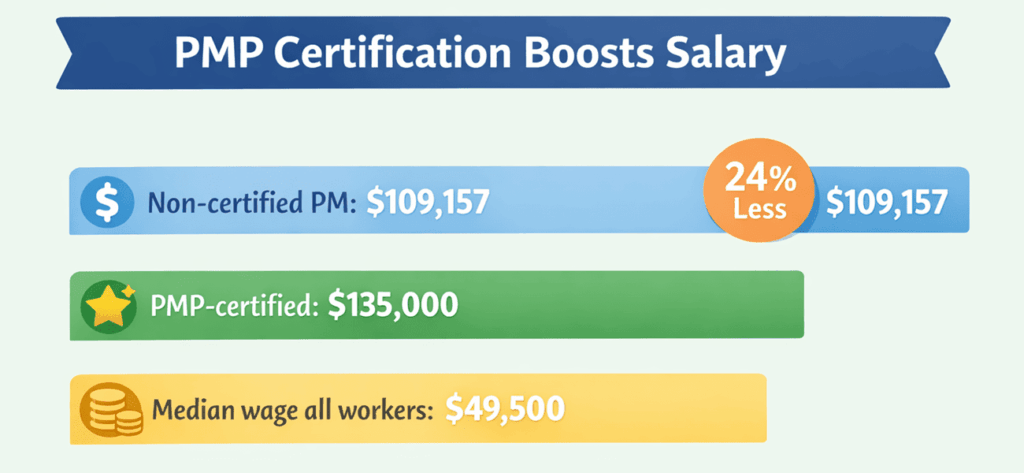
PMP certification can boost your salary. The infographic compares median earnings for non-certified project managers ($109,157), PMP-certified managers ($135,000), and the median U.S. wage ($49,500) based on PMI and BLS data.
Job Outlook and Career Growth
One reason professionals pursue PMP certification is that the field continues to expand. As organizations face complex projects—from software deployments to infrastructure upgrades—qualified project managers are indispensable. The BLS projects that jobs for project management specialists will grow by 6 percent between 2024 and 2034, which is faster than average. Roughly 78,200 new positions will open each year.
The job market is strong across industries. According to BLS data, median wages for project management specialists range from $96,700 in construction to $111,350 in finance and insurance. These figures show that project management skills are valued in both traditional and high-tech sectors.
Beyond job prospects, the PMI salary survey highlights that two-thirds of PMP-certified professionals received a pay increase during the past year, and three-quarters saw raises of up to 10 percent. Even as AI and automation reshape the workplace, PMI notes that organizations will need up to 30 million more project professionals by 2035. In short, now is an excellent time to invest in your professional development.
Why PMP Certification Matters
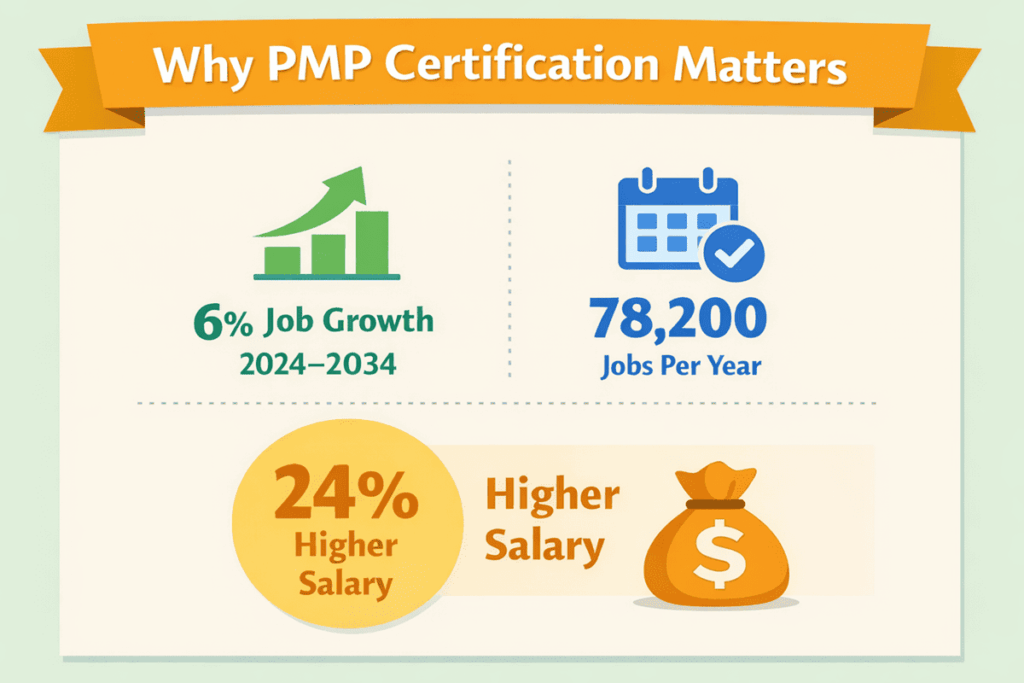
This graphic summarizes key career benefits: 6 percent projected job growth between 2024 and 2034, an average of 78,200 job openings per year, and a 24 percent salary advantage for PMP-certified professionals.
FAQs
Q1. What prerequisites do I need before taking the PMP exam?
You need a four-year degree (or equivalent), at least 36 months of project leadership experience within the past eight years, and 35 contact hours of project management education. The PM Sprout course satisfies the education requirement.
Q2. How long does the PM Sprout course take to complete?
You receive one year of access and can progress at your own pace. Many students complete the 35 hours in four to eight weeks by studying a few hours per week.
Q3. Is the course mobile-friendly?
Yes. You can access lessons on a desktop, tablet, or smartphone. The platform is responsive and remembers where you left off.
Q4. Does the course offer support?
Absolutely. You can post questions in the discussion forum or email the instructor. Responses are timely, and fellow students often provide advice.
Q5. What is the passing rate for students who take the PM Sprout course?
The creator reports that the vast majority of students pass on their first attempt, and there is a full year of access for revision and a mock test to gauge readiness.
Summary
PMP certification is more than a credential; it’s a pathway to career advancement, higher earnings, and long-term security. Recent data show that PMP-certified professionals earn significantly more than their non-certified peers and work in a field that continues to grow. If you’re in New York City—or anywhere in the world—looking to elevate your project management skills, consider the PM Sprout 35?Contact?Hour PMP Training Program. The online format fits your busy schedule and provides the tools to succeed.
Ready to take the next step? Enroll in the PM Sprout program here and start your journey toward becoming a certified project manager.

I am Mohammad Fahad Usmani, B.E. PMP, PMI-RMP. I have been blogging on project management topics since 2011. To date, thousands of professionals have passed the PMP exam using my resources.