
Productivity shows how much output you get from a given input. In simple terms, it tells you how efficiently people, teams, or machines produce results. A productivity calculator makes this easy. You enter output and input, click a button, and get the result right away.
Businesses use productivity metrics to track performance, compare teams, and improve resource use. Productivity is also defined as an output-to-input ratio, and labor productivity is often expressed as output per hour worked.
Productivity Calculator
Use this productivity calculator to find how efficiently work is being completed.
Productivity Calculator
How to Calculate Productivity
You can follow these steps to calculate productivity.
Step 1: Find the Output
Output is the total amount of work produced. It can be units made, sales completed, tasks finished, or services delivered.
Step 2: Find the Input
Input is the resource used to create the output. It can be labor hours, number of workers, money spent, or machine time.
Step 3: Apply the Productivity Formula
Use this formula:
Productivity = Output ÷ Input
Divide the total output by the total input.
Step 4: Calculate the Result
Use a calculator or the productivity tool above to find the answer.
Example:
Output = 500 units
Input = 100 hours
Productivity = 5 units per hour
Step 5: Interpret the Result
A higher result means better efficiency.
If productivity rises, you produce more with the same resources.
If productivity falls, you may need to review your process, tools, or staffing.
Productivity Formula
The productivity formula is simple:
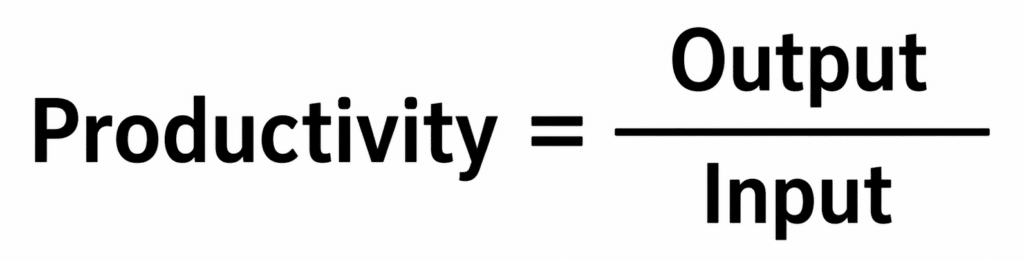
Here:
- Productivity = efficiency of production
- Output = goods or services produced
- Input = resources used to produce that output
Productivity Example
Imagine a factory produces 1,200 items in 8 hours.
Now calculate productivity:
Productivity = Output ÷ Input
Productivity = 1,200 ÷ 8
Productivity = 150 units per hour
What does this mean?
It means the factory produces 150 units every hour. If the factory improves its process and produces 1,400 items in the same 8 hours, productivity rises to 175 units per hour. That simple comparison helps managers track efficiency and spot opportunities for improvement. The idea aligns with standard labor productivity measures that compare output with hours worked.
Importance of Productivity
Productivity helps businesses understand how well they use time, labor, money, and equipment. It shows whether a process is efficient or wasteful. When you measure productivity often, you can spot weak areas early and make better decisions.
A productivity calculator saves time and reduces manual errors. It also helps managers compare teams, review process changes, and set realistic targets. Why guess when you can measure? Clear numbers make planning much easier.
FAQ
Q1. What is productivity?
Productivity is a measure of efficiency. It shows how much output you get from a given amount of input.
Q2. How do you calculate productivity?
You calculate productivity by dividing output by input.
Formula:
Productivity = Output ÷ Input
Q3. What is a productivity calculator?
A productivity calculator is a simple tool that helps you quickly find productivity using output and input values.
Q4. What are common productivity inputs?
Common inputs include labor hours, number of workers, machine time, materials, and operating cost.
Q5. Why is productivity important?
Productivity is important because it helps businesses improve efficiency, reduce waste, control costs, and increase profit.
Summary
Productivity is a simple but powerful measure of efficiency. It tells you how much output you get from the resources you use. With a productivity calculator, you can find results fast, reduce mistakes, and make better decisions. Whether you manage a factory, office, store, or project team, this metric helps you improve performance. Use it regularly to track progress, compare results, and find ways to work smarter.

I am Mohammad Fahad Usmani, B.E. PMP, PMI-RMP. I have been blogging on project management topics since 2011. To date, thousands of professionals have passed the PMP exam using my resources.