
Project management maturity is a key factor that determines how well an organization delivers its projects. Many teams struggle with delays, budget issues, and unclear processes because their project management practices are underdeveloped. Project management maturity helps organizations move from inconsistent, reactive approaches to structured and predictable methods.
As project management maturity improves, team members can plan and manage risks more effectively and deliver consistent results. Understanding project management maturity allows organizations to identify gaps and take practical steps toward improvement.
Whether you are a beginner or an experienced project professional, learning about project management maturity can help you increase efficiency, improve outcomes, and achieve long-term business success with greater confidence and control.
What is Project Management Maturity?
Project management maturity describes the extent to which an organization applies structured, repeatable processes to run projects. Mature organizations have standardized methods, trained professionals, and tools that enable data-driven decision-making. Immature organizations lack consistency and often reinvent the wheel on each project.
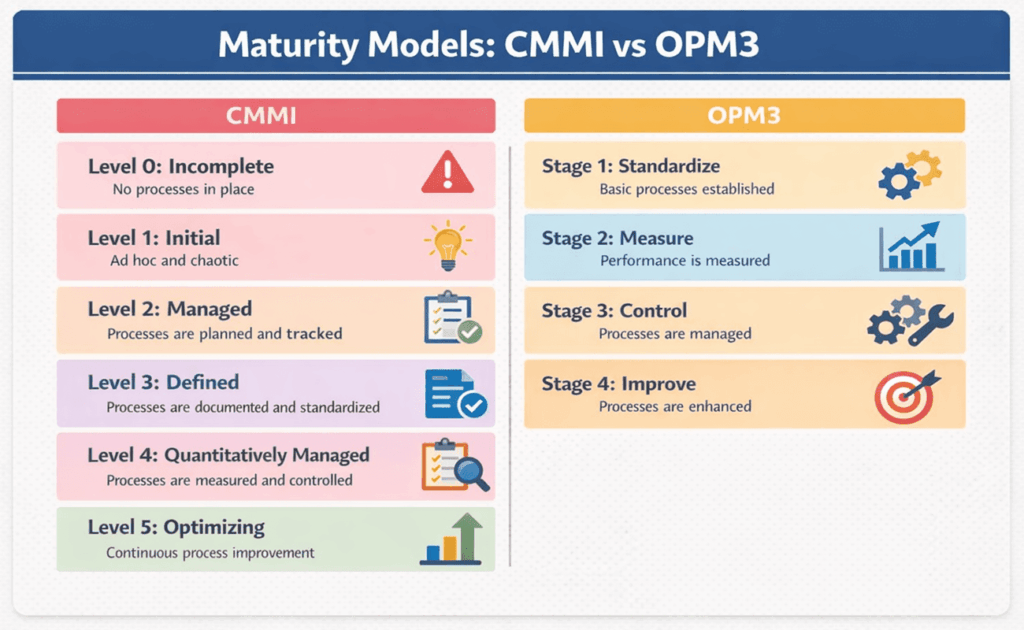
Many frameworks describe maturity. Two widely recognized models are Capability Maturity Model Integration (CMMI) and Organizational Project Management Maturity Model (OPM3). CMMI uses six levels, from Level 0: Incomplete (no consistent process) to Level 5: Optimizing, where continuous improvement is baked into the culture. OPM3 follows four stages: Standardize, Measure, Control, and Improve, helping organizations progress from defining processes to refining them. The infographic below summarizes the key stages in both models.
Why Maturity Matters
Project management maturity is important because it helps organizations deliver projects consistently and reliably. When maturity is low, teams often face delays, budget overruns, and unclear responsibilities. As maturity increases, processes become clear, repeatable, and easier to manage. This leads to better planning, stronger risk control, and improved communication among team members.
Mature organizations can also make faster, more informed decisions by using data and proven methods. Higher maturity improves project success rates and increases the likelihood of achieving business goals. It also builds trust with stakeholders, as results become more predictable.
In simple terms, project management maturity turns chaos into structure, helping organizations save time, reduce costs, and deliver better outcomes on every project.
How to Assess Your Organization’s Project Management Maturity
Assessing maturity starts with understanding current practices. Several approaches can help:
- Top-down surveys: Leadership interviews reveal the organization’s strategic goals, governance structure, and perception of project management effectiveness.
- 360-degree assessments: Engage project managers, team members, and stakeholders to gather a holistic view of processes, tools, and culture. This approach uncovers gaps between official policy and everyday practice.
- Process audits: Review documentation, templates, and historical project data to measure consistency. Look for evidence of planning, risk management, schedule control, and post-project reviews.
Use a combination of these methods to create a balanced picture. Once you know where you stand, compare your findings against maturity models such as CMMI or OPM3 to identify opportunities for improvement.
Making Sense of the Results
After an assessment, organizations often ask, “Now what?” Start by prioritizing the gaps that most affect project outcomes. If risk management is weak, invest in training and tools that help teams identify and respond to risks early. If schedule slips are common, focus on planning and resource management. Build a roadmap that includes short-term wins and long-term goals. Celebrate quick wins to maintain momentum, and revisit your roadmap regularly to adjust priorities.
Benefits of Improving Maturity
Raising project management maturity delivers wide-ranging benefits:
- Higher success rates: Mature organizations deliver projects that meet goals, schedules, and budgets far more often.
- Better ROI: Standardized processes reduce waste and improve resource utilization, resulting in a higher return on investment.
- Greater stakeholder satisfaction: Clear communication and consistent practices build trust with sponsors and customers.
- Improved morale: Team members in mature organizations report higher engagement and confidence because roles, processes, and expectations are clearly defined.
Practical Steps to Increase Maturity
- Invest in training: Provide accredited project management training (e.g., PMP® or CAPM) and continuous education on emerging methodologies.
- Standardize processes: Develop templates and guidelines for planning, risk management, change control, and lessons learned. Make them easily accessible.
- Measure performance: Track schedule adherence, budget variance, and stakeholder satisfaction. Use dashboards to visualize trends and drive data-driven decisions.
- Secure executive sponsorship: Active and timely leadership support correlates with higher success rates. Encourage sponsors to engage regularly in project decision-making.
- Adopt the right tools: Choose project management software that fits your organization’s size and complexity. Automate reporting to free up time for analysis and decision-making.
FAQs
Q1. How long does it take to improve project management maturity?
Many organizations see noticeable improvements within 6–12 months, but reaching higher maturity levels can take several years, depending on size and commitment.
Q2. Do we need a Project Management Office (PMO) to be mature?
While 82% of organizations have a PMO, only 37% are satisfied with their maturity. A PMO helps, but success depends more on executive support, clear processes, and continuous improvement than on structure alone.
Q3. Which maturity model should we use?
Choose the model that resonates with your organization’s culture. CMMI is process-focused, while OPM3 emphasizes organizational outcomes. Both provide guidance for continuous improvement.
Summary
Project management maturity helps organizations deliver projects with better results and less risk. When processes are clear and teams are well trained, success rates improve, and projects stay on time and within budget. By assessing current practices and making steady improvements, organizations can move from confusion to control. Start small, focus on key gaps, and build a culture of continuous improvement. Over time, higher maturity leads to stronger performance, better outcomes, and long-term business success.

I am Mohammad Fahad Usmani, B.E. PMP, PMI-RMP. I have been blogging on project management topics since 2011. To date, thousands of professionals have passed the PMP exam using my resources.