Your project’s success depends on knowing what you must build and how you will build it. Many professionals confuse the two and end up building the wrong thing. Requirements vs scope sound academic, but the distinction matters in the real world.
Think about a project that missed its goal. Was the need unclear, or was the work poorly defined? Requirements explain what stakeholders expect. Scope defines the work needed to deliver it. When you understand both, you reduce confusion, avoid rework, and keep your project on track from start to finish.
Key Takeaway
- Requirements state the need. They describe what stakeholders expect to get from the project.
- Scope defines the work. It outlines all the tasks needed to deliver the requirement.
- Clear definitions reduce scope creep. Projects with well-defined scope and requirements experience less scope creep and budget loss.
- High business acumen reduces failure. Project professionals with strong business skills report lower failure rates (8% vs 11%).
- Scope creep is common. In recent surveys, 41% of professionals listed scope creep or unrealistic deadlines as a main reason projects fail.
Understanding Project Requirements
Requirements describe what stakeholders need from the project. They capture the goals, conditions, and capabilities the product or service must meet. PMI defines a requirement as “a condition or capability that is required to be present in a product, service, or result to satisfy a contract or other formally imposed specification.
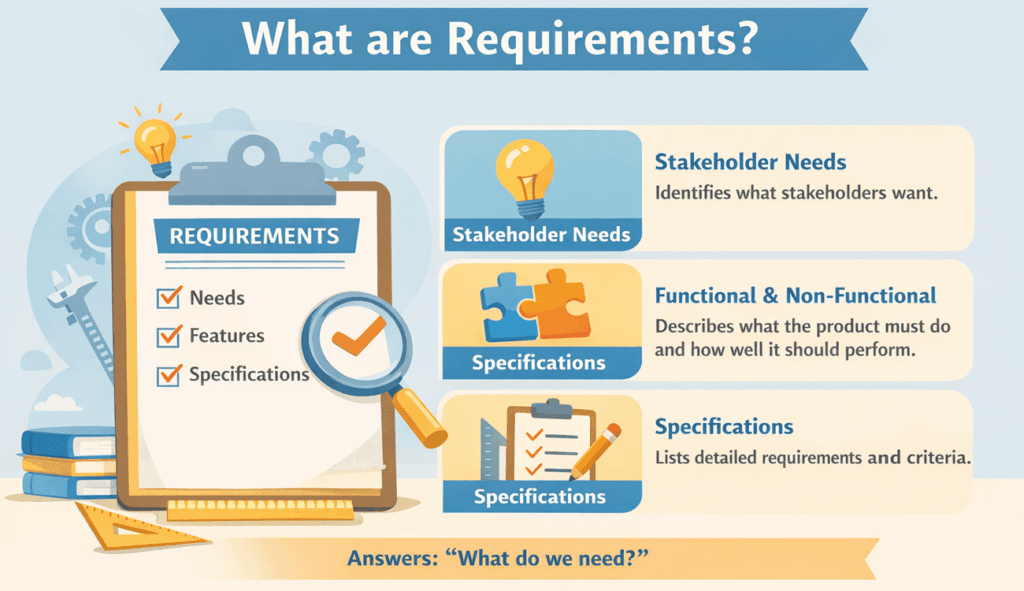
Requirements can be functional (what the product does) or non-functional (how the product behaves). For example:
- Functional requirement: A website must allow users to search a catalog of 1,000 books.
- Non-functional requirement: Search results should appear within two seconds.
Clear requirements align stakeholder expectations with project deliverables. Poorly defined or conflicting requirements cause rework, missed deadlines, and dissatisfied customers. Stakeholder interviews, surveys, observation, and prototyping help capture accurate requirements.
Why Requirements Matter
Without solid requirements:
- Developers build features that stakeholders never asked for.
- Teams waste time fixing misunderstandings rather than delivering value.
- Scope statements become meaningless, as the target is unclear.
A clear requirements document is a reference point for acceptance criteria and quality assurance. It also supports traceability; every requirement should trace to a deliverable and test, ensuring nothing is missed.
Understanding Project Scope
Project scope is the total work needed to complete a project. It explains what the team will deliver and what work they must do. It also shows what is included and what is not included. Think of scope as a clear boundary for the project. It helps the team stay focused and avoid extra work.

(PMI) defines scope as “the sum of the products, services, and results to be provided as a project”. In simple terms, scope covers the entire workload, from planning and design through delivery and closure.
For example, if you build a website, the scope includes design, coding, testing, and launch. It does not include future updates unless stated. A clear scope helps plan time, cost, and resources. It also prevents confusion and scope creep. When everyone understands the scope, the project runs smoothly and finishes on time.
Why Scope Matters
Scope acts as the boundary of the project. It sets expectations, guides resource allocation, and provides a baseline for measuring progress. A well-defined scope lets you:
- Build a work breakdown structure (WBS) that breaks the project into manageable tasks.
- Estimate cost and schedule more accurately.
- Manage change requests through a formal process.
- Communicate clearly with stakeholders about what is included and what is not.
When the scope is vague, projects are vulnerable to scope creep—uncontrolled additions of features or tasks. That’s why a scope management plan exists: to define, develop, and control the scope. We’ll explore that later.
Requirements Vs Scope: Key Differences
A requirement tells you why you are doing something. Scope tells you how you will do it. Mixing these concepts leads to confusion. For example, saying “we need to build a user interface and back-end” is scope, not a requirement. The requirement might be “users can view and update their account information securely.”

The terms are related but distinct. The table below summarizes the differences.
| Parameter | Scope | Requirements |
| Focus | The work required to meet the need. | The need or goal that stakeholders want to satisfy. |
| Nature | Detailed tasks, deliverables, and constraints. | High?level statements of expected outcomes. |
| Examples | Design booking interface, build back-end, test, deploy, and train staff. | “Allow customers to book appointments online.” |
| Purpose | Defines the project boundary, workload, and resource plan. | Aligns stakeholder expectations and guides solution design. |
| Change control | Changes are managed through a formal process to control cost and schedule. | Changes often originate from evolving business needs. |
Real-World Example: Mobile Banking App
A financial institution wants to offer customers a mobile banking app that lets them check balances, transfer funds, and pay bills on their phones. The requirement is clear: provide secure mobile access to banking services. The product is the mobile banking application. The scope includes designing the user interface, developing front-end and back-end code, integrating payment gateways, conducting security and usability testing, deploying the app to app stores, and training customer support staff.
If the requirement is vague, for example, say, “build an app that does everything our website does,” developers may include features like investment management or chatbots that were not requested. A clear requirement (“allow customers to view accounts, transfer money, and pay bills securely via mobile device”) guides scope definition. The project team then uses that requirement to plan tasks, budgets, and schedules. When new features are requested, a change control process evaluates impacts on cost and timeline.
Best Practices to Keep Your Project on Track
Clarity in requirements and scope doesn’t happen by accident. Adopt these practices to stay on track:
- Engage stakeholders early and often. Understand their needs, clarify ambiguities, and secure agreement on requirements before moving to detailed planning.
- Document everything. Write down requirements and scope in accessible documents. Share them with stakeholders and the team.
- Use a change control process. Treat every change as a decision. Evaluate its impact on cost, schedule, and quality, and obtain approval before incorporating it.
- Connect tasks to requirements. Maintain a traceability matrix that links each requirement to its tasks and deliverables. This prevents unnecessary work.
- Review and update regularly. Hold periodic scope and requirements reviews. Catch creeping changes early.
- Communicate clearly. Use simple language and visual aids (such as infographics) to explain the scope and requirements. This helps non-technical stakeholders understand what will be delivered.
Following these practices fosters transparency and accountability. Your team will spend less time firefighting and more time delivering value.
FAQs
Q1. What is the primary difference between project requirements and project scope?
Requirements describe what stakeholders need the project to achieve, while scope outlines the work and deliverables needed to satisfy those needs.
Q2. Can requirements change during a project?
Yes. Business needs evolve so that requirements may change. A change control process ensures that changes are evaluated and approved before they are added to the scope.
Q3. How does an unclear scope lead to project failure?
A vague scope invites scope creep, leading to schedule and budget slippage. Research shows that projects with poorly defined scope experience higher failure rates and budget losses.
Q4. What is scope creep?
Scope creep refers to uncontrolled growth in project scope. It happens when new tasks or features are added without adjusting time or budget. Scope creep is a leading cause of project failure.
Q5. Why should I create a requirements management plan?
A plan ensures requirements are gathered, prioritized, traced, and controlled. It reduces rework and aligns the project with stakeholder expectations.
Summary
Understanding requirements and scope helps you deliver the right result with less confusion. Requirements tell you what stakeholders need. The scope shows the work to meet those needs. When both are clear, you avoid rework, delays, and cost overruns. Projects stay focused, and teams work with confidence. Always define requirements first, then build a clear scope. Review both often and control changes carefully. This simple approach keeps your project aligned, efficient, and successful from start to finish.
This topic is important for the PMP exam.

I am Mohammad Fahad Usmani, B.E. PMP, PMI-RMP. I have been blogging on project management topics since 2011. To date, thousands of professionals have passed the PMP exam using my resources.