
Servant leadership plays an important role in modern Agile teams. Understanding the traits of servant leadership helps project managers build trust, improve collaboration, and support team growth. In Agile environments, leaders succeed when they guide, listen, and remove obstacles instead of controlling every task.
The servant leadership traits encourage humility, empathy, accountability, and strong communication. These qualities help teams stay motivated and focused on delivering value. When leaders focus on people first, team members feel empowered to share ideas and solve problems.
As a result, projects run more smoothly, innovation increases, and organizations can achieve better outcomes through stronger teamwork and shared responsibility.
What is Servant Leadership?
The term was coined by Robert K. Greenleaf in 1970. In his essay The Servant as Leader, Greenleaf argued that a true leader chooses to serve first and leads only after making that choice. Instead of commanding from above, a servant leader listens, supports, and removes obstacles so that team members can focus on their work. This people-centric mindset aligns naturally with Agile, which values collaboration, adaptability, and continuous improvement.
Servant Leadership Vs Autocratic Leadership
Autocratic leaders control every decision and expect unquestioning compliance. In high-risk environments like the military, this style can be effective. Yet in knowledge work and Agile product development, it often leads to poor morale and slow decision-making. Servant leaders, by contrast, view themselves as facilitators. They create conditions for success by listening, coaching, and letting the team self-organize. This approach builds trust and creativity, resulting in better products and happier teams.
Why Servant Leadership Matters in Agile
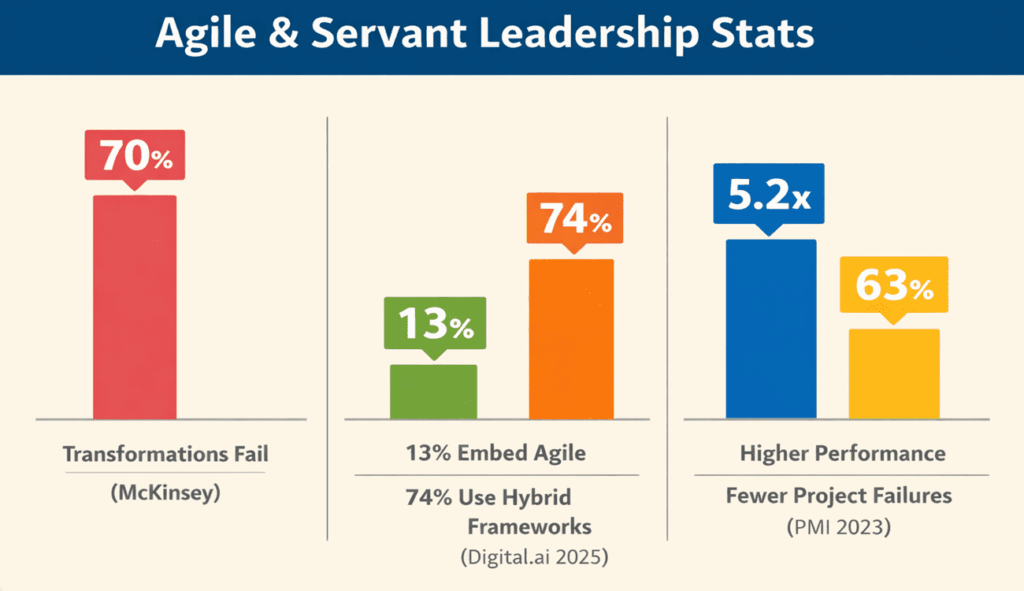
Agile frameworks like Scrum, Kanban, and XP encourage regular feedback, rapid iteration, and cross-functional collaboration. They thrive when people feel empowered. According to Digital.ai’s 2025 State of Agile analysis, only 13-% of organizations have deeply embedded Agile practices, and 74% rely on hybrid frameworks that mix Agile with other methods.
These numbers show that many teams struggle to fully embrace Agile. Servant leadership can bridge this gap by aligning leadership behaviors with Agile values. When leaders support rather than dictate, teams are more likely to successfully adopt Agile mindsets and practices.
Seven Key Traits of a Servant Leader
1. Humility
Servant leaders recognize that they don’t have all the answers. They invite diverse perspectives and acknowledge that success comes from the team’s collective effort. A humble project manager, for example, will admit mistakes and encourage honest feedback. This openness reduces fear and encourages continuous learning.
2. Active Listening
Listening isn’t just hearing words; it’s understanding needs. An Agile servant leader listens attentively during sprint retrospectives and daily standups. They ask clarifying questions, reflect on what they’ve heard, and follow through on action items. Such listening builds trust and helps uncover hidden obstacles.
3. Seeing the Value in People
Every team member brings unique strengths. Servant leaders take the time to understand individual skills and aspirations. They assign tasks that align with each person’s talents and provide opportunities for growth. For instance, when a quiet developer shows interest in facilitation, a servant leader might mentor them to run a future sprint review.
4. Trustworthiness
Trust is earned through consistent actions. Servant leaders do what they say they will do. In Agile, this could mean shielding the team from scope changes or management pressures so they can focus on delivering on their commitments. When leaders trust their teams to self-organize, team members reciprocate by taking ownership of their commitments.
5. Caring
Genuine care goes beyond polite conversation. It involves empathy and a willingness to support team members when challenges arise. Servant leaders look out for signs of burnout, encourage work-life balance, and celebrate achievements. Small gestures, such as acknowledging personal milestones or offering flexible hours during personal emergencies, create a supportive culture.
6. Accountability
Servant leaders hold themselves accountable to the team. Instead of blaming individuals when deliverables slip, they ask, “What could I have done to help?” This accountability models the behavior they expect from others. It encourages a culture where mistakes are seen as learning opportunities rather than failures.
7. Putting People First
Above all, servant leaders prioritize the needs of team members. They clear obstacles, provide resources, and advocate for their team’s well-being. In practice, this might involve negotiating more realistic deadlines, securing training opportunities, or handling conflicts promptly and fairly.
Servant Leadership and Agile Transformation
Why do so many organizations struggle to scale Agile? One major reason is leadership misalignment. Digital.ai’s research indicates that leadership involvement remains low, with only 15-% of leaders actively shaping Agile practices. Leaders who cling to command-and-control thinking inadvertently undermine Agile principles. By adopting servant leadership, executives demonstrate the humility and trust that Agile teams need to succeed.
Power Skills and Servant Leadership
Project Management Institute’s Pulse of the Profession 2023 report highlights how interpersonal skills influence outcomes. Teams that master so-called power skills such as communication, empathy, and leadership enjoy 5.2 times higher performance and 63% fewer project failures. Servant leadership inherently develops these skills. By listening actively, communicating clearly, and showing empathy, servant leaders strengthen collaboration and deliver better results.
Applying Servant Leadership in Your Agile Team
- Set a Clear Vision – Co-create a shared goal with your team. Instead of imposing targets, facilitate a discussion about what success looks like.
- Remove Obstacles – Ask team members during stand-ups and retrospectives what’s blocking them. Then act quickly to clear those roadblocks, whether it’s resolving dependencies, negotiating with stakeholders, or improving tooling.
- Encourage Self-Organization – Let teams decide how to accomplish tasks. A servant leader may guide planning and facilitate Scrum ceremonies, but they avoid micromanaging.
- Practice Transparent Communication – Share information openly with the team. Provide context for decisions and explain changes.
- Support Growth – Offer training, mentorship, and stretch assignments. Celebrate learning as much as delivery.
- Model Desired Behaviors – Demonstrate humility, accountability, and care in daily interactions. Team members will imitate what they see.
Handling Challenges and Criticism
Critics sometimes argue that servant leaders are too soft or risk enabling poor performance. It’s true that leaders must balance empathy with accountability. Servant leadership doesn’t mean avoiding tough decisions; it means making them in partnership with the team. For example, when performance issues arise, a servant leader provides candid feedback and supports improvement. If the team needs structure, the leader can introduce lightweight metrics or guidelines without reverting to command-and-control behaviors.
Putting It All Together
Servant leadership isn’t a trend; it’s a mindset that aligns with Agile values and addresses the challenges of modern project management. When leaders serve their teams by listening, trusting, and clearing paths, teams become more resilient and innovative. That’s why organizations that cultivate these power skills see dramatic improvements in performance and lower failure rates. As Agile adoption expands and AI reshapes workflows, servant leadership will remain vital.
FAQs
Q1. What makes servant leadership different from other leadership styles?
Servant leaders put the needs of the team before their own. They listen, support, and remove obstacles rather than directing every action. This creates trust and encourages collaboration.
Q2. How does servant leadership help Agile teams?
Agile teams thrive on autonomy and continuous improvement. A servant leader empowers teams to self-organize, facilitates communication, and advocates for the resources they need to deliver value.
Q3. Is servant leadership only for project managers?
No. Anyone in a leadership position, Scrum Masters, product owners, or executives can adopt servant leadership principles. The core idea is to serve the team and achieve shared goals.
Q4. What are some first steps to becoming a servant leader?
Start by practicing active listening and humility. Ask your team what they need and take action to support them. Reflect on your own behavior and be willing to adjust your style.
Summary
Servant leadership plays a vital role in building strong Agile teams and improving project outcomes. By practicing the key traits of servant leadership, such as humility, listening, accountability, and empathy, leaders create an environment where teams feel supported and empowered. This leadership style encourages collaboration, continuous improvement, and shared responsibility. When leaders focus on serving their teams rather than controlling them, productivity and trust grow. Ultimately, adopting the traits of servant leadership helps organizations deliver value faster and achieve lasting project success.

I am Mohammad Fahad Usmani, B.E. PMP, PMI-RMP. I have been blogging on project management topics since 2011. To date, thousands of professionals have passed the PMP exam using my resources.