Thinking about “What Does a PMP Do?”
Have you ever wondered how massive construction projects or complex software launches stay on schedule when everything around them keeps changing? The secret often lies with a Project Management Professional (PMP) who plans, leads, and delivers projects with precision.
The role of a PMP continues to evolve alongside emerging technologies and changing work patterns. This guide unpacks what a PMP does, why the certification matters, and how it can boost your career.
Across industries—technology, healthcare, construction, and finance—PMP-certified leaders keep teams aligned, manage risks, and communicate with stakeholders. According to the Project Management Institute, project management specialists earned a median salary of $100,750 in May 2024. Demand for professionals with project management skills will grow by 33 percent across 11 countries by 2027.
The PMP credential helps experienced managers stand out, but it’s not just about prestige—it’s about learning practices that drive project success.
Let’s dive in.
What is a PMP?
A Project Management Professional (PMP) is a person who holds the PMP certification from the Project Management Institute (PMI) USA. This credential validates your ability to oversee scope, schedule, cost, quality, risk, and team dynamics across sectors. You need either a four-year degree plus 36 months of project experience and 35 hours of training, or a high-school diploma/associate degree plus 60 months of experience and 35 hours of training. You must then pass a rigorous exam covering traditional, Agile, and hybrid methodologies.
Globally, more than 1.6 million professionals hold a PMP certification, and the number continues to rise as businesses seek proven leaders. The PMP is not required for every project management role, but it demonstrates mastery of industry-accepted practices. The credential also holds value internationally; PMI’s salary survey showed that PMP holders earn an average of 33 percent more than non-certified peers across 21 countries.
What Does a PMP Do: Core Responsibilities of a PMP
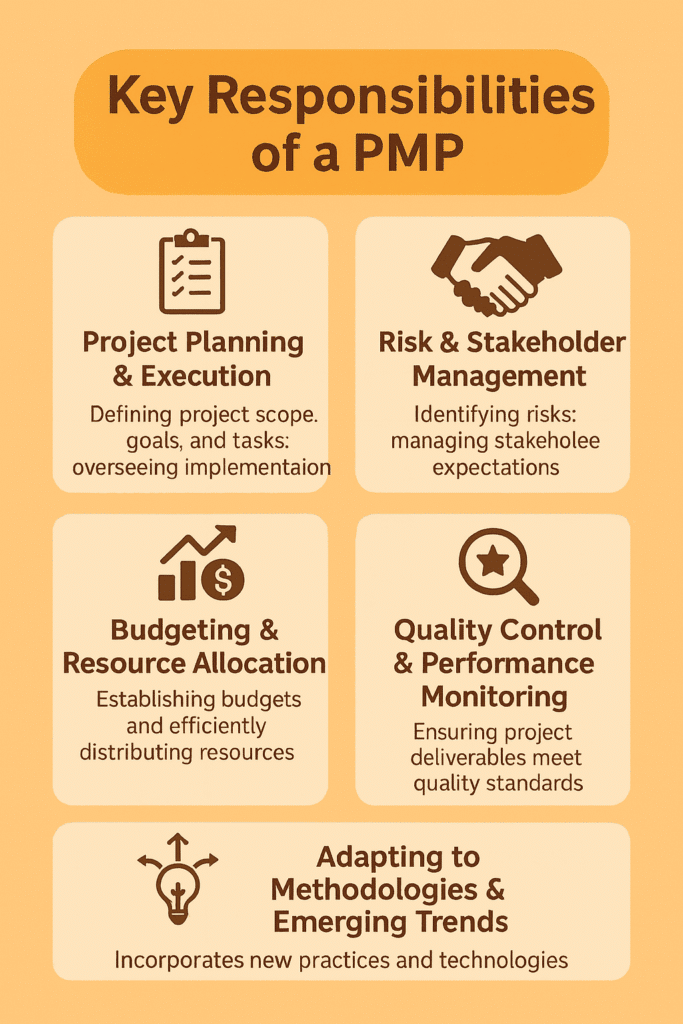
PMP-certified managers take on varied duties. Their primary mission is to deliver projects on time and within budget while meeting stakeholder expectations. Below is a summary of key responsibilities with examples.
| Responsibility | What it Involves | Example |
| Project planning & execution | Defining goals, creating schedules, and assigning tasks to keep work aligned with business objectives. | Developing a software rollout plan that includes milestones, resource needs, and a communication schedule. |
| Risk & stakeholder management | Identifying potential risks and managing expectations through clear communication. | Conducting a risk workshop to prioritize threats and engaging clients through weekly updates. |
| Budgeting & resource allocation | Controlling costs and ensuring resources are used efficiently. | Monitoring material spending for a construction project and adjusting allocations to stay within the $10 million budget. |
| Quality control & performance monitoring | Tracking progress and ensuring deliverables meet agreed standards. | Reviewing code quality metrics at each sprint review and implementing improvements. |
| Adapting methodologies & embracing trends | Integrating Agile, hybrid, and emerging practices to enhance efficiency. | Blending Scrum with Waterfall elements to tailor a marketing campaign and adopting AI tools for status reporting. |
Visualizing the Role
The diagram below illustrates these core responsibilities. Each segment highlights a key focus area for a PMP.
Daily Activities
The U.S. Bureau of Labor Statistics notes that project management specialists typically coordinate budgets, schedules, and staffing, serve as a point of contact for clients, and supervise technical teams. They monitor milestones, review vendor contracts, and lead meetings. During execution, they adjust plans to address changing needs, track costs, and ensure documentation is complete. While the job often takes place in an office, many PMP-certified managers travel to client sites and may work longer hours when deadlines loom.
Emerging Trends in Project Management
Project management is not static. New technologies and work patterns reshape how PMPs operate. Understanding these trends helps you stay relevant.
Artificial Intelligence (AI) and Automation: AI tools analyze historical data, forecast delays, and automate routine tasks. Predictive analytics can identify resource bottlenecks and recommend optimal staffing levels. Virtual assistants handle reminders and generate reports, freeing managers to focus on strategic work. However, AI supplements rather than replace human judgment.
Data?Driven Decision?Making: Modern project managers rely on dashboards and analytics to track performance. Data analytics improves accuracy, reduces uncertainty, and highlights inefficiencies. Leveraging data helps PMPs detect problems early and adapt quickly.
Soft and Digital Skills: As technical tasks are increasingly automated, soft skills such as communication, problem-solving, and collaborative leadership become critical. Project leaders also need digital fluency—using PM software and AI tools effectively. Adaptability and emotional intelligence enable managers to guide teams through change.
Remote and Hybrid Teams: Remote work is here to stay. The Easy Redmine forecast for 2025 notes that project management will rely on remote and hybrid teamwork, AI-driven automation, and sustainability strategies. Managing dispersed teams requires clear communication, trust, and the right collaboration tools.
Sustainability and ESG (Environmental, Social, and Governance) Practices: Organizations are integrating sustainable practices into projects. Epicflow highlights that PM professionals can contribute to reducing emissions, minimizing waste, and enhancing well-being by aligning projects with ESG goals. Incorporating sustainability ensures projects create long-term value.
These trends influence how PMPs plan, execute, and lead. By embracing AI, data analytics, and sustainability while honing soft skills, you remain adaptable in an evolving landscape.
Why Get PMP Certified?
Earning a PMP certification is a significant investment in time and money.
However, the benefits are compelling.
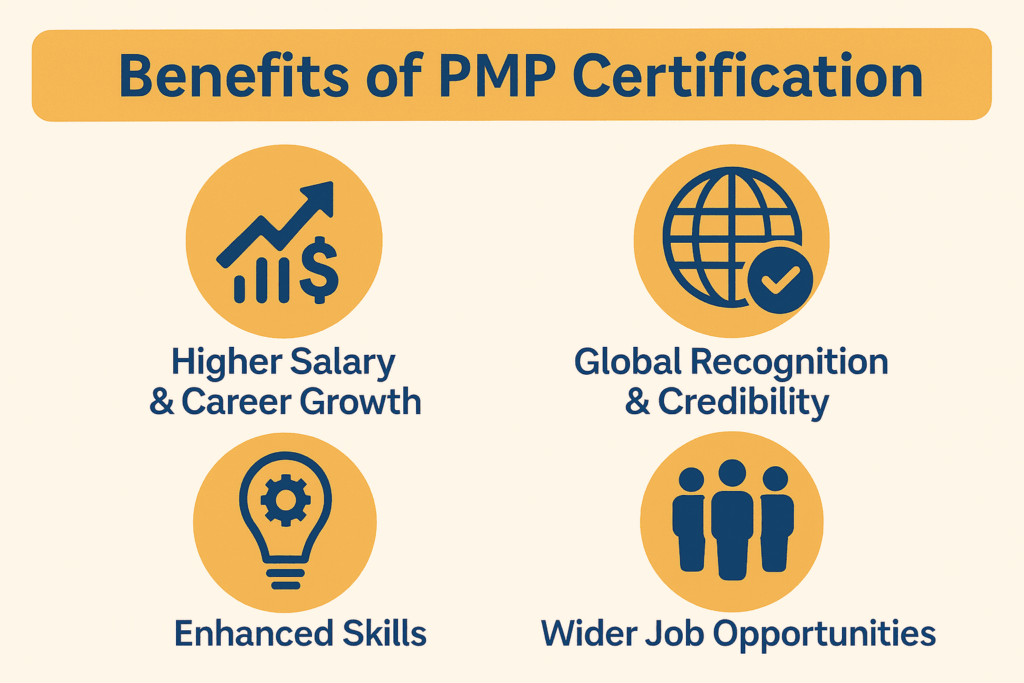
- Higher Salary and Career Growth: PMI’s 2023 Earning Power survey found that PMP-certified professionals earn 33 percent more on average than their non-certified peers across 21 countries. Another study shows that the median salary for PMP holders in the United States is $120,000, compared with $ 94,000 for project managers without the credential. BLS data also show a median pay of $ 100,750 for project management specialists in 2024.
- Global Recognition and Credibility: The PMP is recognized worldwide. Employers view it as evidence that you can lead complex cross-border projects. PMI estimates that 25 million new project management professionals will be needed globally by 2030.
- Enhanced Skills and Expertise: The PMP process exposes you to best practices in Agile, hybrid, and predictive methodologies. You learn to manage scope, cost, and quality while guiding teams through uncertainty.
- Wider job Opportunities: Many organizations list PMP certification as a requirement for senior project roles. Industries such as manufacturing, construction, information services, finance, and professional services are expected to create millions of new project-oriented jobs.
- Improved Efficiency and Productivity: Certified professionals adopt structured approaches that minimize waste, keep projects on schedule, and deliver results. Companies that invest in project management training achieve better outcomes.
The diagram below visualizes these benefits.
How to Become PMP Certified
Ready to pursue your PMP? The process involves meeting eligibility requirements, applying to PMI, studying and passing the exam, and then maintaining your credential.
- Check Eligibility: Verify that you have the required education and experience: either a four-year degree plus 36 months of project experience and 35 hours of project management education or a high school diploma plus 60 months of project experience.
- Apply through PMI: Submit your application, including documentation of your experience and education. PMI may audit your application, so prepare supporting documents.
- Prepare for the Exam: Use PMI’s PMBOK Guide, study courses, and practice exams. Training providers such as Project Management Academy offer exam preparation and 35 contact hours of education.
- Pass the Exam: The PMP exam consists of 180 questions covering people, processes, and business environments. PMI uses a psychometric scoring model; there is no fixed passing score.
- Maintain the Certification: Earn 60 professional development units (PDUs) every three years to keep your credential active. Activities like attending webinars, taking courses, or giving back to the profession count toward PDUs.
Career Paths and Industries
PMP-certified professionals work in many sectors. The BLS lists professional, scientific, and technical services (28 percent), construction (21 percent), manufacturing (7 percent), and finance and insurance (4 percent) as leading employers of project management specialists. In May 2024, there were roughly 1.0 million jobs in this field with a projected 6 percent growth through 2034.
According to a 2024 statistics roundup, 60 percent of project managers use a hybrid delivery approach combining Agile and Waterfall methods. The project management workforce is expected to grow 33 percent by 2027, and PMI projects a need for 25 million new professionals by 2030. Manufacturing and construction anticipate an increase of 9.7 million jobs, information services 5.5 million, and finance and insurance 4.6 million.
As companies digitalize and expand globally, PMP holders can move into roles such as program manager, portfolio manager, product owner, chief project officer, or independent consultant. They may lead cross-functional teams, manage project portfolios, or design strategic frameworks for entire organizations.
Tips for Success as a PMP
- Embrace Lifelong Learning: The field changes fast. Stay current through webinars, courses, and PMI publications. Use AI-driven tools to automate routine tasks and focus on strategic decisions.
- Develop Soft Skills: Strong communication, negotiation, and leadership skills build trust and keep teams aligned. Practice empathy and emotional intelligence to resolve conflicts and motivate people.
- Leverage Digital Tools: Use project management software to schedule, allocate resources, and collaborate. High-performing projects often use dedicated software.
- Promote Sustainability: Incorporate ESG principles by reducing waste, sourcing locally, and promoting diversity. Projects that align with sustainability goals create long-term value.
- Be Adaptable: Hybrid methodologies let you tailor processes to each project. Adjust your approach based on team size, complexity, and stakeholder needs.
FAQs
Q1. What does PMP stand for, and is it worth pursuing?
PMP stands for Project Management Professional. It validates your ability to lead projects and is widely respected. PMP holders earn about 33 percent more than non-certified peers, so it’s a wise investment.
Q2. How long does it take to become PMP certified?
Preparation time varies. Most people spend a few months completing the required education and studying for the exam. Once you pass, you must earn 60 PDUs every three years.
Q3. How much can a PMP earn?
In the United States, the median salary for a PMP is about $120,000, while project management specialists earn a median of $100,750.
Q4. Which industries hire PMP-certified professionals?
Top sectors include professional services, construction, manufacturing, finance, and information services. Global demand is growing, with millions of new roles anticipated by 2030.
Q5. Can AI replace a project manager?
AI automates tasks such as scheduling and data analysis, but human judgment remains essential. AI assists managers, but leadership, creativity, and empathy remain uniquely human skills.
Summary
Project Management Professionals keep projects moving forward even when deadlines slip, budgets tighten, and priorities shift. They plan, communicate, and adapt while balancing scope, cost, and quality. By earning the PMP certification, you demonstrate both expertise and a commitment to continuous improvement. With global demand for skilled project leaders rising, now is a great time to invest in your career. Are you ready to guide your next project to success? Start by exploring PMP training and take the first step toward becoming a certified project leader.
References:
Ready to start your journey to become a PMP? Enroll in PM Sprout’s top-rated online PMP training today and take the first step toward advancing your career.

I am Mohammad Fahad Usmani, B.E. PMP, PMI-RMP. I have been blogging on project management topics since 2011. To date, thousands of professionals have passed the PMP exam using my resources.