Projects are temporary; they must be completed within a defined duration and within budget while fulfilling stakeholder requirements. These three constraints are known as the “triple constraints in project management.”
Constraints are limitations that the project manager must overcome. These elements are interlinked, and managing them effectively is essential for the success of any project.
In this article, I will explain triple constraints in detail and provide strategies for balancing and managing them throughout the project lifecycle.
What Are the Triple Constraints in Project Management?
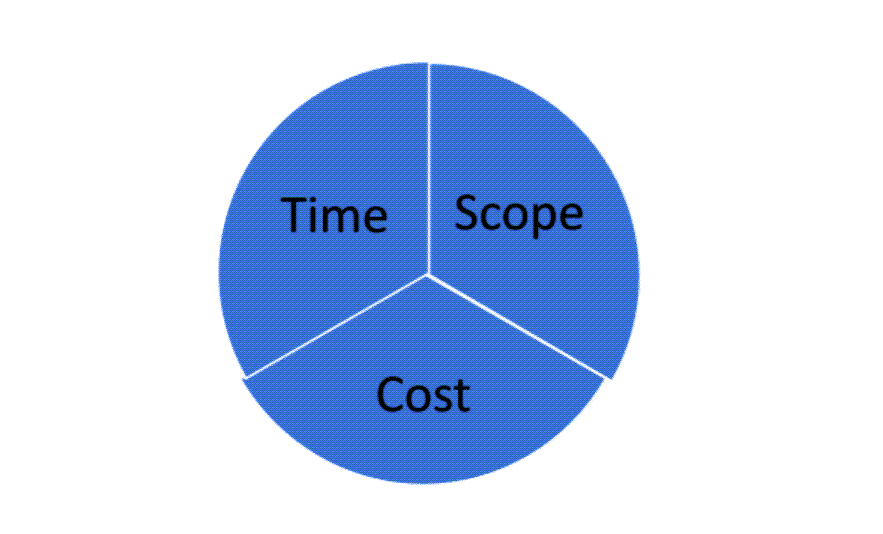
These triple constraints are often known as the project management triangle, where each side represents a constraint: scope, time, and cost.
You may have heard of “hexagonal constraints.” The hexagonal constraints are six project constraints: (1) scope, (2) time, (3) cost, (4) quality, (5) risks, and (6) resources.
The triple constraints have the biggest influence on the project objectives and are referred to as the primary project constraints. A project manager must manage these constraints, and in doing so, they may have to trade off one constraint for another within an acceptable tolerance.
For example, if you conduct unplanned training, you must speed up a few activities to accommodate the schedule.
Poorly managed projects may cause missed deadlines, cost overruns, poor-quality products, change requests, rework, and dissatisfied stakeholders. Therefore, project managers influence the constraints to meet the project success criteria.
1. Scope Constraint
Scope defines the goals, deliverables, and tasks required to complete a project. It outlines what is included in the project and what is excluded. The scope is crucial because it sets the boundaries and expectations about the project deliverable.
A poorly defined scope can lead to scope creep, in which additional tasks and features are added without adjustments in time or cost. This can negatively impact the project objectives.
In traditional project management, the scope is determined at the beginning of the project. The adaptive approach regularly uses customer input to refine the scope until the project is complete. Both approaches view customer satisfaction differently.
2. Time Constraint
Time refers to the schedule for the project’s completion. This includes the deadlines for individual tasks and milestones and the project deadline. Effective time management ensures that a project progresses on time and meets its deadlines. Delays can lead to increased costs and diminished stakeholder satisfaction.
Most projects do not meet their deadline. According to a paper by Health Management Technology titled Storm Warning: Danger Signs During Software Implementation, “only 16.1% of all Management Information System (MIS) projects are completed on time and within budget.”
The problem is not specific to traditional project managers. Other project methodologies have the same problem; however, Agile projects have time-boxed events to control the duration.
3. Cost Constraint
Cost involves the budget allocated for the project. This includes all financial resources required, including labor, materials, equipment, and overhead costs. Managing costs is critical to preventing budget overruns and ensuring the project is completed within its financial constraints. Mismanagement of costs can result in financial losses and project failure.
In Agile projects, you can manage costs by reducing the feedback cycle so that errors and technical debt do not degenerate. Disciplined Agile recommends a stable team, thus reducing costs associated with Tuckman’s Team development ladder.
In traditional project management, the ability to influence cost is highest at the initial stage of the project, so ensure the scope is well defined. As the project progresses, amending the scope becomes more costly.
You can use the following tools to manage cost constraints in projects:
- Alternative Analysis: This technique evaluates and selects alternative options for project execution (e.g., “Should I buy or lease a tool?)
- Earned Value Management: Earned value management combines scope, time, and resources to measure project performance.
- Cost of Quality: This includes prevention, appraisal, and failure costs. Prevention and appraisal costs reduce failure costs.
- Reserve Analysis: A contingency and management reserve analysis helps control the costs. Analyzing these reserves will give you an idea of how you are progressing.
What is the Triple Constraint Theory?
The triple constraint theory states that a project operates within time, cost, and schedule boundaries. A change in one constraint affects the other two constraints. For example, if the scope of work increases, the cost and the project duration will also increase. As a project manager, you are responsible for managing all aspects of the project and making tradeoffs.
How to Manage Triple Constraints
Now, we will discuss how to manage each constraint.
Managing Scope
The project scope includes the work required to complete the project.
Here is how you can manage this project constraint:
- Collect project requirements.
- Develop the scope of work.
- Create a scope baseline and get it approved.
- Carry out the work and keep comparing it against the scope baseline.
- Influence the factors that affect scope baseline changes.
- If any changes occur, then raise a change request and update the scope baseline.
If the scope is the client’s biggest priority, they might consider flexibility in cost and duration. In such a situation, you can make slight changes in schedule and cost without affecting the scope baseline.
Managing Time
You must complete the project before the deadline.
Here is how you can manage this project constraint:
- Break the work down to the activity level.
- Identify all activities.
- Determine the duration of all activities.
- Sequence all activities and determine the dependencies.
- Develop the project-schedule baseline and get it approved.
- Execute the project and monitor scheduled performance.
- Influence factors that affect schedule baseline changes.
- If any changes occur, then raise a change request and update the schedule baseline.
If the client’s biggest priority is the schedule, they must be flexible on cost and scope. In such a situation, you can make minor changes in cost and scope without affecting the schedule baseline.
Managing Cost
The project cost includes direct and indirect costs, such as materials, equipment, resources, offices, administration, and electricity.
Here is how you can control the cost constraint:
- Estimate the project cost and determine a budget.
- Monitor the expenses and compare them against the cost baseline.
- Influence the factors that affect cost baseline changes.
- If any changes occur, then raise a change request and update the cost baseline.
If the cost is the biggest priority for the client, they must be flexible on time and scope. In such a situation, you can make slight changes in schedule and scope without affecting the cost baseline.
Best Practices for Managing Triple Constraints
You can use the following best practices to manage triple constraints for your project:
- Follow the plan and influence the factors that affect changes. Avoid scope creep and gold plating. Properly communicate with the client.
- Prioritize constraints. This will help you make adjustments if changes in any baseline cannot be avoided. Get the project sponsor to agree to it.
- Follow the integrated change-control process to approve changes in any baselines.
Triple Constraint Examples
The following are two examples of triple constraints (one in construction projects and the other in software development projects).
Construction Project Example
- Scope: Building a new office complex with ten floors, including office spaces, a parking garage, and recreational facilities.
- Time: The project is planned to be completed in 18 months.
- Cost: The budget is set at 10 million USD.
- Example Interaction: If the project deadline is moved up by three months (i.e., time decrease), the project might require additional labor or overtime work (i.e., cost increase), or the scope might need to be reduced by cutting non-essential facilities.
Software Development Project Example
- Scope: A company plans to develop a new customer relationship management (CRM) system with specific features (e.g., customer data management, sales tracking, and automated email marketing).
- Time: The project is scheduled to be completed in six months.
- Cost: The budget is set at 500,000 USD.
- Example Interaction: If additional features are requested (i.e., scope increase), then the project may need more time to complete, additional funds, or both. Conversely, if the budget is cut, the project may need to be scaled down in scope (i.e., scope decrease) or expedited (i.e., time decrease), which could affect quality.
Summary
Understanding and managing the triple constraints in project management is crucial for project success. These interdependent elements form the core framework that will guide you through planning, executing, and controlling projects. Balancing these constraints will require careful planning, effective communication, and proactive conflict resolution. Adjustments made to one constraint will impact others; therefore, you must monitor and adapt to ensure that project objectives are met.
Mastering the triple constraint dynamics can help you better manage challenges, optimize resources, and complete the project.

I am Mohammad Fahad Usmani, B.E. PMP, PMI-RMP. I have been blogging on project management topics since 2011. To date, thousands of professionals have passed the PMP exam using my resources.