Confusion about the project manager vs product owner distinction is common in today’s Agile and hybrid workplaces. Professionals often wonder: Who sets the priorities? Who manages the budget? Who defines the product vision? Understanding these roles is critical for team alignment, project success, and career growth.
This definitive guide clarifies the responsibilities, skills, differences, and career paths for both positions—backed by current data, real-world examples, and actionable advice. Whether you’re deciding which role to pursue or looking to improve team collaboration, you’ll find clear answers here.
Let’s get started.
What Does a Project Manager Do?
A project manager plans, organizes, and guides a project from start to finish. Their main job is to make sure the project meets its goals on time and within budget. They define the project scope, set clear objectives, and create a realistic schedule. A project manager also estimates costs and controls spending to avoid overruns.
They coordinate people, tasks, and resources so everyone knows what to do and when to do it. Clear communication is a key part of the role. The project manager shares updates, listens to concerns, and resolves conflicts quickly. They also manage risks by spotting problems early and taking action before issues grow.
During execution, the project manager tracks progress and adjusts plans when needed. At the end, they close the project, review results, and document lessons learned. By providing structure, clarity, and leadership, a project manager helps teams deliver successful outcomes and meet business goals.
What Does a Product Owner Do?
A product owner defines and protects the product vision in project management. Their main role is to make sure the team builds the right product that delivers real value to users and the business. They gather input from customers, stakeholders, and leaders, then turn those needs into clear product requirements.
The product owner creates and manages the product backlog. They write user stories, rank features by priority, and decide what the team should work on first. This helps the team focus on the most valuable work. The product owner also works closely with the development team, answering questions and giving fast feedback during each iteration.
Throughout the project, the product owner reviews completed work and accepts or rejects it based on agreed-upon goals. By balancing business needs, customer value, and technical effort, the product owner guides the product toward successful outcomes.
Key Differences Between Project Manager and Product Owner
While both roles aim to deliver value, they operate in different ways. A project manager plans and executes a project from start to finish. She manages the budget, timeline, scope, and risk. She is accountable for meeting the contract and satisfying stakeholders. In contrast, a product owner crafts the product vision, communicates it to the team, prioritizes features, and ensures every release improves customer satisfaction. He or she does not assign tasks or control the schedule; instead, the team self-organizes to build what the product owner describes.
Side-by-Side Comparison: Project Manager vs Product Owner
| Parameter | Project Manager | Product Owner |
| Primary Focus | Project delivery (on time, on budget, within scope) | Product value (maximizing ROI and user satisfaction) |
| Success Metrics | Schedule adherence, budget compliance, and scope fulfillment | User adoption, customer satisfaction, business value delivered |
| Key Responsibilities | Planning, scheduling, risk management, resource allocation, stakeholder reporting | Backlog management, user story definition, prioritization, acceptance testing |
| Leadership Style | Directive, coordinative, control-oriented | Visionary, collaborative, inspirational |
| Main Stakeholders | Internal teams, executives, clients, vendors | Customers, developers, marketing, business stakeholders |
| Certifications | PMP, PRINCE2, CAPM | CSPO, PSPO, SAFe Product Owner/Product Manager |
| Common Tools | Microsoft Project, Jira (for timelines), Asana, Smartsheet | Jira (for backlog), Trello, Productboard, Aha!, Confluence |
| Time Horizon | Temporary (project lifespan) | Ongoing (product lifecycle) |
| Parameter | Project Manager | Product Owner |
Below is an infographic summarizing the key differences.

Both roles involve leadership, but their styles differ. Project managers tend to direct, coordinate, and control. Product owners inspire, align, and communicate the “why” behind the work. Understanding these distinctions helps teams avoid confusion and ensures that someone is always looking out for both the project’s health and the product’s value.
Shared Skills and Similarities
Despite their different focuses, project managers and product owners share several skills. They both need excellent communication. They must explain goals to diverse audiences, listen to concerns, and translate feedback into action. They also need leadership: motivating a cross-functional team requires empathy and clear direction. Organization is another shared trait; both roles handle competing priorities and must adjust plans as situations change.
Finally, both roles aim to deliver a return on investment. A project manager measures success by scope, time, and cost; a product owner measures success by user satisfaction and business value. When these professionals collaborate, they align vision with delivery and help their organizations succeed.
Job Outlook and Demand
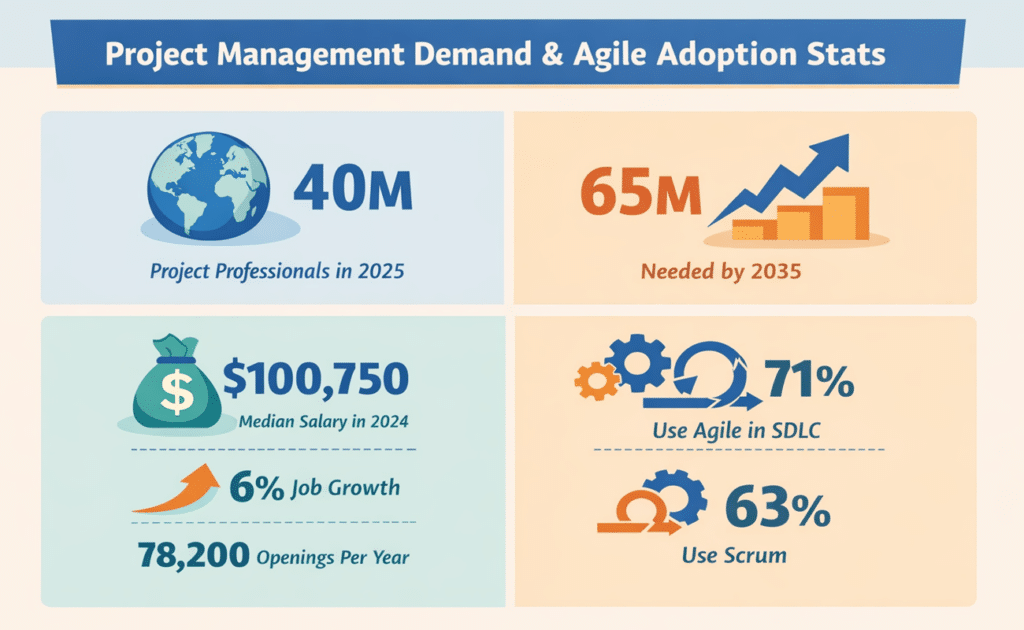
The demand for project professionals is rising worldwide. In 2025, there were nearly 40 million project professionals, and by 2035, organizations could need around 65 million, leaving a gap of up to 29.8 million professionals. This gap represents both a challenge and an opportunity for people entering the field. It underscores the importance of investing in training and professional development.
Agile adoption continues to expand. With more than 71 percent of teams using Agile practices and 63 percent relying on Scrum, companies need skilled product owners who understand customer needs and can translate those needs into prioritized backlogs. At the same time, the U.S. Bureau of Labor Statistics reports steady job growth and competitive salaries for project management specialists. These trends suggest that whether you choose a project manager or product owner path, career prospects are strong.
Below is a second infographic that distills these numbers into an easy-to-read visual. It highlights the current number of project professionals, projected demand, median salary, job growth rate, and the prevalence of Agile and Scrum.
Which Role is Right for You?
Choosing between a project manager and a product owner depends on your strengths and interests. Do you enjoy creating structure, building timelines, and solving logistical problems? If so, you may be drawn to project management. Do you enjoy envisioning new features, speaking with customers, and deciding what should come next? Then the product owner role might be a better fit.
Consider your certifications and experience. The Project Management Professional (PMP) credential demonstrates mastery of planning and control. The Certified Scrum Product Owner (CSPO) emphasizes Agile principles, customer collaboration, and value delivery. Earning one or both can help you decide which mindset feels more natural. Also, think about your work environment. Project managers often spend time with internal teams to optimize processes and resources. Product owners interact more with customers, sales, and marketing. They need negotiation skills and comfort with ambiguity. Reflecting on these preferences will guide your decision.
Industry context matters as well. Product-centric companies—particularly in software and technology—tend to empower product owners. Service-oriented firms may rely more on project managers to deliver client work. Compensation can also vary. Senior product owners may receive equity or performance bonuses, while project managers often receive higher base salaries. The right path is the one that aligns with your natural talents and motivates you to grow.
Essential Tools for Project Managers & Product Owners
Both roles rely on technology to collaborate, plan, and deliver. The following are the most widely used tools:
For Project Managers:
- Scheduling & Planning: Microsoft Project, Smartsheet, Asana
- Risk & Budget Tracking: RiskyProject, SAP Project System
- Communication: Slack, Microsoft Teams, Zoom
- Reporting: Power BI, Tableau, Jira Advanced Reports
For Product Owners:
- Backlog Management: Jira Software, Trello, Azure DevOps
- Roadmapping: Productboard, Aha!, Roadmunk
- User Feedback: UserVoice, Hotjar, SurveyMonkey
- Prototyping & UX: Figma, Miro, Balsamiq
Shared Platforms for Collaboration:
- Documentation: Confluence, Notion, Google Workspace
- Agile Ceremonies: Miro (for virtual retrospectives/sprint planning)
- Version Control: GitHub, GitLab (for tracking user stories and issues)
Tip: Many organizations now use integrated tool stacks (e.g., Jira + Confluence + Slack) to ensure seamless workflow between project execution and product development.
FAQs
Q1. Can one person serve as both a project manager and a product owner?
In small teams or startups, one person may temporarily fill both roles. However, this can create conflict between project constraints and product value. For clarity and focus, it’s recommended to separate the roles as the team grows.
Q2. Do project managers need Agile experience to work with product owners?
Yes. Even in hybrid environments, understanding Agile principles (Scrum, Kanban) improves collaboration. Many Project Managers now pursue Agile certifications like PMI-ACP® to bridge the gap.
Q3. Which role typically pays more: project manager or product owner?
Salaries vary by location, industry, and experience. According to recent data:
- Project Managers in the U.S. earn a median salary of $95,000–$115,000 (PMP® certified earn 20% more on average).
- Product Owners in tech hubs can earn $100,000–$130,000, often with equity or performance bonuses in product-led companies.
Q4. Is a product owner the same as a product manager?
No. A Product Manager focuses on market strategy, roadmap, and long-term vision. A Product Owner is a tactical role within an Agile team, managing the backlog and ensuring iteration goals are met. In some organizations, one person may wear both hats.
Q5. Can a project manager become a product owner?
Absolutely. Many Project Managers transition by gaining expertise in user-centered design, backlog refinement, and Agile ceremonies. Earning a CSPO® certification and seeking mentorship from senior Product Owners can ease the shift.
Q6. Which tools do both roles commonly use?
- Shared Tools: Jira, Confluence, Microsoft Teams, Miro
- PM-Specific: Microsoft Project, Smartsheet, Primavera
- PO-Specific: Productboard, Aha!, Roadmunk, UserVoice
Summary
Understanding the distinct roles of Project Manager and Product Owner is more than academic—it’s essential for delivering successful projects and products. While the Project Manager ensures disciplined execution, the Product Owner champions user value. Together, they form a powerful partnership that drives organizational growth.
As digital transformation accelerates and Agile adoption expands, the demand for both roles continues to surge. The projected global talent gap of 29.8 million project professionals by 2035—coupled with rising salaries—makes now an ideal time to invest in your career.
Ready to Take the Next Step?
- For aspiring Project Managers: Explore the PMI’s PMP Handbook and consider a structured course from platforms like Coursera or Udemy.
- For future Product Owners: Enroll in a Certified Scrum Product Owner (CSPO) workshop via the Scrum Alliance.
Whether you choose to specialize in projects or products, your ability to blend process with value will define your success. Start building your expertise today.
Summary

I am Mohammad Fahad Usmani, B.E. PMP, PMI-RMP. I have been blogging on project management topics since 2011. To date, thousands of professionals have passed the PMP exam using my resources.