
Every project carries uncertainty, and that is where quantitative risk analysis (QRA) becomes essential. It helps you measure risk using data rather than guesswork. With the quantitative risk analysis process, you can estimate both the likelihood of an event and its impact in clear numerical terms.
This risk management process makes decision-making easier and more reliable. Today, many organizations use quantitative risk management to address complex challenges such as cost overruns, delays, and market changes. When you apply quantitative risk analysis correctly, you gain better control over outcomes. You can plan smarter, reduce surprises, and improve results.
What is Quantitative Risk Analysis?
Quantitative risk analysis involves using mathematical models to estimate the likelihood and impact of potential events. Unlike qualitative methods that categorize risks as high, medium, or low, QRA translates each threat into a probability distribution. This approach lets you compare risks objectively and prioritize mitigation strategies.
For example, you might calculate the probability of a budget overrun based on historical cost data and forecasted delays. By combining these inputs, you can determine the likelihood of staying within budget and set aside a contingency fund.
Why Quantitative Risk Analysis Matters Today
The quantitative risk analysis process plays a key role in decision-making. It helps you understand risks using clear data, not guesses. With the quantitative risk analysis process, you can measure both probability and impact in numbers. This makes it easier to compare risks and set priorities.
You can plan budgets, timelines, and resources with more confidence. It also improves communication since numbers are easier to explain than opinions. Many organizations use the quantitative risk analysis process to reduce uncertainty and avoid costly surprises. It supports better planning and stronger control over outcomes.
Qualitative Vs Quantitative Risk Analysis
Both qualitative and quantitative approaches have their place. Qualitative analysis relies on expert judgment to rank risks, often using categories like “high,” “medium,” and “low.” It’s fast and inexpensive, but can be subjective. Quantitative analysis, on the other hand, uses numbers and models to estimate risk.
For instance, instead of simply labeling a delay as “high risk,” you would estimate there’s a 30% chance of a two-week delay and a 10% chance of a four-week delay. Combining the probability of the delay with its cost gives you the expected monetary value (EMV), a key metric in decision-making.
A simple way to illustrate the difference is to ask: would you rather know there is a “high” risk of a budget overrun, or that there is a 30% chance the project will exceed costs by USD 50,000? The latter figure, based on quantitative analysis, provides a clearer basis for action.
Key Steps in Quantitative Risk Analysis
A quantitative risk analysis process may involve the following steps:
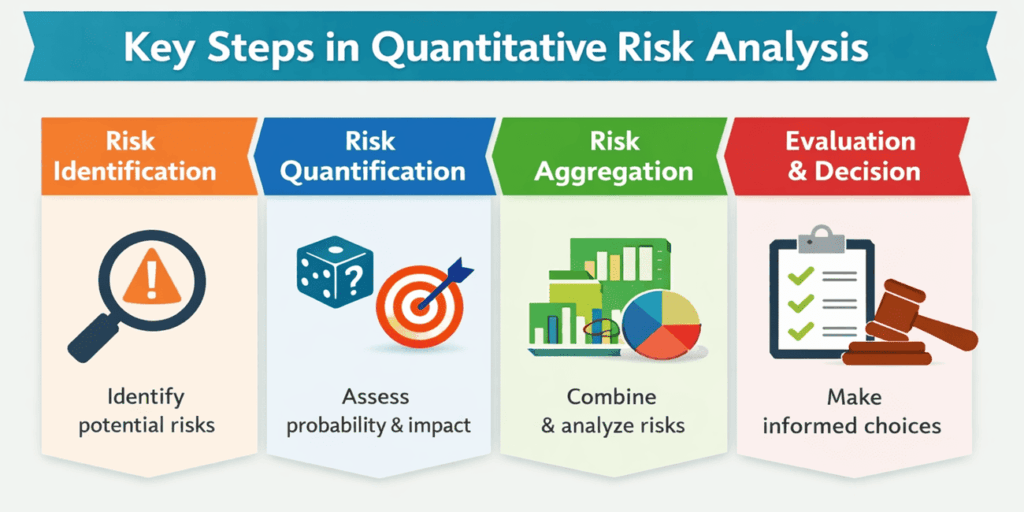
Identify Risks: Start by listing all potential events that could affect your project or investment. These might include cost overruns, schedule delays, regulatory changes, or equipment failures. Consult stakeholders and review historical data to build a comprehensive list.
Quantify Probability & Impact: For each risk, estimate how likely it is to occur and what the consequences would be. Use probability distributions (such as normal, triangular, or log-normal) based on data or expert input. Determine both the likelihood and the monetary or operational impact if the risk materializes.
Aggregate Risks: Individual risks rarely act alone. Combine all quantified risks to evaluate the overall impact on your project or portfolio. Monte Carlo simulations are a common way to aggregate risks and generate a range of possible outcomes.
Make Decisions: Use the results to prioritize risks, allocate resources, and develop mitigation strategies. Decision-makers can set contingency reserves, negotiate contracts, or redesign processes based on the quantified data.
Techniques Used in Quantitative Risk Analysis
Monte Carlo Simulation
Monte Carlo simulation runs thousands (or even millions) of scenarios using random inputs to model uncertainty. Each simulation produces an outcome, and together they create a distribution of possible results. This helps you understand the range of outcomes for project costs, timelines, or investment returns.
For example, when evaluating a construction project, a Monte Carlo simulation can estimate the probability of on-time completion under varying weather conditions, supply delays, and labor productivity rates.
Sensitivity Analysis
Sensitivity analysis measures how changes in individual variables affect the overall outcome. By tweaking one input at a time, you can identify which factors have the most influence on the result. This technique helps prioritize risk mitigation. If a schedule delay is highly sensitive to equipment availability, a manager might invest more in maintenance or redundancy.
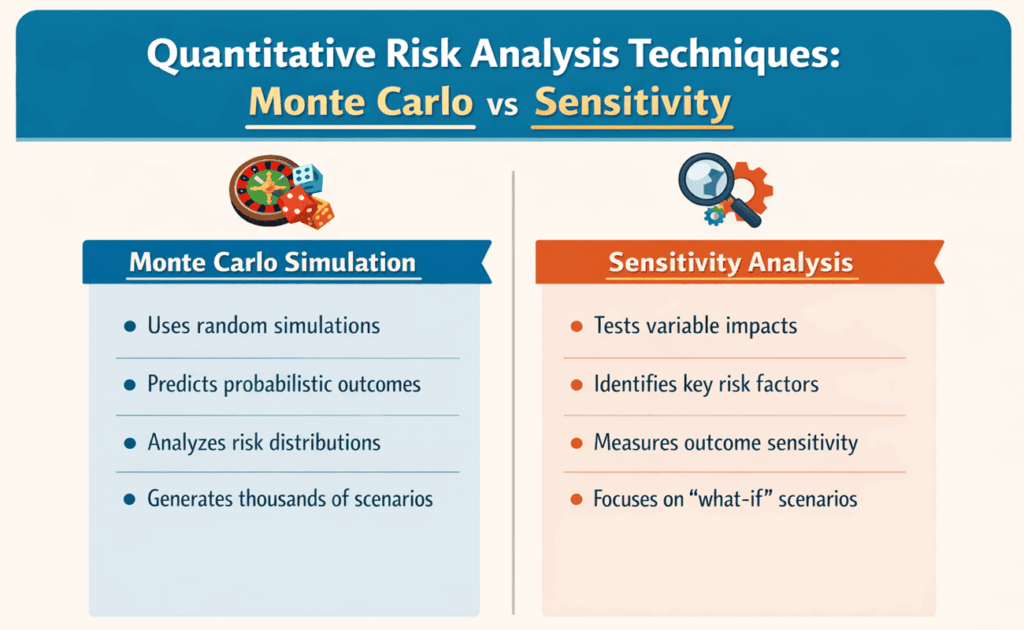
Sensitivity analysis is also useful for “what-if” scenarios, such as exploring how fuel prices impact profitability or how interest rate changes affect loan repayment.
Scenario Analysis
Scenario analysis involves building discrete scenarios, such as optimistic, pessimistic, and most likely, and assigning probabilities to each. Unlike Monte Carlo simulations that generate thousands of random scenarios, scenario analysis examines a small set of detailed stories. It’s a useful complement to other techniques when decision-makers need to explore specific, plausible futures, such as a severe economic downturn or a sudden regulatory change.
Decision Trees
Decision trees map out a series of choices and potential outcomes, including probabilities and payoffs. They help you visualize complex decisions and evaluate the expected value of each path. For example, a pharmaceutical company deciding whether to invest in clinical trials might use a decision tree to compare the expected cost and success probability of different development paths.
Benefits of Quantitative Risk Analysis
Quantitative risk analysis offers several advantages over purely qualitative approaches:
- Improved decision-making: By translating uncertainty into numbers, decision-makers can compare alternatives objectively and allocate resources effectively.
- Enhanced communication: Charts and probability distributions make risks easier to explain to stakeholders and investors.
- Prioritization: Quantified risks can be ranked by expected impact, ensuring that teams focus on the most significant threats.
- Objective approach: Numbers reduce the influence of individual bias and support consistent decision-making across projects.
- Strategic alignment: Quantitative insights can reveal where risk management processes need strengthening and how they can deliver a competitive advantage.
FAQs
Q1. What’s the difference between qualitative and quantitative risk analysis?
Qualitative analysis uses expert judgment to rank risks, while quantitative analysis assigns probabilities and values to estimate their impact.
Q2. Why should I use a Monte Carlo simulation?
Monte Carlo simulation produces a range of possible outcomes and their probabilities, helping you plan for best and worst-case scenarios.
Q3. Is quantitative risk analysis only for large projects?
No. Any project or investment with uncertainty, big or small, can benefit from quantifying risks and making informed decisions.
Q4. Can I perform quantitative risk analysis without specialized software?
Yes, but tools like @RISK automate the process, making simulations and sensitivity analyses easier to perform and interpret.
Summary
Quantitative risk analysis gives you a clear view of uncertainty. It turns complex risks into simple numbers you can act on. With this approach, you can plan better, reduce surprises, and improve results. It also helps teams make confident decisions based on data, not guesswork. As projects grow more complex, using quantitative methods becomes essential. When you apply these techniques, you stay prepared and in control. In the end, better risk insight leads to better outcomes and stronger project success.
Note: This process is important from the perspective of the PMP and PMI-RMP Certification Exams.

I am Mohammad Fahad Usmani, B.E. PMP, PMI-RMP. I have been blogging on project management topics since 2011. To date, thousands of professionals have passed the PMP exam using my resources.