
Direct damages in project and contract management are the immediate, measurable costs arising from a failure to meet contractual requirements. These damages are closely linked to the project’s scope, cost, and quality baselines. When a contractor delivers defective work, misses specifications, or abandons a project, the cost to repair, replace, or complete that work is classified as direct damages.
Direct damages help determine financial responsibility without complex assumptions. They include rework costs, replacement of nonconforming materials, additional labor, and expenses incurred to restore the project to its planned state. Unlike indirect losses, direct damages are predictable and easier to document through invoices, progress reports, and inspection records.
Understanding direct damages enables you to manage risk, enforce accountability, and protect the project budget. Clear contract clauses and proper documentation ensure that direct damages can be identified, justified, and recovered efficiently when disputes arise.
What is the Importance of Direct Damages?
The importance of direct damages lies in their role in protecting cost, schedule, and accountability. Direct damages represent the actual financial impact caused by a contract failure, such as defective work, incomplete scope, or non-performance. By clearly identifying direct damages, you can recover the exact cost required to restore the project to its agreed condition.
Direct damages are important because they provide clarity and fairness in disputes. They focus on measurable losses, which reduces disputes and accelerates resolution. From a cost-control perspective, tracking direct damages helps managers identify where failures occur and improve future planning, quality control, and vendor selection.
In contract management, direct damages support effective risk allocation. Well-defined direct damages clauses ensure that each party understands its responsibilities and consequences. Recognizing the importance of direct damages strengthens financial discipline, improves contract enforcement, and helps projects stay aligned with their original objectives.
Direct Damages Vs Consequential Damages
Direct and consequential damages differ mainly in how closely the loss is linked to the breach of contract.
Direct damages are the immediate and natural result of a failure to perform a contract. In project and contract management, they cover the cost required to fix, replace, or complete the work exactly as agreed. These damages arise directly from the breach and are usually easy to calculate and document.
Consequential damages, on the other hand, are indirect losses that occur as a secondary effect of the breach. They do not flow directly from the defective work itself but from its wider impact on business operations, such as lost profits or loss of use. Consequential damages often depend on foreseeability and are more difficult to prove.
Comparison Table: Direct Damages Vs Consequential Damages
| Basis of Comparison | Direct Damages | Consequential Damages |
| Nature of loss | Immediate and direct | Indirect and secondary |
| Link to breach | Arise directly from the breach | Arise as a result of wider effects |
| Predictability | Highly predictable | Less predictable |
| Measurement | Easier to calculate and document | Harder to quantify |
| Common examples | Repair costs, replacement costs, completion costs | Lost profits, loss of business, loss of use |
| Contract treatment | Commonly recoverable | Often limited or waived by contract |
| Project management impact | Affects cost and quality control | Affects revenue and business outcomes |
Common Direct Damages in Construction Projects
Common direct damages in construction projects are the immediate costs that arise when work does not meet contract requirements. These damages are directly linked to the contractor’s failure to perform as agreed and are usually easy to identify and measure.
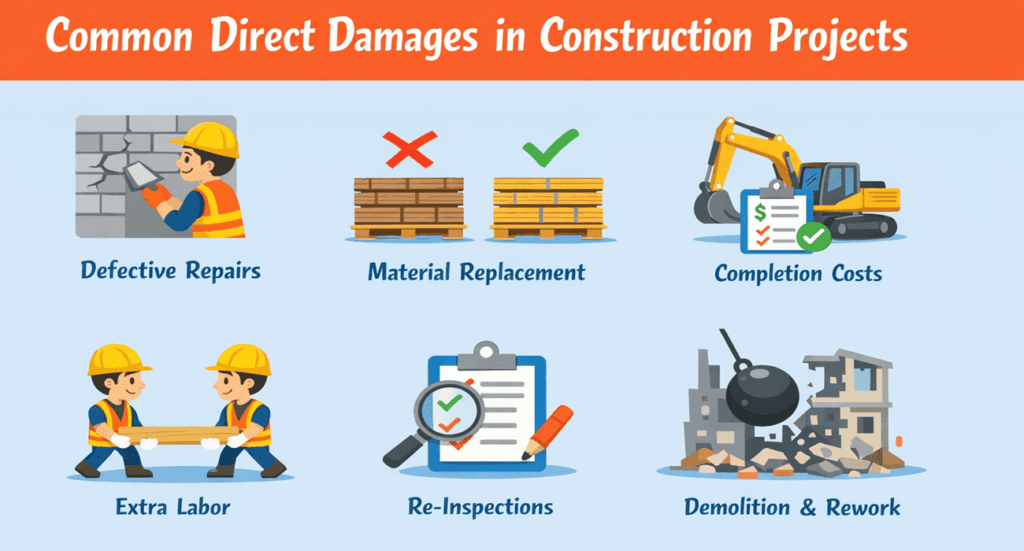
One common direct cost is the repair of defective work, such as correcting poor workmanship or design errors. Another is the cost of replacing non-conforming materials that fail to meet specifications. If a contractor abandons the project or is terminated, the additional cost to complete the work with another contractor constitutes direct damage.
Construction projects may also incur additional labor costs, re-inspection and testing fees, and demolition and rework expensesto bring the project back into compliance. In some cases, equipment reinstallation or temporary protection work also qualifies as direct damages. These costs flow directly from the breach and are essential to restoring the project to its intended condition.
How to Calculate Direct Damages
You can calculate direct damages by identifying the exact cost required to restore the project to its contractual position after a breach or failure. The focus is always on measurable, immediate losses.
First, review the contract scope and specifications to confirm the originally required deliverables. This establishes the baseline for comparison. Next, the actual performance is assessed through site inspections, quality reports, and progress records to identify gaps or defects.
Then, you calculate the cost to correct the problem, such as repairing defective work, replacing non-conforming materials, or completing unfinished tasks. These costs are supported by invoices, labor records, equipment logs, and subcontractor quotations. Only costs that would not have occurred without the breach are included.
Finally, all calculations are documented clearly to show a direct cause-and-effect link between the breach and the cost. This structured approach ensures that direct damages are accurate, defensible, and aligned with contract and project management principles.
Contract Clauses That Affect Direct Damages
Contract clauses that affect direct damages define who bears the cost, how damages are calculated, and whether recovery is limited. You must understand these clauses early on, as they directly affect cost recovery and dispute outcomes.
One key clause is the scope of work clause, which clearly defines what must be delivered. Any failure against this scope creates the basis for direct damages. The performance and quality standards clause also matters, as it determines whether work is considered defective or non-conforming.
The defect correction or warranty clause allows the owner to require repairs at the contractor’s cost, directly affecting direct damages. A termination-for-cause clause allows recovery of additional completion costs if a contractor fails to perform. The limitation of liability clause may cap the amount of direct damages recoverable, while a waiver of consequential damages clause indirectly strengthens claims for direct damages by narrowing what is excluded.
Together, these clauses control how direct damages are identified, measured, and enforced in project and contract management.
FAQs
Q1. Are direct damages always recoverable?
Direct damages are usually recoverable if clearly proven, properly documented, and directly linked to a contract breach. Recovery may still depend on contract terms and applicable law.
Q2. Do direct damages include lost profits?
No, direct damages do not include lost profits. Lost profits are typically classified as consequential damages because they arise indirectly from the breach.
Q3. Can direct damages be limited by contract?
Yes, contracts may limit direct damages through liability caps, exclusions, or specific clauses that restrict recovery amounts or define allowable cost categories.
Q3. Who decides what qualifies as direct damage?
Courts, arbitrators, or adjudicators decide what qualifies as direct damage by reviewing contract language, project facts, evidence, and the direct link between breach and loss.
Summary
Direct damages are a critical concept in project and contract management because they represent the real, immediate costs of contract failure. By understanding how direct damages arise, how they are calculated, and which contract clauses affect them, you can protect budgets and reduce disputes. Clear documentation, well-drafted contracts, and early corrective action make direct damages easier to manage and recover. When handled correctly, direct damages support accountability, fair risk allocation, and successful project outcomes.

I am Mohammad Fahad Usmani, B.E. PMP, PMI-RMP. I have been blogging on project management topics since 2011. To date, thousands of professionals have passed the PMP exam using my resources.