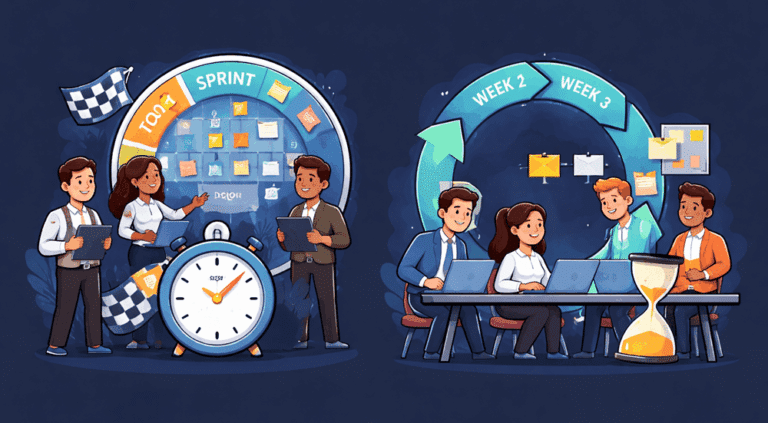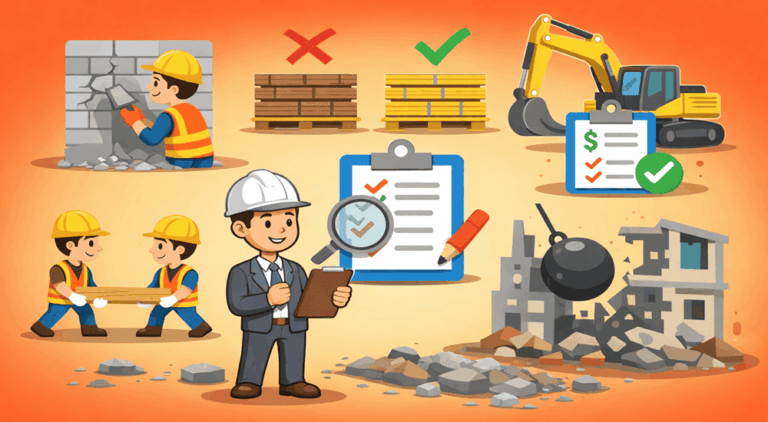
Project risk can make or break your success. Many professionals struggle to understand different types of risk, especially variability and ambiguity risk. These two are often confused, even by experienced project managers. Yet, knowing the difference helps you plan better and avoid surprises.
Variability risk concerns known factors that change, while ambiguity risk stems from missing information. Both types of risks need different strategies.
In this blog post, you will learn clear definitions, simple examples, and practical ways to manage them. Whether you’re preparing for the PMP exam or managing real projects, this guide will help you make smarter decisions and reduce uncertainty.
What is Project Risk?
Project risk is any uncertain event or condition that can affect a project’s goals. It can impact scope, time, cost, or quality. Risk is not always negative. Some risks create opportunities for better results. Every project has risks because the future is never fully known.
You must identify risks early and plan how to handle them. You have to analyze the likelihood and impact of each risk. Then, decide whether to avoid, reduce, transfer, escalate, or accept it. Regular monitoring helps keep risks under control. Managing project risk well improves decision-making and increases the chance of project success.
Four Types of Project Risk
Not all risks are the same.
PMI describes four categories of project risk:
- Event risk: Future events that may or may not occur but would affect objectives if they do. Examples include a supplier going out of business or a stakeholder requesting a major change.
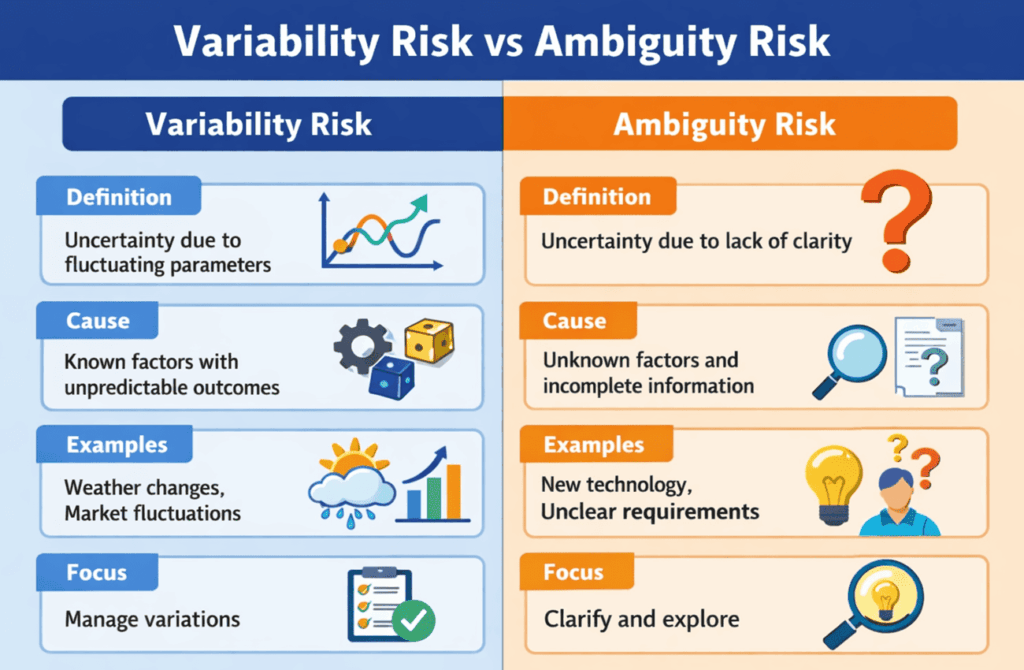
- Variability risk: Uncertainty from known variables, such as how long a task will take or how many defects might appear. The outcome is certain, but the exact value is not.
- Ambiguity risk: Uncertainty caused by a lack of knowledge. New technology, unknown requirements, or unclear regulations create ambiguity.
- Emergent risk: Unknowable events outside current experience. These “unknown unknowns” arise from blind spots and are often unpredictable.
Event and emergent risks are about whether something will happen. Variability and ambiguity risks are about how much and how well we understand. Knowing the difference helps project teams choose the right tools.
Why Risk Classification Matters
Risk classification helps you understand different types of uncertainty in a project. When you group risks clearly, you choose the right response for each one. For example, variability risks need better estimates, while ambiguity risks need more research. Without classification, teams may use the wrong strategy and waste time or money. It also improves communication, as everyone understands the type of risk and its impact.
Clear classification helps prioritize risks based on urgency and effect. It supports better planning and decision-making. In the end, proper risk classification reduces surprises and increases the chances of project success.
Deep Dive: Variability Risk
Variability risks come from uncertain ranges of known variables. You know a task will be performed, but the precise value, such as time, cost, or error count, could fall anywhere between a minimum and a maximum.
For example, a trial scheduled for 20 days might run as short as 15 days or as long as 30 days. Other variability risks include fluctuating productivity, changes in currency rates, or unusual weather conditions.
Pros: Variability risks are predictable. Because you can estimate ranges, you can build contingency buffers and even use quantitative models like Monte Carlo simulations. A model helps narrow down the range and identify worst-case and best-case outcomes.
Cons: These variables are not controllable. If you underestimate the spread, your project may run over schedule or budget. Estimation must be an ongoing practice. Failing to refine estimates increases the chance that variability derails the plan.
How to Manage Variability Risks
- Improve estimates: Use historical data, expert judgment, and statistical tools such as Monte Carlo simulation to assess possible outcomes.
- Create buffers: Allow extra time or budget when ranges are wide and adjust as the project progresses.
- Monitor indicators: Track variables closely. If productivity dips or error rates rise, adjust your plan before delays compound.
Deep Dive: Ambiguity Risk
Ambiguity risks arise from missing knowledge. They occur when you do not fully understand the technology, requirements, market, or regulation. Examples include developing a product with unknown technical requirements or entering a new market with unclear customer preferences.
Pros: Once you identify a knowledge gap, you can often fill it. Seeking expert advice, conducting research, or prototyping can reduce ambiguity.
Cons: Ambiguity wastes time and resources when left unchecked. Teams may chase the wrong requirements or build features that stakeholders do not need. Sometimes solving the ambiguity requires outside help or new tools.
How to Manage Ambiguity Risks
- Explore and experiment: Break work into small increments and learn through prototypes or pilots.
- Engage experts: Bring in subject-matter experts or consult benchmarks to fill gaps.
- Clarify requirements: Use workshops, interviews, and user stories to make unclear requirements explicit.
Event and Emergent Risks
Event risks are discrete occurrences, such as a supplier failure or a change in regulations, that may or may not happen. They are treated with traditional risk management techniques: identify the event, assess its probability and impact, and decide whether to mitigate, transfer, or accept it.
Emergent risks, sometimes called “Black Swans,” are outside our current experience and cannot be predicted. While you cannot plan for specific emergent risks, you can build resilient processes and flexible teams to adapt quickly when surprises occur.
Variability Vs Ambiguity Risks
The infographic below shows the key differences between variability and ambiguity risks:
How to Identify, Prioritize, and Respond to Risks
Effective risk management involves continuous cycles of identification, analysis, prioritization, response, and monitoring.
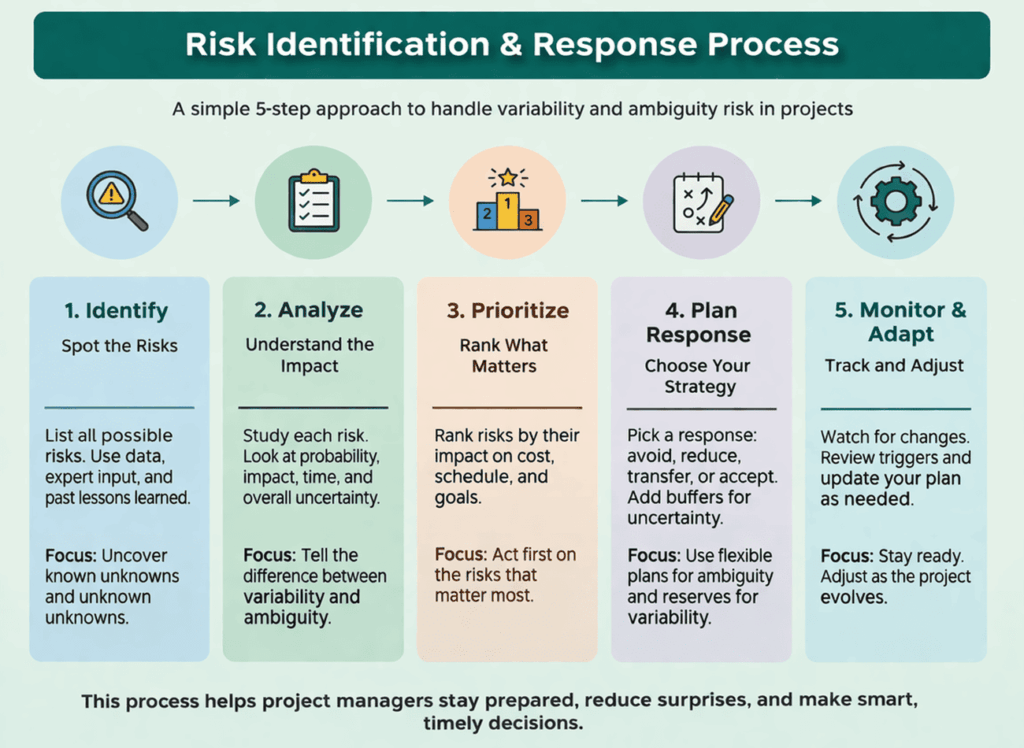
The following process illustrates a simple approach:
- Identify Risks: Gather insights from team members, stakeholders, and available data. Brainstorm potential events, variables, and knowledge gaps.
- Analyze Risks: Estimate the probability and impact of each risk. Use qualitative ratings or quantitative models where appropriate.
- Prioritize Risks: Rank them by urgency and importance. Focus on the ones that could severely affect objectives.
- Plan Responses: Develop strategies to reduce threats and enhance opportunities. Risk responses may include avoidance, transfer, mitigation, acceptance, or exploitation.
- Monitor and Adapt: Track risk status and the effectiveness of responses. Adjust plans as new information emerges.
Tips for the PMP Exam
- Link each risk type to its corresponding analysis tool. Use probability distributions for variability risks and prototypes for ambiguity risks.
- On the exam, look for clues. If a scenario describes uncertain ranges (e.g., variable productivity), think of variability risk. If it mentions unknown technology or unclear rules, think of ambiguity risk.
- Remember that event and emergent risks involve whether something will happen, while variability and ambiguity risks involve uncertainty in how it happens or whether you understand it.
FAQs
Q1. What is the difference between variability risk and ambiguity risk?
Variability risk arises from uncertainty in known variables, such as time or cost ranges. Ambiguity risk comes from missing information or an unclear understanding.
Q2. How can I reduce variability risk in my project?
Use better estimates, create buffers, and monitor key indicators. Statistical models, such as Monte Carlo simulations, help you understand possible outcomes.
Q3. Why is ambiguity risk dangerous?
Because you cannot plan for what you do not know, ambiguity wastes resources and can derail a project. Filling knowledge gaps and using iterative approaches reduces this risk.
Summary
Variability and ambiguity risks shape how projects succeed or fail. Variability concerns known factors that change, while ambiguity stems from missing knowledge. Each needs a different approach. Strong estimates help control variability, while learning and exploration reduce ambiguity. When you understand both, you make better decisions and avoid costly mistakes. Keep reviewing risks, adapt your plan, and stay flexible. A clear risk strategy helps you deliver value and improves your chances of project success.

I am Mohammad Fahad Usmani, B.E. PMP, PMI-RMP. I have been blogging on project management topics since 2011. To date, thousands of professionals have passed the PMP exam using my resources.