Understanding the CBAP certification cost is one of the first steps before you begin your journey toward becoming a Certified Business Analysis Professional. Many professionals ask a simple question: how much does the CBAP certification cost? The answer depends on your region, membership status, and preparation approach.
In this blog post, you will learn a clear breakdown of the cost of the CBAP certification, including application fees, exam fees, and additional expenses. Whether you are planning your budget or comparing options, knowing the cost of the CBAP certification helps you avoid surprises.
Let’s get started.
Key Takeaways
- Membership varies by region. Individual IIBA membership costs $155 in Region 1, $100 in Region 2, and $60 in Region 3. Membership unlocks resources and reduces exam fees.
- The application fee is uniform worldwide. The non-refundable application fee is $145. You pay it once your experience and professional development hours meet the CBAP eligibility criteria.
- Exam fee depends on membership status. Members pay $350, while non-members pay $505. The higher non-member fee includes a one-year IIBA membership.
- Total cost differs by country. Because membership fees vary by region, the total cost ranges from $555 for members in Region 3 to $650 for non-members or members in Region 1. See the charts below for a detailed breakdown.
- Certification boosts careers. According to IIBA’s 2025 Global State of Business Analysis Report, 95% of respondents recommend CBAP certification, and 81% report benefits like salary growth within a year.
What is CBAP Certification?
The Certified Business Analysis Professional (CBAP) is a senior-level certification offered by the International Institute of Business Analysis (IIBA). It is designed for experienced business analysts who want to validate their skills and expertise. To qualify, you need at least 7,500 hours of business analysis experience and 35 hours of professional development.
The CBAP exam tests your ability to apply concepts from the BABOK Guide in real scenarios. Earning this certification shows that you can handle complex projects and lead strategic initiatives. It also improves your credibility, career growth, and earning potential in business analysis.
Why Earn CBAP? Key Statistics
Still debating whether the CBAP is worth it? The 2025 Global State of Business Analysis Report shows that business analysis is growing in importance: 76 % of professionals say its impact is expanding, and 81% report formal recognition of the role. Certification fuels this trend. An impressive 95% of respondents recommend the CBAP, and 81 % see tangible benefits, such as salary increases, confidence, and new opportunities, within a year of earning it. These numbers show how valued CBAP holders are in the industry.
Studying for the CBAP will push you to revisit key topics. It will broaden your understanding of strategic analysis and improve your ability to work with stakeholders. The credential will open doors to projects that were previously out of reach. When you invest in yourself, you become more marketable, and employers notice.
A Quick Look at IIBA Regions
IIBA groups countries into three economic regions. Region 1 includes high-income countries such as the United States, Canada, and the United Kingdom. Region 2 covers middle-income countries like South Africa, Singapore, and Nigeria. Region 3 includes emerging economies such as India, Sri Lanka, and Egypt. Membership fees differ by region, $155, $100, and $60, respectively, while the application and exam fees remain the same worldwide. Your region determines the membership cost and, by extension, your total certification cost.
CBAP Certification Cost: Components
Understanding each component of the cost helps you plan your budget and avoid surprises.
IIBA Membership Fee
Membership is optional but strongly recommended. It provides access to study materials, local chapter events, and certification discounts. Membership fees depend on where you live: $155 in Region 1, $100 in Region 2, and $60 in Region 3. Student memberships are available at reduced rates. You can join at any time. Remember that the non-member exam fee already includes a one-year membership. If you buy a membership before registering for the exam, your exam fee will be lower.
Application Fee
To apply for CBAP, you must pay a non-refundable $145 application fee. This fee is the same for everyone and covers the evaluation of your eligibility, work experience, and professional development hours. Apply only when you meet all requirements; otherwise, you may have to pay again.
Exam Fee
The exam fee depends on your membership status. Members pay $350, while non-members pay $505. The higher non-member fee automatically enrolls you in a one-year membership, so your total cost may match the membership path. If you need to retake the exam, the rewrite fee is about $295 for members and $450 for non-members. These fees are subject to change, and occasional promotions may reduce them.
Recertification Fee
CBAP certification is valid for three years. To renew it, you must earn 60 professional development units and pay a recertification fee. Members pay around $85, while non-members pay about $120. Recertifying on time keeps your credential in good standing and preserves its value.
CBAP Certification Cost by Region
The total cost of earning your CBAP varies primarily by region, due to membership fees. The graphic below summarises the costs for 2026. Membership fees come from IIBA’s official pricing, and exam fees from IIBA’s certification fee schedule.
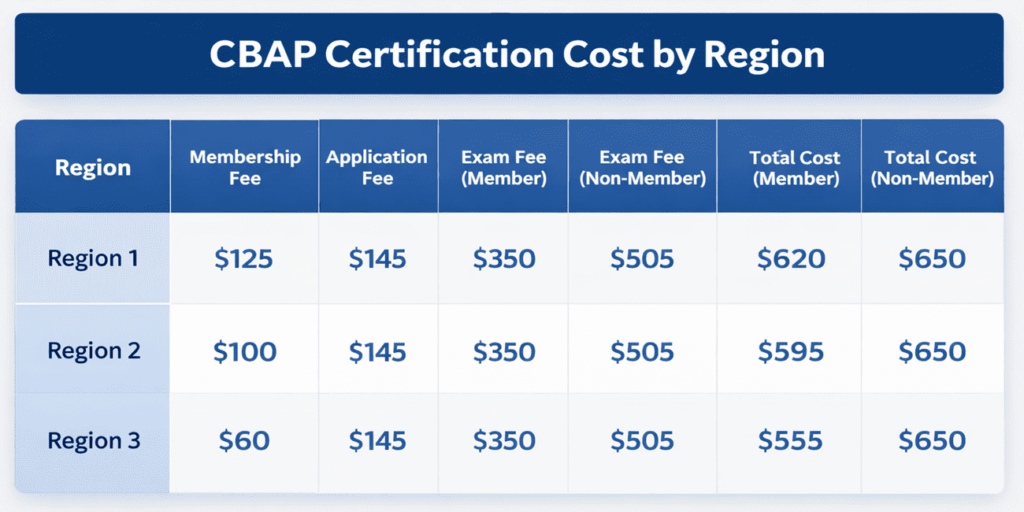
As you can see, candidates in Region 1 pay a total of $650 regardless of membership status. The $505 non-member exam fee includes membership, while the member path involves buying membership ($155), paying the application fee ($145), and then the reduced exam fee ($350). Candidates in Region 2 save by joining IIBA before taking the exam: members pay $595, while non-members still pay $650. Region 3 candidates benefit the most: members pay $555, saving $95 compared with the non-member path.
CBAP Certification Cost by Country
To make the costs more tangible, it helps to look at specific countries. The example countries below span all three regions. Totals for non-members are the same everywhere because the exam fee includes membership. Differences appear on the member side due to varying membership fees.
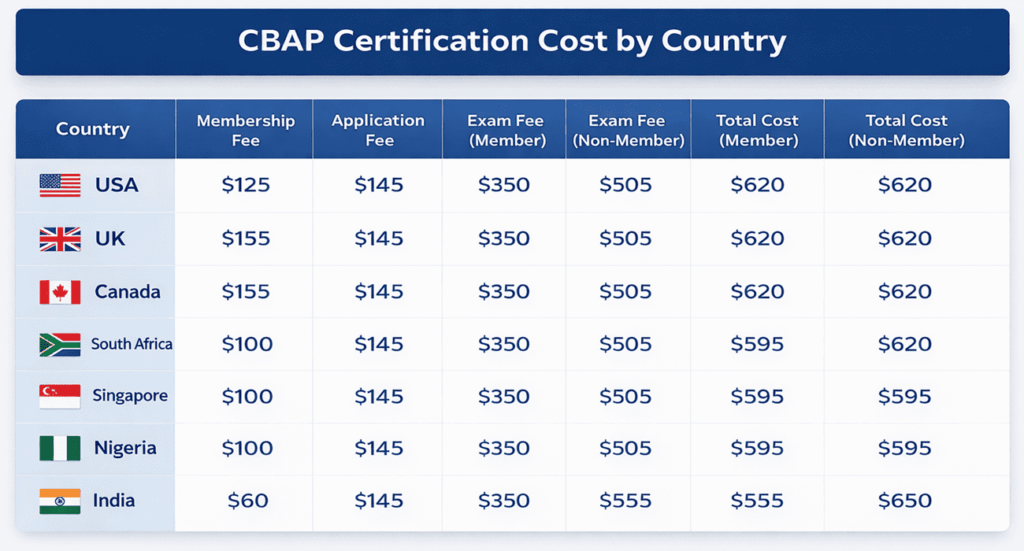
For the United States, the United Kingdom, and Canada (Region 1), the total cost is $650 whether you join IIBA beforehand or not. In South Africa, Singapore, and Nigeria (Region 2), joining IIBA reduces your total cost to $595. In India (Region 3) and other emerging economies, joining IIBA brings the cost down to $555. When planning your budget, also consider currency fluctuations and any local taxes.
Other Expenses & Saving Tips
Study and Training Costs
While fees are fixed, the highest variable cost is exam preparation. You can self-study using the BABOK Guide, which is inexpensive but demands discipline. Many candidates choose formal training to structure their preparation. Instructor-led courses can cost around $800 to $1,500, depending on the provider, location, and whether the format is live or on-demand.
Some providers offer bundled packages that include training, membership, application, and exam fees. Bundles simplify the process and may save money compared with purchasing items separately.
Exam Retake and Recertification
No one plans to fail, but it’s smart to budget for the possibility. Retaking the CBAP exam costs about $295 for members and $450 for non-members. You must wait at least 30 days before retesting. Recertification every three years costs around $85 for members and $120 for non-members and requires 60 hours of professional development. Building these expenses into your long-term budget ensures your credentials remain valid without financial surprises.
Saving Tips
- Join IIBA early. Even if membership doesn’t reduce your total cost in Region 1, it does in Regions 2 and 3 and gives you access to resources that help you pass on the first try.
- Use employer assistance. Many organizations reimburse certification and training fees for professional development. Ask your manager or HR department about available budgets.
- Plan for promotions. IIBA occasionally offers discounted rewrite fees or bundled packages. Subscribe to the IIBA newsletters to learn about promotions.
- Leverage local chapters. IIBA chapters often host study groups and share cost-saving tips. Joining a chapter enhances your professional network and may provide discounts on local events.
FAQs
Q1. What is the total cost to become CBAP certified?
Most candidates spend between $555 and $650 on membership, application, and exam fees. The exact total depends on your region and whether you purchase a membership before the exam.
Q2. Does the exam fee include IIBA membership?
Yes. If you pay the higher $505 non-member exam fee, it automatically includes one year of IIBA membership. Members who pay $350 for the exam must already have an active membership.
Q3. How much does it cost to retake the CBAP exam?
The rewrite fee is about $295 for members and $450 for non-members. You must wait at least 30 days before retesting, and occasional promotions may reduce these fees.
Q4. What does recertification cost?
Recertifying your CBAP every three years costs around $85 for members and $120 for non-members. You’ll also need to submit evidence of 60 professional development units.
Summary
CBAP certification requires both time and financial planning, but the benefits make it worthwhile. The total cost of the CBAP certification varies by region and membership status, ranging from $555 to $650. When you add training and renewal costs, the investment grows, but so do your career opportunities. With strong demand for certified professionals, the CBAP certification can boost your credibility, salary, and career growth. Plan wisely, prepare well, and treat this certification as a long-term career investment.
References:

I am Mohammad Fahad Usmani, B.E. PMP, PMI-RMP. I have been blogging on project management topics since 2011. To date, thousands of professionals have passed the PMP exam using my resources.