
The CBAP certification is one of the most respected credentials for experienced business analysts. It proves that you can handle complex projects and deliver real business value. Many professionals reach a point where they ask, “What’s next for my career?” This certification often provides that answer.
The Certified Business Analysis Professional (CBAP) helps you stand out in a competitive job market. It shows your deep knowledge, strong experience, and ability to lead analysis work. Employers trust this credential because it is based on real-world practice, not just theory.
If you want better roles, higher pay, and global recognition, the CBAP certification can be a smart next step.
In today’s blog post, I will explain the CBAP certification to help you earn it easily.
Key Takeaways
- Globally recognized credential: CBAP is respected across industries and signals mastery in business analysis.
- Salary and confidence boost: In this survey, 95% of professionals recommended CBAP, and 81% reported benefits, including salary increases and greater confidence, within a year.
- Experience-based certification: Applicants must document 7,500 hours of business analysis work and 35 hours of professional development.
- Exam insights: The exam has 120 multiple-choice questions and lasts 3.5 hours. It tests knowledge from the BABOK Guide and includes scenario- and case-based questions.
- Cost considerations: The CBAP application fee is USD 145; the exam fee is USD 505 and includes first-year membership.
- Recertification: To maintain the credential, you must earn professional development units (PDUs) every three years.
- Strategic value: Businesses increasingly see analysis as a strategic driver; average salaries rose nearly 4% in 2025 to USD 88,234.
What is CBAP and Why Does It Matter?
The Certified Business Analysis Professional (CBAP) credential recognizes analysts who lead complex projects, facilitate stakeholder collaboration, and translate organizational strategy into actionable requirements. It is a level-three certification within IIBA’s program, tailored for professionals with at least five years of experience. CBAP holders often work in roles such as senior business analysts, product managers, change managers, and consultants.
CBAP is globally respected and industry-neutral, meaning that your credential applies whether you work in finance, technology, healthcare, or the public sector. Because the certification is experience-based, it proves that you can handle complex initiatives and deliver value to the organization.
Seven Reasons to Pursue CBAP Certification
- Higher Earning Potential – CBAP-certified professionals often command higher salaries than their peers. According to this survey, average salaries for business analysis professionals rose nearly 4% to USD 88,234.
- Accelerated Career Growth – Employers recognize CBAP as proof of advanced expertise. Holders often secure senior roles faster, such as lead analyst or project manager.
- Global Recognition and Versatility – CBAP is internationally recognized, opening doors across industries and regions. It signals that you are equipped to tackle complex business challenges anywhere.
- High Return on Investment – Though the exam fee is USD 505, salary increases and promotions typically offset this cost.
- Enhanced Employability – Many employers prefer CBAP candidates; the certification differentiates you in competitive job markets.
- Leadership and Strategic Skills – Preparing for CBAP deepens your understanding of strategic analysis, stakeholder management, and solution evaluation. These skills are essential in an era where 76% of professionals report that business analysis drives organizational strategy.
- Professional Community and Continuous Learning – Obtaining CBAP grants access to a network of practitioners and exclusive resources. IIBA members enjoy webinars, forums, and digital badges that support ongoing development.
CBAP Certification Eligibility and Application Requirements
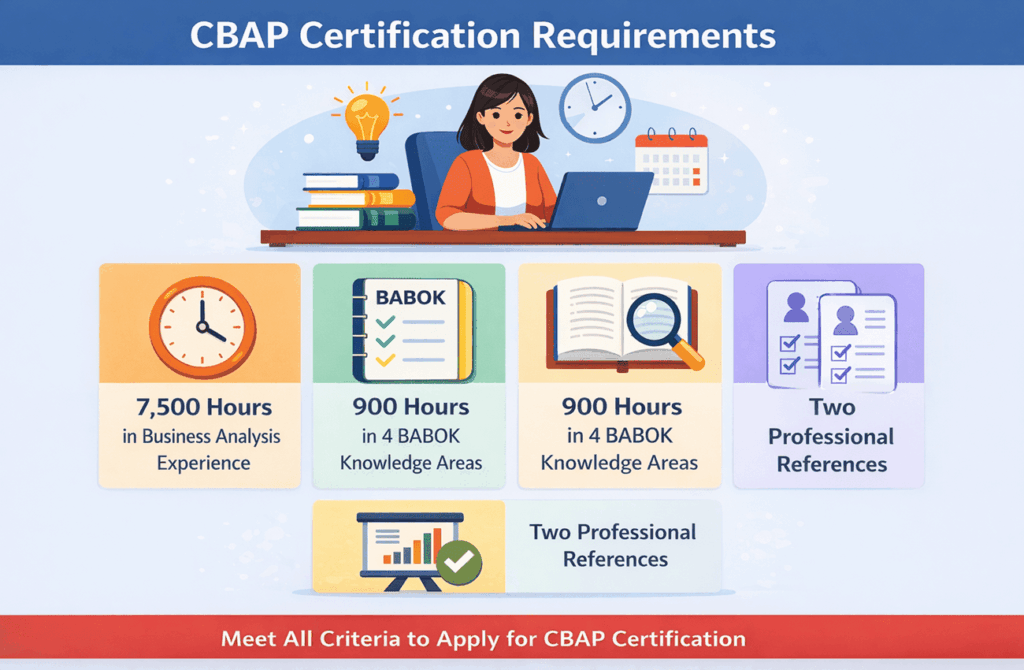
Before applying, ensure that you meet these criteria:
- Work experience: At least 7,500 hours of business analysis work within the last ten years.
- Knowledge areas: Within those hours, at least 900 hours must be logged in four of the six BABOK knowledge areas, for a total of at least 3,600 hours.
- Professional development: 35 hours of professional development in the past four years.
- References: Two professional references (e.g., manager, client, or CBAP holder).
- Code of conduct and terms: Agree to the IIBA Code of Conduct and Terms & Conditions.
- Application fee: Pay the non-refundable USD 145 application fee.
Applicants must record detailed project histories. When describing your work, focus on the tasks performed, knowledge areas covered, and the impact delivered.
Exam Structure and Blueprint
The CBAP exam is computer-based and consists of 120 multiple-choice questions to be completed within 3.5 hours. Questions are scenario- and case-based, testing your ability to apply the BABOK Guide. There is no official passing score; the exam uses a difficulty-based scoring algorithm.
Below is the current exam blueprint (percentage of questions per knowledge area):
| Knowledge Area | Percentage of Questions | Key Skills Covered |
| Business Analysis Planning & Monitoring | 14 % | Setting the scope, stakeholder engagement, and planning BA work |
| Elicitation & Collaboration | 12 % | Gathering requirements, communicating results, and collaborating with stakeholders |
| Requirements Life Cycle Management | 15 % | Managing requirements from inception through retirement |
| Strategy Analysis | 15 % | Evaluating the business environment and recommending changes |
| Requirements Analysis & Design Definition | 30 % | Analyzing requirements, defining solutions, and evaluating options |
| Solution Evaluation | 14 % | Assessing solution performance and recommending improvements |
The exam blueprint underscores the importance of practice: requirements analysis and design account for almost one-third of the exam. Allocate study time accordingly.
CBAP Fees and Recertification
- Application fee: USD 145 (non-refundable).
- Exam fee: USD 505; includes IIBA membership for one year.
- Exam rewrite fee: USD 295 for members or USD 450 for non-members.
- Recertification fee: USD 85 for members or USD 120 for non-members.
CBAP must be renewed every three years. Recertification requires earning a set number of continuing development units (CDUs), typically through professional development activities, volunteer service, or authorship.
How to Prepare for the CBAP Exam
- Obtain the BABOK Guide: The CBAP exam is based on the Business Analysis Body of Knowledge (BABOK). Read each knowledge area carefully and identify your weaker areas.
- Develop a study plan: Allocate several weeks to studying, focusing more on higher-weighted areas (e.g., Requirements Analysis & Design Definition).
- Use practice tests: Full-length practice exams help you build stamina and identify gaps. Several training providers offer online simulators.
- Join a study group: Networking with other candidates can enhance motivation and help clarify difficult concepts.
- Track professional development hours: Ensure you complete your 35 PD hours before applying.
- Schedule the exam: Once your application is approved, choose a convenient time. You can take it online via remote proctoring or at a PSI test center.
CBAP Vs Other IIBA Certifications
IIBA offers a tiered certification path. Early-career analysts may start with the Entry Certificate in Business Analysis (ECBA), while professionals with two to three years of experience can pursue the Certification of Capability in Business Analysis (CCBA). CBAP is designed for senior analysts. Candidates interested in Agile or data analytics can explore specialized certifications such as IIBA-AAC or CBDA.
FAQs
Q1. How long does it take to prepare for the CBAP exam?
Preparation time varies; many candidates spend two to four months studying, depending on their familiarity with the BABOK and the amount of experience.
Q2. Is CBAP worth it if I already have a master’s degree?
Yes. Academic degrees reflect education, whereas CBAP demonstrates applied experience. Employers often value both credentials.
Q3. Can I take the exam online?
Yes. IIBA offers online proctored exams and traditional test centers, giving you flexibility.
Q4. Do I need to renew my CBAP?
Yes. CBAP is valid for three years. You must earn continuing development units (CDUs) and pay a recertification fee to maintain your credential.
Summary
Earning the CBAP certification is an investment in your professional future. It signals deep expertise, increases your marketability, and empowers you to lead large-scale initiatives. With average salaries rising and employers increasingly recognizing the strategic importance of business analysis, there has never been a better time to take this step. Start your CBAP journey today by reviewing the BABOK, documenting your experience, and scheduling the exam.
References:

I am Mohammad Fahad Usmani, B.E. PMP, PMI-RMP. I have been blogging on project management topics since 2011. To date, thousands of professionals have passed the PMP exam using my resources.