Understanding the CCBA certification cost is important if you plan to grow your career in business analysis. Many professionals ask how much the CCBA certification costs and whether it is worth the investment.
The CCBA certification cost includes application, exam, and renewal fees, which may vary based on your membership status. Knowing these details helps you plan better and avoid surprises later.
This guide explains the full cost of the CCBA certification in simple terms, along with its value and benefits. If you want to advance your skills and improve your career opportunities, learning about the cost of the CCBA certification is the first step.
Key Takeaway
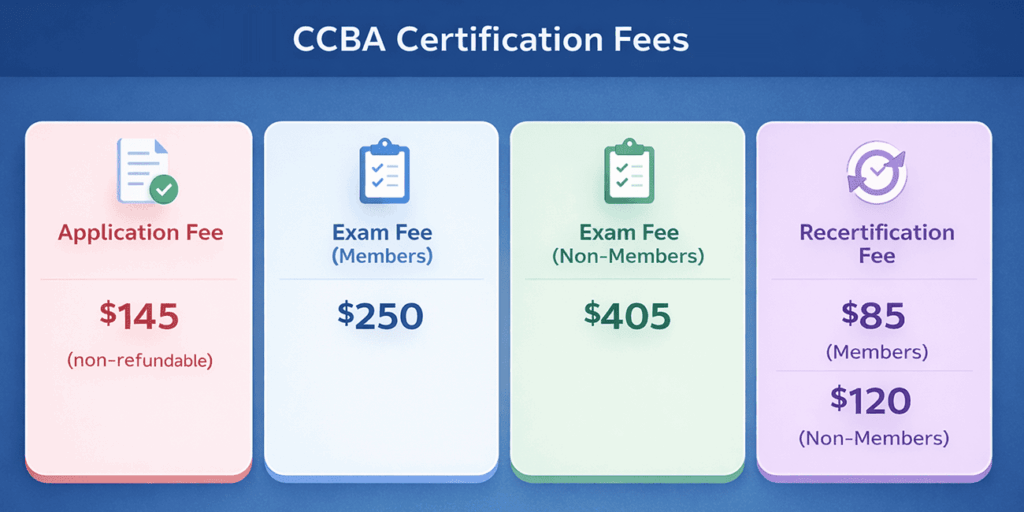
- CCBA certification has three main costs: a $145 application fee, a $250 (members) or $405 (non-members) exam fee, and an $ 85 (members) or $120 (non-members) recertification fee.
- Certification can increase salaries, with average pay reaching about $88,234 and strong professional demand.
- CCBA improves credibility, project success, and access to a global professional network.
- The certification is valid for three years and requires CDUs for renewal, so planning costs early is important.
What is CCBA Certification?
The Certification of Capability in Business Analysis (CCBA) is a mid-level credential awarded by the International Institute of Business Analysis (IIBA). It recognizes professionals who have developed intermediate business analysis skills and want to validate their expertise. Unlike the entry-level ECBA, the CCBA is designed for practitioners with several years of experience who are ready to take on larger projects and responsibilities.
To qualify, you must:
- Education: Hold a high-school diploma or equivalent.
- Work experience: Log at least 3,750 hours of business analysis work within the last seven years across the six BABOK knowledge areas.
- Professional development: Complete 21 hours of professional development within the past four years.
- References: Provide two professional references who can attest to your capability.
- Agree to the code of conduct: Adhere to the IIBA’s code of ethical conduct and terms.
Cost of CCBA Certification: Detailed Cost Breakdown
The cost of the CCBA credential is structured around several distinct fees. The values below are quoted from the IIBA’s 2026 fee schedule and are presented in U.S. dollars. Fees may change without notice, and regional taxes or surcharges can affect what you pay locally.
Check the IIBA website for the most accurate information.
| Non-refundable. Covers the review of your application and supporting documents. | Amount (USD) | Notes |
| Application Fee | $145 | Non?refundable. Covers the review of your application and supporting documents. |
| Exam Fee – Members | $250 | Available only to IIBA members. Includes your first year of IIBA membership. |
| Exam Fee – Non-Members | $405 | For candidates who are not IIBA members. Joining IIBA before paying can reduce this cost. |
| Exam Rewrite Fee | $195 (Members), $350 (Non-Members) | If you need to retake the exam, this discounted fee applies. |
Why become a member? Membership costs vary by country (usually between $55 and $139 per year) and include a discount on the exam fee, access to study resources, and networking opportunities.
When you purchase the exam as a member, the first year of membership is included, making membership a cost-effective choice if you intend to maintain the credential.
Factors Influencing the Total Cost
- Training and Study Materials: Most candidates invest in preparation courses and practice tests. High-quality courses range from $500 to $1,500 depending on the provider, while books and self-study guides can cost $50–$150. Choosing a reputable training provider increases your chance of passing on the first attempt.
- Regional Price Variations: Examination providers may add local taxes or surcharges. For example, test-center fees in Europe or the Middle East may include VAT. Always confirm regional pricing through the IIBA website or your local IIBA chapter.
- Currency Fluctuations: Since fees are listed in USD, candidates outside the United States should monitor exchange rates. Paying early can protect you from currency swings.
How to Become CCBA Certified
The certification process follows a clear sequence:
- Register as an IIBA member (optional): While not required, membership gives you a discounted exam fee and access to practice exams, webinars, and networking. Join through the IIBA membership portal.
- Record your work experience and professional development: Use the IIBA certification portal to log your hours across the BABOK knowledge areas. Only paid work counts toward the 3,750-hour requirement.
- Submit the application and pay the fee: Complete the online application, attach your two references, and pay the $145 application fee. Applications are reviewed within a few weeks.
- Pay the exam fee: After your application is approved, pay the applicable exam fee ($250 for members or $405 for non-members) and schedule your exam with the approved testing partner.
- Prepare for the exam: Study the Business Analysis Body of Knowledge (BABOK) Guide and take practice tests.
- Take the exam: The CCBA exam consists of 130 multiple-choice questions with a three-hour time limit. Questions test both knowledge and application of business analysis techniques. Passing the exam grants you the CCBA credential, which is valid for 3 years.
- Maintain your certification: Earn 60 Continuing Development Units (CDUs) over the three-year cycle and pay the recertification fee ($85 for members or $120 for non-members). Activities include attending conferences, webinars, or contributing to the professional community.
Benefits of CCBA Certification
Professionals sometimes wonder whether the return on investment justifies the effort. Several data points suggest the answer is yes.
- Career growth and salary potential: In the 2025 Global State of Business Analysis report, the IIBA noted that average salaries for business analysts rose nearly 4% to $88,234, and that 95% of respondents recommended certification because it led to salary increases and greater confidence. Many employers recognize CCBA holders as committed professionals who can take on complex projects.
- Strategic recognition: The same IIBA report found that 76 % of organizations believe business analysis drives strategic decisions. CCBA certification signals that you understand best practices and can align projects with organizational goals.
- Growing job market: According to the U.S. Bureau of Labor Statistics, management analysts (a category that includes business analysts) earned a median annual wage of $101,190 in May 2024, and employment is projected to grow 9% from 2024 to 2034. Certification can give you a competitive edge in this expanding field.
Tips to Manage Certification Costs
Plan your budget: List all expected expenses, such as application fees, exam fees, training and study materials, and travel if you opt for in-person courses. Setting aside funds each month can ease the financial burden.
Join the IIBA early: Paying for membership before submitting your application saves you on the exam fee and provides access to valuable study resources. Many chapters also host free study groups.
Use employer support: Some employers reimburse certification costs or offer paid study time. Ask your manager or HR department about professional development policies.
Choose the right training provider: Invest in a course that meets the 21-hour professional development requirement and offers exam-aligned practice questions. High-quality training often leads to a first-time pass, which avoids rewrite fees.
FAQs
Q1. What is the total cost of CCBA certification?
Expect to spend around $500–$1,000, including the application fee ($145), exam fee ($250 for members), study materials, and training courses. Costs vary by region and training provider.
Q2. How long is the CCBA certification valid?
The credential is valid for three years. To renew it, you must earn 60 CDUs and pay the recertification fee ($85 for members, $120 for non-members).
Q3. Do I need to become an IIBA member?
Membership is optional but highly recommended. It reduces the exam fee and provides access to study resources, webinars, and a professional network.
Q4. Is the CCBA exam hard?
The exam is challenging because it tests both knowledge and practical application. With proper preparation and practice questions, most candidates can pass on the first attempt.
Q5. Can I take the exam online?
Yes, the IIBA offers remote proctored exams. You can also take the exam at an approved test center, whichever suits your schedule.
Summary
The CCBA certification is a smart investment for business analysts seeking to advance their careers. It involves clear costs, including application, exam, and renewal fees. With proper planning, you can manage these expenses without stress. The certification builds your skills, improves job opportunities, and increases your earning potential. If you want to stand out in a competitive market, the CCBA certification can help you achieve your professional goals and move forward with confidence.
References:

I am Mohammad Fahad Usmani, B.E. PMP, PMI-RMP. I have been blogging on project management topics since 2011. To date, thousands of professionals have passed the PMP exam using my resources.