Agile project management has become one of the most effective ways to manage modern projects. Businesses today need faster delivery, better teamwork, and the ability to adapt quickly to change. That is why many organizations now rely on agile methods instead of rigid traditional systems. Understanding agile project management basics helps project teams improve communication, reduce delays, and deliver better results through short work cycles called sprints.
These methods also keep customers involved throughout the project, which improves satisfaction and reduces risk. Learning the basics of agile project management is important for project managers, team leaders, and businesses that want to stay competitive in fast-changing industries.
This blog post explains Agile values, principles, frameworks, benefits, and practical implementation steps in simple terms.
Key Takeaway
- Agile is about flexibility and customer focus. It values people, working products, collaboration, and responding to change.
- Agile is widely adopted. More than 86 percent of software teams and 48% of engineering/R&D teams use Agile practices.
- Scrum is the most popular framework. According to the 17th State of Agile report, 63% of Agile users employ Scrum.
- The Agile software market is booming. Industry analysts project the Agile project management software market to grow from USD 6.75 billion in 2026 to USD 16.99 billion by 2033.
What is Agile?
Agile is a mindset and methodology designed to handle change. It originated in software development but now applies across industries. Instead of delivering a final product after months of work, Agile teams deliver small increments regularly. Each increment is reviewed, feedback is gathered, and adjustments are made. This approach reduces risk, improves quality, and fosters continuous improvement. Think of it as taking many small steps rather than one giant leap.
Agile emerged in 2001 when a group of software practitioners created the Agile Manifesto. They distilled their ideas into four core values and twelve guiding principles. These values prioritize human interaction, working products, customer collaboration, and adaptability over rigid processes and contracts.
The Four Values of Agile
The Agile Manifesto outlines four fundamental values:
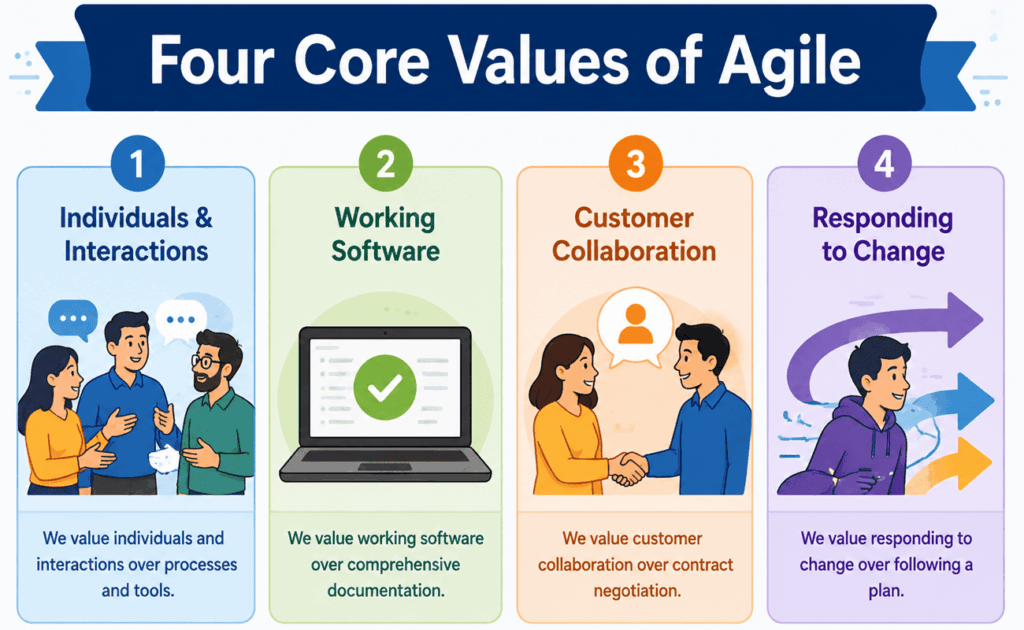
- Individuals and interactions over processes and tools. People drive creativity and problem-solving, so the focus is on collaboration rather than strict protocols.
- Working software over comprehensive documentation. Delivering a functional product matters more than producing extensive paperwork.
- Customer collaboration over contract negotiation. Continuous communication with customers ensures the product meets their needs.
- Responding to change by following a plan. Agile teams welcome change and adapt quickly rather than rigidly sticking to a fixed plan.
The Twelve Principles of Agile
Beyond the values, the Agile Manifesto lists twelve principles that guide how teams work. These principles emphasize delivering value early, welcoming changing requirements, collaborating closely with stakeholders, building projects around motivated individuals, communicating face-to-face, measuring progress through working products, sustaining a steady pace, maintaining technical excellence, maximizing simplicity, empowering self-organizing teams, and reflecting regularly to improve. Together, they create a culture where continuous improvement and customer satisfaction are central.
Agile Project Management Basics Explained
Agile project management adapts these values and principles to broader project work. Instead of completing everything in one long phase, teams work in iterations or sprints, usually lasting two to four weeks. Each sprint produces a small piece of the final product. At the end of each sprint, the team reviews their work, gathers feedback, and plans the next sprint.
This iterative approach has several advantages:
- Frequent delivery: Clients see progress early and can provide feedback, reducing the risk of costly rework.
- Flexibility: Changes can be incorporated without derailing the entire project.
- Continuous improvement: After each sprint, the team reflects on what went well and what could be improved, then adjusts their process accordingly.
A sprint typically involves planning, design, coding or development, testing, and review. For example, imagine your team is building a mobile app. In the first sprint, you might develop and test the login screen. Once the login screen is working, you move on to the next feature while refining the previous one based on feedback. By the end of several sprints, you have a fully functional app.
Roles in Agile Project Management
Successful Agile teams rely on clear roles and responsibilities. While specific frameworks may use different terms, three core roles appear in many Agile environments:
- Product Owner: Represents the customer or stakeholders. This person defines the product vision, prioritizes tasks, and ensures the team builds the most valuable features first.
- Scrum Master or Agile Coach: Facilitates the Agile process. The Scrum Master removes obstacles, fosters collaboration, and ensures adherence to Agile principles. Instead of commanding the team, this role supports and guides the team.
- Development Team: Consists of cross-functional members who design, build, test, and deliver the product. Team members work collaboratively and share responsibility for outcomes.
In larger organizations, additional roles, such as Release Train Engineers (in SAFe) or Kanban Service Owners, support scaling Agile across departments. Regardless of structure, Agile emphasizes empowerment and trust. Teams decide how to accomplish their work rather than being micromanaged.
Popular Agile Frameworks
Agile is an umbrella term, and several frameworks help teams put its principles into practice. Here are the most common options:
Scrum
Scrum is the most widely used Agile framework, adopted by 63 percent of Agile practitioners. It divides work into short sprints, with defined roles (Product Owner, Scrum Master, Development Team) and ceremonies (Sprint Planning, Daily Stand-Up, Sprint Review, Sprint Retrospective). Scrum emphasizes transparency and continuous improvement.
Kanban
Kanban visualizes work on a board with columns such as “To Do,” “In Progress,” and “Done.” It limits the number of items in progress, encouraging focus and reducing bottlenecks. Kanban is flexible; teams can adopt it without reorganizing existing roles.
SAFe (Scaled Agile Framework)
The Scaled Agile Framework (SAFe) helps large enterprises apply Agile practices across multiple teams. According to the 17th State of Agile report, SAFe is the top choice at the enterprise level, used by 26 percent of organizations.
Hybrid Approaches
Not all projects fit neatly into one framework. Many organizations blend Agile methods with predictive (Waterfall) approaches. Recent data show that 31.5 percent of companies adopt hybrid models. Hybrid practices retain the discipline of planning while allowing flexibility where needed.
Benefits of Agile Project Management
Why are so many teams embracing Agile? The benefits go beyond faster delivery:
- Higher customer satisfaction. An industry analysis found that 93% of organizations using Agile reported improved customer satisfaction. By delivering incrementally and involving stakeholders often, teams can refine the product based on real feedback.
- Greater success rates. The same analysis showed 73% of Agile organizations achieved success rates over 75%.
- Improved collaboration and alignment. Agile values emphasize people and teamwork; as a result, teams communicate more often and stay aligned with business goals.
- Adaptability to change. Welcoming change is a core principle. Agile teams pivot more easily than those using rigid approaches, reducing wasted effort.
- Transparency and visibility. Tools like Kanban boards and Scrum ceremonies make progress visible, allowing for better decision-making.
Industry Adoption of Agile
Agile adoption is no longer confined to software development. Data from 2026 show that 86% of software development teams and 48% of engineering/R&D teams use Agile practices. Healthcare and financial services each report over 53% adoption of hybrid Agile methods. Marketing departments are quickly catching up; 86% of marketing teams plan to adopt Agile practices.
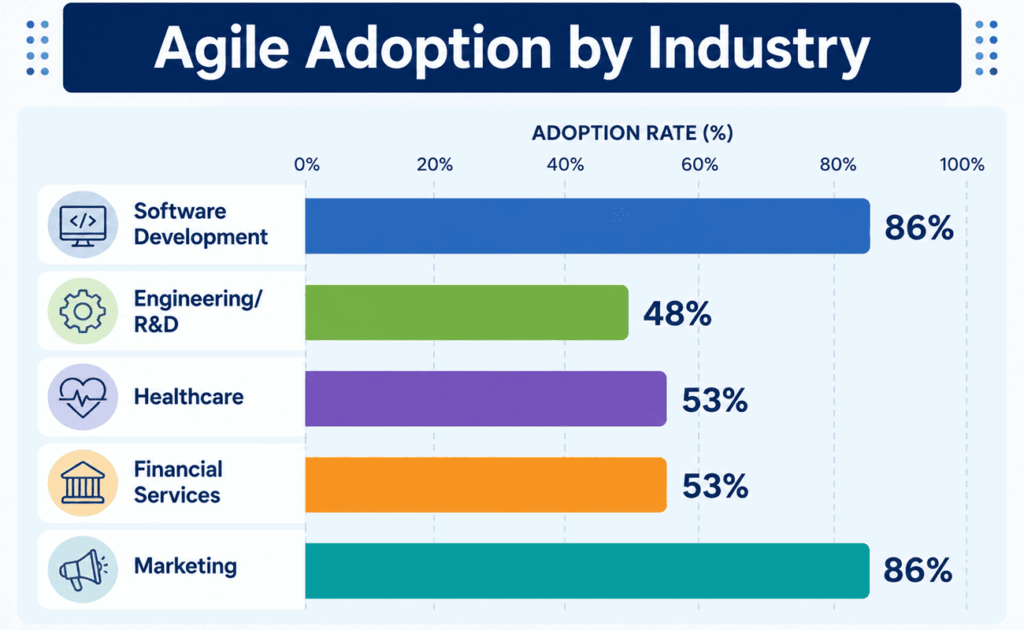
Why are these sectors turning to Agile? Agile helps teams respond to regulatory changes in healthcare and finance, facilitates faster product launches in technology, and improves campaign responsiveness in marketing. As adoption grows, training and certification programs, such as the PMI Agile Certified Practitioner (PMI-ACP), are in high demand.
Comparing Agile and Waterfall
Traditional, predictive (Waterfall) project management follows a linear sequence: requirements, design, development, testing, and deployment. Each phase must be completed before the next begins. This approach suits projects with stable requirements and clear outcomes, such as construction or infrastructure.
Agile differs in several ways:
- Flexibility. Waterfall locks down requirements early; Agile adapts as you learn.
- Delivery cadence. Waterfall delivers a finished product at the end; Agile delivers incremental value throughout the project.
- Stakeholder involvement. Waterfall often involves stakeholders at the beginning and end; Agile engages them constantly.
- Risk management. Waterfall concentrates risk at the end when testing reveals issues; Agile spreads risk through continuous integration and testing.
Which approach is best? It depends on project complexity and stakeholder needs. Many organizations use hybrid methods, combining upfront planning with iterative delivery.
Challenges of Agile Adoption
While Agile offers many advantages, it isn’t a magic bullet. Common challenges include:
- Resistance to change. Teams accustomed to command-and-control structures may struggle with self-organization. Leadership must support the shift and provide coaching.
- Incomplete adoption. Implementing stand-ups without embracing Agile values leads to “Agile-in-name-only.” Success requires commitment to collaboration and continuous improvement.
- Scaling issues. Agile works well for small teams; scaling to hundreds of people is complex. Frameworks like SAFe or Disciplined Agile provide guidance but add bureaucracy.
- Resource constraints. Agile teams need dedicated members. Splitting people across multiple projects undermines focus and reduces productivity.
Recognizing these obstacles early helps you plan mitigation strategies, such as training, coaching, and strong executive sponsorship.
FAQs
Q1. What is Agile project management in simple terms?
Agile project management is a way of working that delivers a project in small, manageable increments. Teams work together, seek feedback often, and adapt quickly to change.
Q2. How is Agile different from Waterfall?
Waterfall follows a step-by-step process with fixed requirements. Agile focuses on short cycles, frequent deliveries, and flexibility to change requirements during the project.
Q3. Why is Scrum so popular?
Scrum provides a clear structure, defined roles, regular meetings, and time-boxed sprints, which help teams stay organized and deliver results. It’s widely adopted because it balances discipline with adaptability.
Q4. Which industries use Agile the most?
Agile began in software development, where adoption exceeds 80 percent. Engineering, R&D, healthcare, finance, and marketing are catching up, with adoption rates ranging from 48 percent to 86 percent.
Q5. Do I need special tools to use Agile?
While you can start with simple boards and sticky notes, digital tools like Jira, Trello, or Azure DevOps help teams collaborate, track work, and generate reports.
Summary
Understanding agile project management basics helps teams deliver work faster, improve collaboration, and respond to change with confidence. Agile encourages continuous learning, customer feedback, and steady improvement through short development cycles. As more industries adopt Agile methods, professionals who understand its values, principles, and frameworks gain a strong advantage. Whether you manage software, marketing, healthcare, or business projects, Agile can help your team stay flexible, organized, and focused on delivering real value in a changing business environment.

I am Mohammad Fahad Usmani, B.E. PMP, PMI-RMP. I have been blogging on project management topics since 2011. To date, thousands of professionals have passed the PMP exam using my resources.