
The Benefit-Cost Ratio, or BCR, helps you determine whether a project is worth the money. It compares the present value of expected benefits with the present value of expected costs. A result above 1 indicates that benefits exceed costs. A result below 1 indicates that costs exceed benefits. This metric is common in cost-benefit analysis, capital budgeting, and project selection.
A BCR calculator makes this process quick. You enter the present value of benefits and the present value of costs, and the tool instantly gives you the ratio. That saves time and cuts manual errors.
Benefit Cost Ratio (BCR) Calculator
Use this calculator to find the Benefit Cost Ratio for your project.
Benefit Cost Ratio (BCR) Calculator
Enter the present value of benefits and costs to calculate the Benefit Cost Ratio.
How to Calculate BCR
You can use the following steps to calculate the Benefit Cost Ratio.
Step 1: Find the Present Value of Benefits
First, estimate all expected project benefits. Then convert those future benefits into present value. BCR uses present values because money today is worth more than the same amount in the future.
Step 2: Find the Present Value of Costs
Next, calculate all project costs and convert them into present value as well. This gives you a fair comparison between what you spend and what you expect to gain.
Step 3: Apply the BCR Formula
Use this formula:
BCR = Present Value of Benefits ÷ Present Value of Costs
This is the standard way to calculate the ratio.
Step 4: Calculate the Result
Divide the present value of benefits by the present value of costs.
Example:
Present Value of Benefits = 120,000
Present Value of Costs = 80,000
BCR = 120,000 ÷ 80,000 = 1.50
Step 5: Interpret the Result
If BCR is greater than 1, the project is financially attractive because benefits exceed costs. If BCR equals 1, the project breaks even. If the BCR is less than 1, the project is not financially attractive because costs exceed benefits.
Benefit Cost Ratio Formula
The BCR formula is as follows:
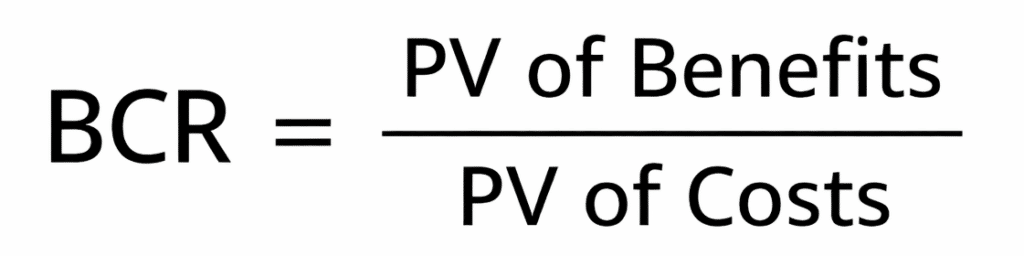
Where:
BCR = Benefit Cost Ratio
PV = Present Value
A more detailed version can account for benefits and costs across multiple periods, but the core idea remains the same: divide discounted benefits by discounted costs.
BCR Example
Imagine you are comparing a project investment.
Present Value of Benefits = 250,000
Present Value of Costs = 200,000
Now calculate BCR:
BCR = 250,000 ÷ 200,000 = 1.25
What does this mean?
A BCR of 1.25 means the project returns more value than it costs. For every 1 dollar spent, the project generates 1.25 dollars in benefits. That makes the project financially acceptable under the BCR rule.
Importance of BCR
The Benefit-Cost Ratio helps you quickly compare projects. It provides a single number that indicates whether a project makes financial sense. This can help managers rank options, justify decisions, and screen weak investments early.
Still, BCR should not be your only tool. A project can look strong on BCR but still carry weak assumptions, risky forecasts, or important nonfinancial factors. Many analysts review BCR alongside other measures such as NPV and IRR. That gives a fuller picture. Ever seen a project look great on paper and then fall apart in real life? That is why one number should never carry the whole decision.
FAQ
Q1. What is the Benefit Cost Ratio?
The Benefit-Cost Ratio is a financial metric that compares the present value of a project’s benefits to the present value of its costs. It helps you judge project value.
Q2. How do you calculate BCR?
You calculate BCR by dividing the present value of expected benefits by the present value of expected costs. A value above 1 suggests the project is worthwhile.
Q3. What does a BCR above 1 mean?
A BCR above 1 means benefits are greater than costs. In simple terms, the project is expected to create more value than it consumes.
Q4. What does a BCR below 1 mean?
A BCR below 1 means project costs are greater than project benefits. This usually shows that the project is not financially attractive.
Q5. What are the limitations of BCR?
BCR depends on cash flow estimates and discount rates. If those inputs are weak, the result can mislead you. It also does not capture every strategic or qualitative factor.
Summary
The Benefit-Cost Ratio is a simple tool for assessing whether a project is worth the investment. It compares discounted benefits with discounted costs and gives you a quick answer. If the ratio is above 1, the project looks financially sound. If it is below 1, the project needs a closer look. A BCR calculator makes the math easy and helps you make faster decisions. Use it with other financial tools to get a better view of project value.

I am Mohammad Fahad Usmani, B.E. PMP, PMI-RMP. I have been blogging on project management topics since 2011. To date, thousands of professionals have passed the PMP exam using my resources.