The PMI Talent Triangle shapes how project managers grow and stay relevant. It focuses on three key skill areas: business acumen, power skills, and ways of working. Each area builds a different strength. Business acumen helps you understand strategy and financial impact. Power skills improve how you lead and communicate with people. Ways of working focus on tools, methods, and delivery practices.
Today, organizations expect more than task execution. They want project managers who think like business leaders. That is where business acumen skills become critical. By learning how these three arms work together, you can deliver real value, not just complete projects.
In this blog post, I will explain business acumen and show how it fits into the PMI Talent Triangle.
What Is Business Acumen?
Business acumen means thinking like an owner. It blends financial literacy, strategic insight, and operational awareness. Imagine a project leader who reads a profit-and-loss statement and immediately sees the impact of a scope change on margins. This person can communicate that impact to executives, adjust plans, and still meet customer needs. That holistic view is business acumen.
Business acumen combines three core abilities:
- Financial literacy: Understanding budgets, cash flow, and key performance indicators helps you see how decisions affect profitability. For instance, analyzing a project’s cash flow can reveal when expenses exceed incoming revenue, allowing for timely adjustments.
- Strategic thinking: Looking beyond immediate tasks to assess market trends, competition, and organizational priorities ensures your project aligns with the bigger picture. A project manager who notices shifting customer preferences can pivot product features to keep the company competitive.
- Operational insight: Knowing how functions interconnect enables you to anticipate the ripple effects of decisions. If marketing launches a new campaign, sales may need support, and operations may need to boost capacity. Business acumen helps you coordinate those moving parts.
Why Business Acumen Matters in Project Management
Business acumen helps you see the bigger picture behind every project. It allows you to connect daily tasks to business goals such as profit, growth, and customer value. When you understand financial data and market trends, you make better decisions and avoid costly mistakes. You can also explain your ideas clearly to senior leaders.
Strong business acumen builds trust. It shows that you think beyond execution and focus on results. This skill also improves your ability to prioritize work and manage risks. In today’s fast-changing environment, project managers with business acumen stand out and deliver real value to their organizations.
Core Components of Business Acumen
Business acumen is multifaceted. Below are the main components and practical tips on how to strengthen each:
1. Financial Literacy
Understanding financial statements empowers you to interpret your project’s effect on profitability. Study income statements, balance sheets, and cash flow reports. Pay attention to metrics like gross margin, return on investment (ROI), and earnings before interest, taxes, depreciation, and amortization (EBITDA).
For example, if you see decreasing profit margins despite rising sales, investigate cost structures and pricing strategies. Regularly review your organization’s quarterly reports and ask finance colleagues to explain unfamiliar terms.
2. Strategic Thinking and Market Awareness
Strategic thinking involves analyzing market trends, competition, and customer needs. Read industry news, attend webinars, and follow thought leaders to stay informed. Think about long-term consequences: will a short-term discount harm your brand? How do demographic shifts affect product demand?
Ask questions that connect tactical decisions to strategic goals. If your company operates in multiple regions, study cultural and regulatory differences to avoid missteps.
3. Operational Insight and Systems Thinking
Projects do not exist in isolation. Understanding how departments interact helps you anticipate bottlenecks and collaborate effectively. Shadow colleagues in different functions, such as sales, supply chain, and customer service. Map out your organization’s processes to see how work flows from one team to another. When evaluating a new tool, consider how it affects different teams.
For example, implementing an automation solution may reduce manual effort in operations but require training from HR and IT.
4. Customer and Stakeholder Understanding
Business acumen also means knowing your stakeholders. Conduct interviews or surveys to learn what customers value and how they measure success. Listen during meetings to understand executive priorities. Clear communication builds trust, helps you manage expectations, and ensures your project delivers value.
When presenting status updates, highlight benefits in terms executives understand: revenue impact, customer satisfaction, and risk reduction.
How to Develop Business Acumen
Developing business acumen is a journey. You can follow the following steps to develop business acumen skills:
- Seek cross-functional experience: Volunteer for projects outside your usual domain. For instance, if you work in IT, join a marketing campaign, or sit in on product development sessions. This exposure broadens your perspective and helps you see how different parts of the business operate.
- Learn from financial documents: Read annual reports, quarterly earnings calls, and industry analyses. Practice calculating ROI and profit margins. Try to connect these numbers to real decisions. Many project managers keep a journal to track financial observations and reflect on lessons learned.
- Ask mentors for guidance: Find a mentor in finance or senior leadership. Ask them to explain how they make decisions and what they look for in project updates. Shadow them during budget meetings or executive reviews.
- Take structured courses: Enroll in business acumen training modules or MBA foundation classes. Many courses offer PDUs that meet your certification requirements while enhancing your skills.
- Practice decision simulations: Use business simulations or case studies to hone your judgment. Simulations let you experiment in a safe environment and see immediate feedback.
Business Acumen and the PMI Talent Triangle
To renew a PMI certification, you must earn professional development units across three categories: Business Acumen, Power Skills, and Ways of Working. Each category requires a minimum of eight PDUs. The remaining PDUs can come from any category, depending on your certification.
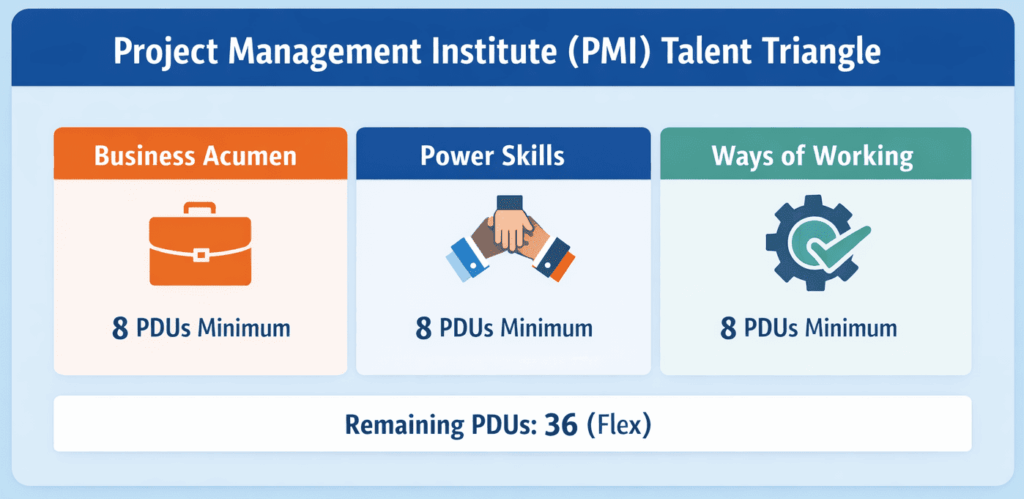
Understanding the PMI Talent Triangle helps you plan your professional development. While business acumen PDUs ensure you think strategically, power skills focus on leadership and collaboration, and ways of working concentrate on project methodologies. Balancing all three keeps your skills relevant.
How to Earn Business Acumen PDUs
Many activities qualify for business acumen PDUs. Each hour of learning equals one PDU. Here are popular options:
- Instructor-led courses and workshops: Attend classes that cover financial literacy, strategic planning, or business analysis.
- Online self-paced modules: Web-based courses or webinars allow you to study at your own pace. Look for content created by recognized experts or organizations like PMI.
- Reading and research: Reading books, white papers, or articles on business strategy, finance, or market analysis can earn PDUs. Be sure to document your learning time and record it when reporting PDUs.
- Volunteering and on-the-job learning: Participating in organizational change initiatives, drafting a business case, or performing competitive analysis can also qualify if you learn new business skills. Always align your activities with PMI guidelines.
When you are ready to claim your PDUs, log into PMI’s CCRS (Continuing Certification Requirements System), select the appropriate category, and record your activity details. Keep documentation in case PMI requests verification.
The CCR Handbook provides detailed instructions.
FAQs
Q1. What qualifies as a Business Acumen PDU?
Any structured learning activity that enhances your understanding of finance, strategy, or business operations counts, including courses, webinars, reading, and volunteer work.
Q2. How many Business Acumen PDUs do I need to renew my certification?
PMI requires at least 8 PDUs in the business acumen category during each three-year renewal cycle, regardless of your certification type.
Q3. Can Business Acumen PDUs overlap with Power Skills or Ways of Working?
No. PDU categories do not overlap. You must meet the minimum requirement of 8 PDUs in each category, and additional PDUs cannot substitute for other categories.
Q4. Why is business acumen important for project managers?
Strong business acumen helps you align projects with organizational goals, communicate value to executives, and make informed decisions that lead to better project outcomes.
Q5. How do I report my Business Acumen PDUs?
Log in to the PMI CCRS, select your certification, and submit details about the learning activity. Keep proof of participation for audit purposes.
Summary
Business acumen is no longer optional for project managers. It helps you link your work to real business results and make smarter decisions. When you combine business acumen with power skills and ways of working, you become a complete professional. This balance is the core of the PMI Talent Triangle. By building these skills, you improve project outcomes, earn leaders’ trust, and grow your career with confidence and purpose.

I am Mohammad Fahad Usmani, B.E. PMP, PMI-RMP. I have been blogging on project management topics since 2011. To date, thousands of professionals have passed the PMP exam using my resources.