Keeping your professional skills up to date isn’t just a good idea; it’s a requirement in many fields. If you hold a Project Management Professional (PMP) credential or another license, you need to track your learning hours using units like PDUs and CEUs. Understanding what those units mean and how they differ is the first step toward staying compliant.
Have you ever wondered whether the time you spend at a workshop will count toward both your project management and another license?
This blog post explains the difference between Continuing Education Units (CEUs) and Professional Development Units (PDUs) in simple language. You’ll see how each unit is measured, which organizations accept them, and why investing in accredited programs protects your career.
Let’s get started.
What is Continuing Education?
Continuing education refers to structured learning that takes place after you earn an initial certificate or license. Professional bodies use continuing education to make sure their members keep up with new standards and best practices. Lawyers must complete a certain number of hours each year to maintain their licenses, and nurses do the same in their state. Without these ongoing classes and workshops, practitioners could fall behind and put clients or patients at risk.
In other words, continuing education proves you care about quality and safety. The idea sounds simple, but the way it’s tracked and measured can vary widely by profession.
The Growth of Continuing Education
The importance of ongoing learning isn’t just anecdotal; it’s a huge market. A research report notes that the U.S. continuing education market was valued at about US$66.91 billion in 2024 and is expected to reach US$95.98 billion by 2030, reflecting a compound annual growth rate of 6.20 percent. This surge is driven by the rapid expansion of online platforms and a growing need for specialized skills across industries.

As employers demand more up-to-date expertise, professionals must invest in high-quality programs that deliver tangible results. Whether you learn in a classroom or online, the market shows that people are taking continuing education seriously.
Understanding Professional Development Units (PDUs)
PDUs are the measurement used by the Project Management Institute (PMI) to quantify professional development for its certifications. According to PMI’s guidelines, one PDU equals one hour of learning, teaching, or volunteering related to project management. PDUs are specific to the PMI ecosystem and are separate from the CEUs used by other professions.
Each certification has its own renewal cycle. For example, holders of the Project Management Professional (PMP), Program Management Professional (PgMP), and Portfolio Management Professional (PfMP) must complete 60 PDUs within a three-year cycle. The Certified Associate in Project Management (CAPM) requires 15 PDUs. These totals are split between two categories: Education and Giving Back.
The PMI Talent Triangle and PDU Categories
Not all PDUs are equal. PMI’s Talent Triangle divides project management skills into three areas: Ways of Working (technical project management methods), Power Skills (interpersonal competencies like communication and leadership), and Business Acumen (strategic and domain knowledge).
PMI requires at least 8 PDUs in each area during a renewal cycle to make sure your growth is well-rounded. Education PDUs can be earned by attending instructor-led courses, webinars, self-directed study, or academic coursework. Giving Back PDUs come from activities that contribute to the profession: volunteering with a PMI chapter, mentoring new project managers, writing articles, or presenting at events.
For PMP holders, at least 35 PDUs must come from education, and no more than 25 PDUs can be earned by giving back. Log your hours in the Continuing Certification Requirements System (CCRS) and retain evidence like certificates or attendance sheets in case you’re audited.
Common Paths to Earn PDUs
There are many ways to accumulate PDUs. You can sign up for live or virtual courses through PMI Authorized Training Partners, attend PMI Global Summit sessions, or complete online workshops on topics like agile practices. Reading a project management book and discussing it with peers counts as self-directed learning. Donating your time to a local PMI chapter or mentoring a colleague also earns giving-back PDUs.
To get the most from your hours, choose activities that align with your career goals and the Talent Triangle. A creative way to stay engaged is to pair your PDUs with other credentials. If you mentor new project managers, you gain leadership experience and earn PDUs simultaneously.
Understanding Continuing Education Units (CEUs)
Where PDUs are designed for PMI, CEUs measure continuing education in many other fields as well. The International Accreditors for Continuing Education and Training (IACET) defines a CEU as ten contact hours of participation in an organized continuing education experience, delivered under responsible sponsorship and qualified instruction. This definition means that one CEU equals ten hours of class time, and the instruction must be well-designed and accredited.
Lawyers, nurses, architects, and many other professionals must accumulate a certain number of CEUs to keep their licenses active. Each profession and state sets its own rules. A course that offers CEUs will state how many units you earn upon completion, and licensing boards verify these records during audits.
Accredited Vs Self-Proclaimed CEUs
Not all CEUs carry equal weight. IACET explains that accredited CEUs are issued by providers that meet rigorous standards for learning outcomes, instructor qualifications, participant verification, and recordkeeping. Accredited programs often carry a stamp of approval from recognized bodies such as IACET, and their credits are widely accepted by employers and regulators.
By contrast, self-proclaimed CEUs may not follow consistent standards, and licensing boards may reject them. When choosing a program, ask if it is accredited, what standards it follows, and whether it provides documentation for your records. Taking accredited courses ensures your investment in time and money translates into credits that protect your license.
How to Choose the Right Continuing Education Program
Selecting a CEU program involves more than counting hours. Start by confirming that the provider is accredited and that the course content aligns with your profession’s competencies. For example, if you’re an architect, look for programs approved by the National Council of Architectural Registration Boards (NCARB).
Review learning outcomes and make sure assessments confirm you learned the material. If you hold multiple licenses, choose courses that offer dual credit. Some training providers list both PDU and CEU values for a single class, although 1 PDU equals 0.1 CEU. Always double-check the ratio with your licensing body because the units may not transfer directly.
CEU Vs PDU: A Quick Comparison
While both units track learning, they serve different purposes. A PDU measures one hour of project management learning within the PMI framework, while a CEU measures ten hours of continuing education in other professions.
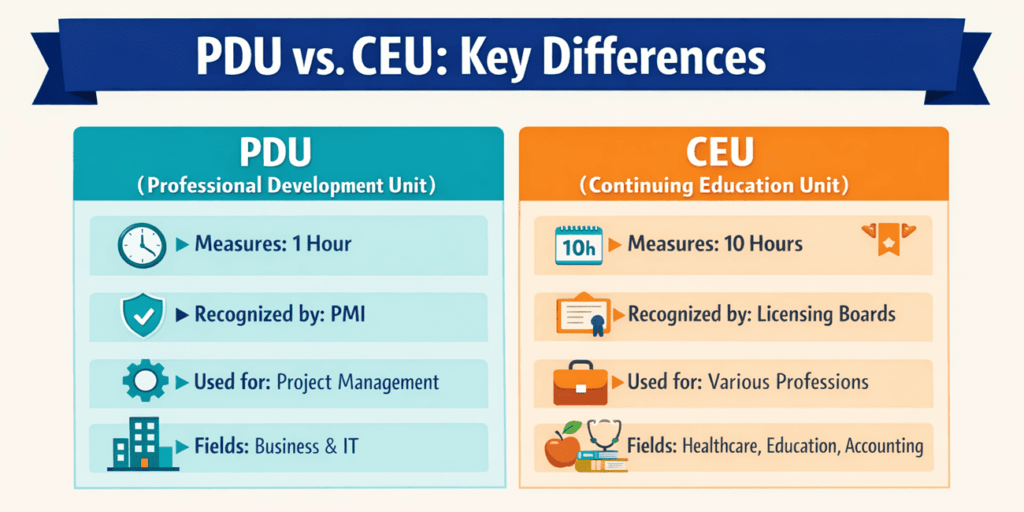
PDUs are accepted only by PMI, and CEUs are accepted by licensing boards across many fields. The units aren’t interchangeable because each organization sets its own standards. The comparison below highlights the core differences.
Conversion and Dual Certifications
Some professionals carry more than one credential. For instance, a project manager who is also a licensed engineer may need both PDUs and CEUs. Many training providers state both values for their courses to help such individuals. However, there is no one-to-one conversion between PDUs and CEUs.
A common ratio is 0.1 CEU equals one PDU, but always check with both PMI and your licensing board because acceptance policies vary. Keeping a spreadsheet of your hours, the categories they apply to, and any dual credits can save you time when it comes to renewal.
Strategies for Managing Multiple Certifications
Balancing multiple professional certifications requires planning.
The following are some practical tips:
- Plan your renewal cycles: Write down the renewal deadlines for each certification. Align them when possible so that you can concentrate on your learning in the same year.
- Choose integrated courses: Look for courses that provide both PDUs and CEUs. Even though conversion isn’t exact, dual-credit offerings reduce the number of separate classes you need to take.
- Use a single tracking system: Keep a simple log or spreadsheet. Record the course name, date, hours, and which certification it supports. Many people find a mobile app or cloud spreadsheet helpful because it’s always accessible.
- Confirm requirements early: Before enrolling, confirm that the course meets the specific rules for your license. If you need PDUs, check that the topic aligns with the Talent Triangle; if you need CEUs, check the accreditation status.
- Engage with communities: Join your PMI chapter or a professional association in your field. These groups often host events that offer PDUs and CEUs and can help you find accredited opportunities.
Managing multiple credentials doesn’t have to feel overwhelming. With a bit of organization, you can meet all your requirements while focusing on learning that benefits your career.
FAQs
Q1. How many PDUs do I need to maintain my PMP certification?
You must earn 60 PDUs in a three-year cycle. At least 35 must come from education, and no more than 25 can come from giving back.
Q2. How many hours are in one CEU?
One CEU equals ten contact hours of structured learning under qualified instruction.
Q3. Are PDUs accepted by state licensing boards?
No. PDUs are recognized only within the Project Management Institute framework. State licensing boards usually require CEUs or other units specific to their profession.
Q4. Can a course count for both PDUs and CEUs?
Some providers list both values, but there is no direct conversion. 0.1 CEU is often considered equivalent to one PDU, but you should verify acceptance with each organization.
Q5. What happens if my PDUs or CEUs are audited?
You must provide documentation such as certificates or attendance records. Keep copies of all proofs of participation for several years in case your renewal is audited.
Summary
Understanding the difference between CEU and PDU helps you maintain certifications and plan learning effectively. PDUs are specific to PMI credentials and measure project management development, while CEUs apply across many regulated professions. Choosing the right learning activities ensures compliance, career growth, and continuous skill improvement. By tracking credits properly and selecting accredited training, professionals can stay competitive, meet renewal requirements with confidence, and build a strong foundation for long-term professional success.
Further Readings:

I am Mohammad Fahad Usmani, B.E. PMP, PMI-RMP. I have been blogging on project management topics since 2011. To date, thousands of professionals have passed the PMP exam using my resources.