monday.com and Jira are two popular project management tools that help businesses streamline daily tasks, manage teams, run operations efficiently, access important attachments and documents, communicate with team members in real-time, and gain insights into their business through reports and dashboards.
In this article, I will explain both software options to help you decide which is best for your needs.
Let’s start with monday.com.
What is monday.com?
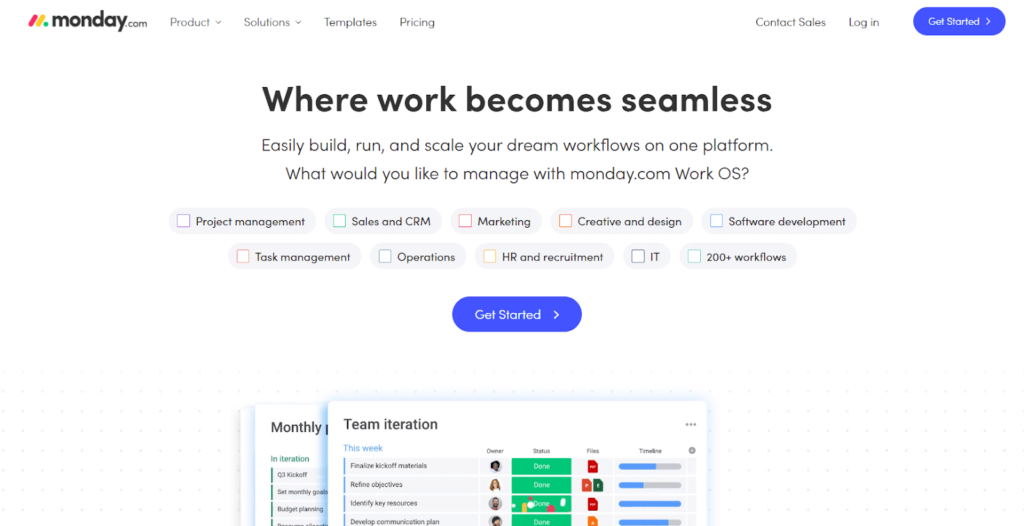
monday.com is a complete project management software launched as DaPulse before being rebranded as monday.com in 2017. This powerful platform, founded in 2012 by Roy Mann and Eran Zinman, offers robust project management features.
monday.com provides solutions across various industries for project management, task management, sales and CRM, software development, operations, inventory tracking, human resources, and more. Over 225,000 customers in 141 countries trust this software, with major brands like Adobe, Coca-Cola, L’Oréal Paris, BBC Studios, and Discovery Channel among them.
Key Features of monday.com
User-Friendly Interface
Monday.com features a clean, intuitive interface packed with functionality. Within the platform, you can create tasks, assign them to team members, set priorities, share files, and start conversations. The streamlined layout makes it easy to manage tasks and projects in one place.
Multiple Views
The platform offers various viewing options to help visualize data. Users can switch between timelines, boards, charts, calendars, card views, tables, Kanban boards, and Gantt charts. Its drag-and-drop interface allows for easy movement of task cards.
Workload Management
One standout feature is the Workload view, which shows the distribution of tasks among team members. This allows you to quickly identify team members who are overloaded or underloaded and reassign tasks as necessary to optimize efficiency.
Automation
Automation features save time by setting up “if-this-then-that” rules. These rules allow for automated reactions to specific actions, streamlining repetitive processes.
Integrations
monday.com integrates with various third-party applications, such as Mailchimp, Slack, Zoom, Outlook, Salesforce, HubSpot, and more, making it adaptable to various business needs.
Read my monday.com review.
Ratings

I have used Capterra’s reviews in this article. As Capterra is a trustworthy review platform, we can rely on it.
On Capterra, 5146 users have rated Monday.com 4.6 stars out of 5.
Pros of monday.com
- User-friendly Interface: Easy to use and navigate, even for beginners.
- Customizable Views: Offers different ways to visualize data, like boards, charts, and timelines.
- Task Management: You can create, assign, and prioritize tasks easily.
- Automation: Automates repetitive tasks, saving time and effort.
- Workload Management: Helps balance team members’ tasks to prevent overload.
- Integration Options: Connects with popular apps like Slack, Zoom, and Salesforce.
- Scalable: Suitable for both small teams and large organizations.
Cons of monday.com
- Cost: This can be expensive, especially for smaller teams or startups.
- Learning Curve: Some advanced features may take time to understand fully.
- Limited Free Plan: The free version has restricted features and user limits.
- Overwhelming at First: The many features can feel overwhelming for new users.
- Limited Offline Access: This is a cloud-based solution that requires an internet connection to function.
monday.com Pricing
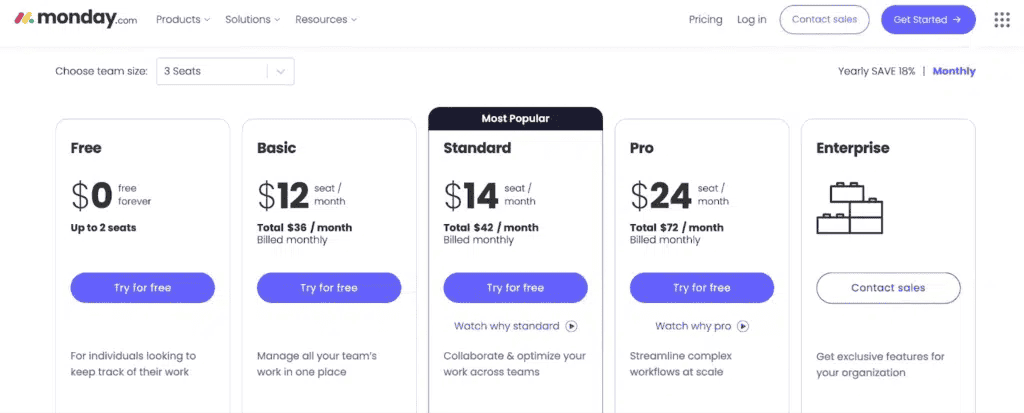
monday.com offers five pricing plans:
- Free: A newly introduced plan that is completely free of charge.
- Basic: This plan starts at 12 USD per seat per month.
- Standard: Pricing for this plan begins at 14 USD per seat per month.
- Pro: This plan starts at 24 USD per seat per month.
- Enterprise: For pricing details on this plan, please contact the monday.com sales team.
All plans come with an 18% discount when billed annually.
What is Jira?

Before diving into Jira, it is important to understand its parent company, Atlassian. Atlassian is an Australian software company founded in 2002 by college friends Mike Cannon-Brookes and Scott Farquhar. The company creates technology solutions that help organizations work more efficiently.
The name “Jira” comes from “Gojira,” the Japanese word for Godzilla, inspired by another bug-tracking tool called Bugzilla.
Atlassian offers multiple Jira products, each tailored for different needs:
- Jira Software: A project management tool for software development and issue tracking.
- Jira Work Management: Best suited for non-IT teams to manage their work.
- Jira Service Management: A platform for service desk support.
- Jira Align: Helps align business strategy with project execution.
Each Jira product has its pricing structure based on its unique offerings. In this article, we will compare monday.com with Jira Software, the leading project management tool for software development teams. Jira Software is widely trusted and has over 260,000 customers, including major companies like eBay, VISA, Square, and Cisco.
Key Features of Jira Software
Kanban Board and Interface
Jira’s Kanban Boards make task management easy by clearly displaying tasks in “to-do,” “in-progress,” and “done” columns. You can customize the boards by renaming them, adding new ones, and moving tasks via drag-and-drop. Users can create tasks (or issues), assign them, and add labels, descriptions, comments, attachments, tags, and subtasks—all of which help streamline complex projects.
Roadmaps
Jira’s roadmaps help teams plan project timelines and task sequences. This feature, commonly used by product management teams, clearly visualizes the project’s process and progress.
Automation
Jira excels in automation, allowing users to set rules and triggers to automate repetitive tasks. Its drag-and-drop interface makes creating automation rules easy and offers hundreds of pre-built templates to get started.
Reporting
Jira provides detailed insights into project progress with customizable dashboards. These dashboards allow users to view their activities, assigned tasks, and project status in one place. You can choose from various data presentations to suit your reporting needs.
Integrations
Jira connects with over 3,000 applications, ensuring a seamless experience by integrating with the tools you already use.
Ratings

4.4 stars out of 5 given by 14,690 users is a great score.
Pros of Jira
- Excellent for Agile Teams: Tailored for agile project management with features like Scrum and Kanban boards.
- Advanced Customization: Highly customizable workflows and issue tracking to fit various project needs.
- Detailed Reporting: Offers robust reporting tools like burndown charts and sprint reports for performance tracking.
- Integration Options: Integrates well with many tools, including Confluence, Slack, and GitHub.
- Scalable: Suitable for small and large teams, from startups to enterprises.
- Automation: Allows automation of tasks and workflows to boost efficiency.
- Strong developer Tools: Great for software development teams with built-in issue tracking and release management.
Cons of Jira
- Complex Setup: It can be difficult to set up and configure for new users.
- Steep Learning Curve: The advanced features and customization options require time to master.
- Costly for Large Teams: Pricing can increase significantly as team sizes grow.
- Overwhelming for Small Projects: It may feel too complex for small or simple projects.
- Performance Issues: Large projects with many tasks can sometimes slow down the platform.
Jira Pricing
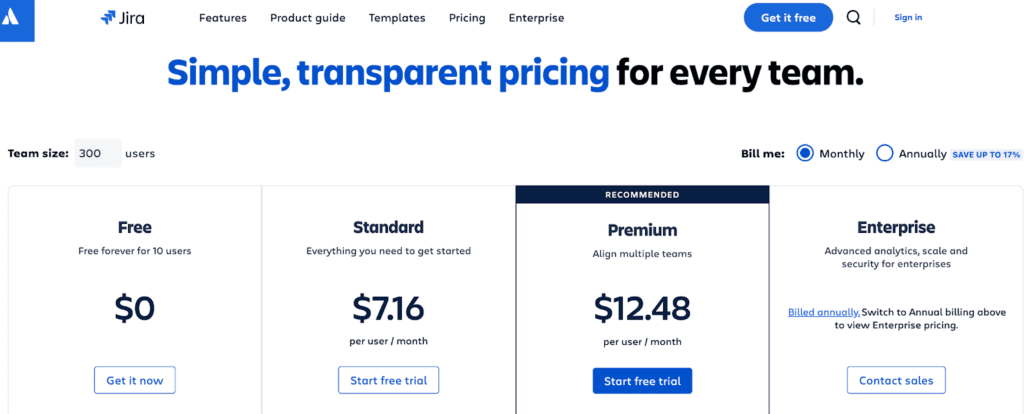
Jira offers four pricing plans:
- Free: This is a complimentary plan.
- Standard: This plan starts at 7.16 USD per user per month.
- Premium: The pricing for this plan begins at 12.48 USD per user per month.
- Enterprise: For pricing details, please contact their sales team.
monday.com Vs Jira
Features
I have outlined the features of both monday.com and Jira Software above. While both platforms offer similar tools to help businesses manage projects efficiently, Jira Software is specifically designed for software teams, making it an ideal choice for technical users.
On the other hand, monday.com is more suited for non-technical teams, though its high level of customization makes it versatile for various types of projects.
One notable difference is that monday.com lacks features like roadmaps available in Jira Software.
Conclusion: If you are part of a software development team, I recommend choosing Jira Software. However, for individual users or non-technical teams, monday.com is a better fit.
User Experience
A platform becomes ineffective if it is difficult to use, which is why the software’s interface is crucial.
Both monday.com and Jira Software offer drag-and-drop functionality for easy customization, quick-start templates, and comprehensive guides or knowledge bases.
From my experience with both platforms, here’s my take:
With monday.com, I found the interface intuitive enough that I didn’t need to rely on the tour guide or knowledge base. However, I did need those resources with Jira Software at times, as navigating certain features or understanding specific functions was occasionally challenging.
Conclusion: Based on my user experience, I consider monday.com the most user-friendly option.
Pricing
I have covered the pricing structures for both platforms in their respective sections.
monday.com uses a tiered pricing model based on the size of your team. It starts with a minimum of 3 users and then increases to 5, 10, 15, 20, etc.
Jira, on the other hand, follows a per-user pricing structure. If your team consists of 6 people, you’ll only pay for 6 seats, offering more flexibility for smaller teams.
When comparing prices, Jira’s Premium plan costs $12.48 per user per month, while monday.com’s Pro plan, which is equivalent to Jira’s Premium plan, costs $24 per user per month. Jira’s pricing is more affordable across all plans.
Jira offers discounts for teams with more than 101 users, while monday.com does not provide such discounts.
Storage Comparison
- monday.com offers 500 MB for the free plan, 5 GB for the Basic plan, 20 GB for the Standard plan, 100 GB for the Pro plan, and 1000 GB for the Enterprise plan.
- Jira Software provides 2 GB for the free plan, 250 GB for the Standard plan, and unlimited storage for both the Premium and Enterprise plans.
Conclusion: Jira Software is the winner based on pricing and storage.
Support
monday.com offers 24/7 customer support across all its plans, including the free version. They provide a comprehensive support center for self-help with videos, webinars, articles, a knowledge base, and a community forum. They offer one-on-one training.
On the other hand, Jira Software provides support through community forums, user guides, and tips. The free plan includes access to the community forum only. Support is available during business hours with the Standard plan, while 24/7 customer support is only offered with the Premium and Enterprise plans.
Conclusion: In terms of support, monday.com is the clear winner.
Examples of monday.com and Jira
monday.com
monday.com is a robust platform ideal for teams in creative, event planning, sales, and HR roles, offering visually engaging tools and flexibility for diverse projects.
1. Creative Teams
- Use Case: Advertising agencies, marketing teams, and design studios.
- Why It Works: The visually appealing interface allows creative teams to easily track projects, manage tasks, and collaborate on ideas. Customizable boards enable teams to tailor workflows for brainstorming sessions, content calendars, and campaign management.
2. Event Planning Teams
- Use Case: Event coordinators and planners.
- Why It Works: Teams can utilize the timeline and calendar views to manage event logistics, timelines, and resources. Features like file sharing and real-time updates keep everyone on the same page leading up to the event.
3. Sales and CRM Teams
- Use Case: Sales teams managing leads and client relationships.
- Why It Works: monday.com’s flexible pipelines can help track leads through different sales process stages, with easy updates and visual dashboards for quick overviews of sales performance.
4. HR Teams
- Use Case: Human resources managing recruitment and onboarding processes.
- Why It Works: HR teams can create workflows to track candidate applications, onboarding tasks, and employee performance reviews, ensuring efficient processes and communication.
Jira
Jira is particularly suited for software development, IT operations, QA, and product management teams that require detailed tracking, Agile methodologies, and integration with development workflows.
1. Agile Development Teams
- Use Case: Software development teams working with Agile methodologies (Scrum, Kanban).
- Why It Works: Jira offers robust tools for sprint planning, backlog management, and release tracking. Its ability to create user stories and epics aligns well with Agile workflows, making it easier to adapt to changes.
2. IT Operations Teams
- Use Case: IT teams managing incidents, changes, and service requests.
- Why It Works: Jira Service Management helps IT teams respond to issues quickly and improve service delivery with features like incident tracking and customizable workflows.
3. QA and Testing Teams
- Use Case: Quality assurance teams focused on testing and bug tracking.
- Why It Works: Jira’s issue tracking system allows QA teams to log bugs, track their resolution, and ensure all requirements are met before releases. Integration with development tools enables seamless collaboration between QA and development teams.
4. Product Management Teams
- Use Case: Product managers overseeing product development and feature releases.
- Why It Works: Jira’s road mapping and backlog management capabilities help product teams prioritize features and track progress against timelines, facilitating better communication with development teams.
Comparison Table
The following table shows the key differences between the features and benefits of monday.com and Jira:
| Feature/Benefit | monday.com | Jira |
| Project Management | Flexible project views (Kanban, Gantt, Calendar) | Robust Agile project management with Scrum and Kanban |
| User Interface | Intuitive and visually appealing | Functional but can be complex for new users |
| Customization | Highly customizable boards and workflows | Custom issue types, workflows, and fields |
| Integrations | Wide range of integrations (Slack, Google Drive, etc.) | Strong integrations with development tools (Bitbucket, Confluence) |
| Collaboration Tools | Real-time collaboration features (comments, tags) | Collaboration through comments and mentions, especially for development teams |
| Reporting and Analytics | Visual reporting tools and dashboards | Advanced reporting capabilities (burn-down charts, sprint reports) |
| Task Management | Easy task creation and management | Detailed task tracking with statuses and priorities |
| Automation | Built-in automation features | Automation rules for repetitive tasks and workflows |
| Mobile App | Comprehensive mobile app for task management | The mobile app focused on issue tracking and management |
| Pricing | Competitive pricing with tiered options | Tiered pricing with a focus on larger teams |
| Ideal For | Teams across various industries, especially non-tech | Primarily for software development and IT teams |
Conclusion
When comparing features, monday.com comes out ahead with a 2-1 score over Jira.
However, it’s important to note that Jira Software is highly intelligent, and choosing between these platforms depends on your needs. If I had a software team, I’d opt for Jira Software, as it’s tailored for technical teams. For non-technical users, though, I’d recommend monday.com due to its broader features, intuitive interface, and strong customer support.
If budget is a priority, Jira Software is the better option. Although it’s designed primarily for technical teams, it can also be useful for non-technical teams and help your business save money. Ultimately, choosing software is a subjective decision. Select the platform that meets your needs, fits your budget, and supports your long-term goals.
Before you decide, I highly recommend using both platforms’ free trials. Testing them will help you better understand which software best suits your needs.
I hope this article has helped you choose between these two leading project management tools.
Some links in this post are affiliate links, and I will earn a commission if you purchase after clicking. Please understand that I recommend these resources because they are useful, not just because of my commissions. Please do not purchase unless you need the materials to achieve your goals. Read the disclaimer.

I am Mohammad Fahad Usmani, B.E. PMP, PMI-RMP. I have been blogging on project management topics since 2011. To date, thousands of professionals have passed the PMP exam using my resources.