Keeping your PMI certification active is essential if you want to stay relevant in today’s fast-changing project environment. The PMI Continuing Certification Requirements (CCR) program ensures that certified professionals continue to grow their skills and knowledge over time.
By earning Professional Development Units (PDUs), you not only maintain your credential but also strengthen your ability to manage projects effectively. Whether you hold a PMP, CAPM, or another PMI certification, understanding the latest PDU requirements is key.
This blog post explains the PMI CCR program in a simple way, so you can plan your learning, track your progress, and renew your certification with confidence.
What is the PMI CCR Program?
The Project Management Institute created the CCR program to help certificants continually strengthen their skills. Every PMI credential is valid for a three-year cycle. During that time, holders must earn a certain number of professional development units (PDUs) and log them in the online Continuing Certification Renewal System.
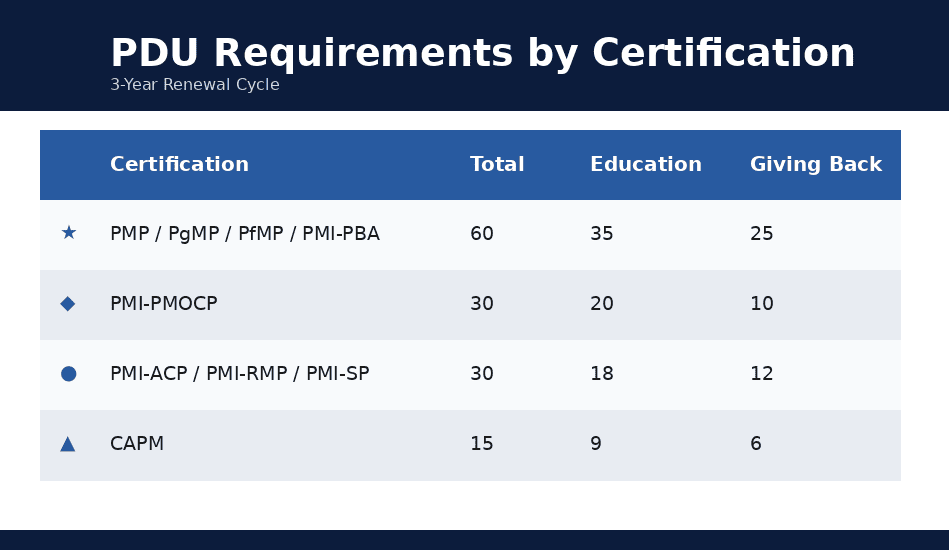
For major certifications such as Project Management Professional (PMP), Program Management Professional (PgMP), Portfolio Management Professional (PfMP), and Professional in Business Analysis (PMI-PBA), holders must earn 60 PDUs every three years. At least 35 PDUs must come from education activities, while up to 25 PDUs may come from giving back to the profession. In addition, a minimum of eight PDUs in each of the three PMI Talent Triangle skill areas is required.
Other certifications have different totals. The PMI Project Management Office Certified Professional (PMI-PMOCP) requires 30 PDUs, with 20 in education and 10 in giving back. The Certified Associate in Project Management (CAPM) requires 15 PDUs, including nine education PDUs and six giving-back PDUs.
PDU Requirements by Certification
To visualize the current PDU requirements, the infographic below summarizes the cycle length, total PDUs, and the split between education and giving back for major PMI credentials.
Breaking Down the PMI Talent Triangle
PMI’s Talent Triangle reflects the balance of skills required for success. In 2021, the institute updated the categories to Ways of Working, Power Skills, and Business Acumen. Ways of Working covers methods, frameworks, and delivery approaches. Power Skills include leadership, communication, and team-building. Business Acumen encompasses industry knowledge, strategic thinking, and the ability to connect projects to organizational goals.
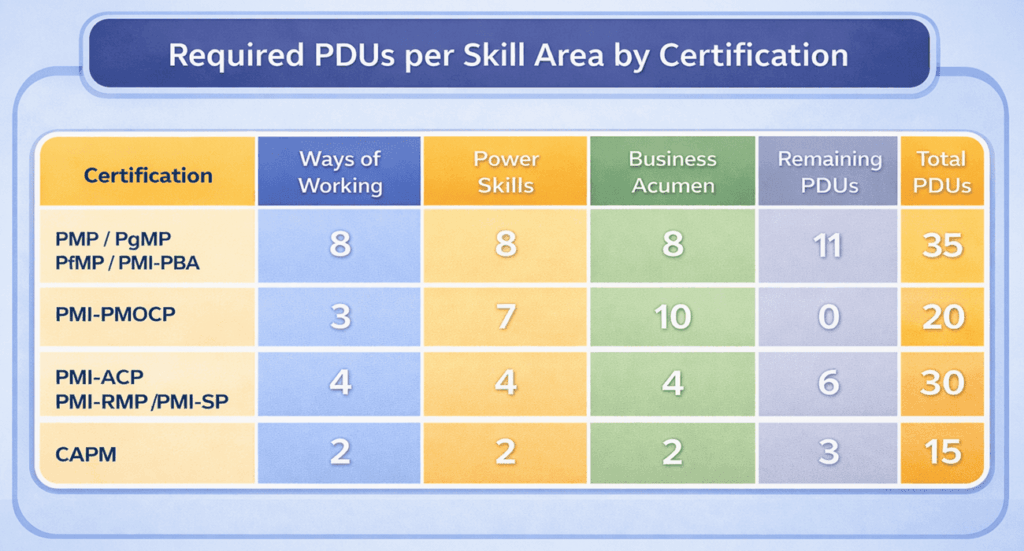
For PMP, PgMP, PfMP, and PMI-PBA holders must earn at least eight PDUs in each skill area. PMI-PMOCP holders must obtain three PDUs in Ways of Working, seven in Power Skills, and ten in Business Acumen, while CAPM holders need two PDUs in each area.
The following infographic illustrates these minimums:
How to Earn PDUs
PDUs come from educational and giving-back activities. Education PDUs include instructor-led courses, online training, webinars, and self-study. These hours help you learn new practices and stay current. For example, attending a three-hour Agile workshop would earn three education PDUs. You may earn all of your required PDUs in the education category if you prefer.
Giving back PDUs recognize your contributions to the profession. Working as a practitioner, volunteering for a local PMI chapter, mentoring new project managers, or creating content (such as articles or webinars) all count toward this category. PMP holders can claim up to 25 PDUs for giving back during each cycle.
Serving as a project manager on a complex internal initiative might earn eight PDUs (the maximum allowed for work as a practitioner), while writing an article or presenting at a conference can earn additional units.
Benefits of Maintaining Your PMI Certification
Why invest time in renewal? First, it keeps your skills sharp and ensures you’re up to date with evolving methods. Second, certification renewals demonstrate commitment and professionalism to employers. PMI’s 2025 salary survey found that PMP-certified respondents earn a median salary 17% higher than their non-certified peers. In the United States, PMP holders reported a median salary of $135,000, 24% higher than that of those without the credential. Nearly 60% of certified respondents received a raise in the past year, with most increases up to 10%. These figures highlight the tangible return on maintaining your certification.
Demand for project talent continues to grow. PMI’s 2025 Global Project Management Talent Gap report projects that the world could need up to 30 million additional project professionals by 2035, with demand increasing by 64 % from 2025 to 2035. Keeping your certification current ensures you remain competitive as industries transform.
Steps to Record PDUs in the CCRS
Recording your activities is straightforward. First, log in to your myPMI account and access the Continuing Certification Renewal System. Second, enter each PDU activity (course, webinar, volunteer work, or article) with details such as provider, date, and number of units. Finally, pay the renewal fee when PMI notifies you. Once approved, your credential will be valid for another three-year cycle.
FAQs
Q1. How often do I need to renew my PMP certification?
Every PMI credential operates on a three-year cycle. You must earn and record the required PDUs before the cycle ends.
Q2. What counts as a PDU?
A PDU represents one hour of structured learning or professional service. Education PDUs come from courses, webinars, or self-study. Giving back PDUs comes from working as a practitioner, volunteering, or creating content.
Q3. Can I earn all my PDUs through education?
Yes. For most certifications, you may earn the full PDU requirement through education activities as long as you meet the minimum skill-area requirements.
Q4. What happens if I’m audited?
A small percentage of renewal submissions are audited. During an audit, PMI may request proof of your PDU activities, such as certificates of completion or letters verifying volunteer work. Keeping records makes the process easy.
Summary
Maintaining your PMI certification is a smart investment in your career. It keeps your skills fresh and shows your commitment to growth. By understanding PDU requirements and planning ahead, you can avoid last-minute stress. The CCR program is simple once you follow a clear path. Keep learning, track your progress, and stay consistent. When you renew on time, you protect your credibility and open doors to better opportunities in project management.
References:
Further Readings:

I am Mohammad Fahad Usmani, B.E. PMP, PMI-RMP. I have been blogging on project management topics since 2011. To date, thousands of professionals have passed the PMP exam using my resources.