Many PMP aspirants worry about how wrong answers might affect their exam scores. The fear of losing marks often makes candidates hesitate before selecting an answer they’re unsure about.
Understanding how the PMP exam is scored is an integral part of your preparation strategy. Before attempting the test, it helps to know whether incorrect answers affect your score and how to handle uncertain questions.
In this blog post, I will explain about the PMP exam negative marketing, how the PMP exam treats wrong answers, what scoring approach the Project Management Institute uses, and how you can make the most of every question on the test.
Is There Any Negative Marking in the PMP Certification Exam?
Many PMP aspirants worry about losing marks for wrong answers. The good news is that the PMP exam has no negative marking. You won’t lose any points for choosing an incorrect answer.
Negative marking means losing marks for incorrect answers. For example, if each wrong answer deducts 0.25 points, you’d hesitate before guessing. The Project Management Institute (PMI) does not use negative marking for the PMP exam.
This means you can safely attempt every question without fear of penalty.
PMP Exam Structure
The PMP certification exam includes 180 questions that test your understanding of project management principles.
The questions are divided as follows:
- People Domain: 42%
- Process Domain: 50%
- Business Environment: 8%
You have 230 minutes to complete the test, which includes two 10-minute breaks. Out of 180 questions, 175 are scored, and 5 are unscored pretest questions. These unscored questions help PMI evaluate future test items.
Why You Should Never Leave Any Question Blank
Since there’s no penalty for wrong answers, leaving a question blank is a missed opportunity.
Imagine this:
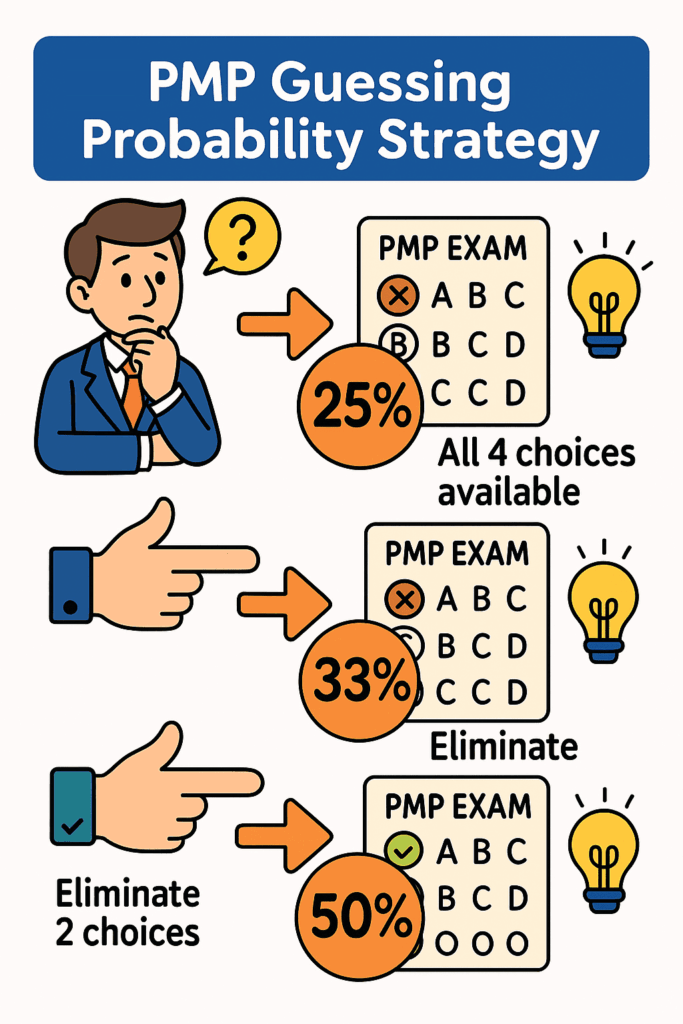
- Each question has four options.
- If you guess blindly, you have a 25% chance of picking the correct one.
- If you can eliminate one wrong choice, your chance improves to 33%.
- Eliminate two, and your odds jump to 50%.
This simple elimination strategy can make a big difference, especially on tough questions.
Smart Guessing Techniques for the PMP Exam
When you’re unsure about an answer, use these techniques to make educated guesses:
- Eliminate obviously wrong options: Remove choices that contradict PMBOK concepts or sound extreme (like “always” or “never”).
- Look for process-based logic: The PMP exam focuses on process and reasoning, not memorization. Choose the answer that aligns with PMI best practices.
- Avoid emotional responses: Some answers sound “nice” but aren’t correct from PMI’s perspective. Stick to logic, not sympathy.
- Read each question carefully: Words like except, first, or most likely can change the meaning completely.
- Mark and return later: Use the review feature to revisit flagged questions if time allows.
Understanding PMP Exam Scoring
PMI uses a psychometric analysis to determine the passing score. This means there’s no fixed percentage like 70% or 80%. Instead, each question has a different difficulty weight.
Even PMI doesn’t disclose the exact passing score. The result categories are:
- Above Target
- Target
- Below Target
- Needs Improvement
So, the more questions you answer, the higher your chance of hitting “Target” or “Above Target.”
Common Myths About Negative Marking
Here are a few myths PMP aspirants often believe:
- Myth 1: Wrong answers reduce your score.
Fact: They don’t. You only earn points for correct answers. - Myth 2: Leaving questions blank improves your average.
Fact: Blank answers don’t earn any marks. - Myth 3: Guessing can harm your result.
Fact: Guessing smartly can increase your chances of passing.
How to Manage Time During the PMP Exam
Time management plays a significant role in finishing all questions.
Try this strategy:
- Spend about 1.2 minutes per question (230 minutes ÷ 180 questions).
- Don’t get stuck on one question. Mark it and move on.
- Use the final 15–20 minutes to review unanswered questions.
Pro Tip: Prioritize easy questions first (80% of time on 80% of the score).
Example Scenario
Let’s say you face a question about how to handle stakeholder conflict. You’re unsure of the exact process.
You can eliminate two options that clearly don’t fit PMI’s best practices.
Now, you have two left — that’s a 50% chance of being right. By applying elimination, you turn uncertainty into opportunity.
Final Exam Tip: Stay Calm and Confident
During the test, stay calm and focused. If you encounter tough questions, take a deep breath and use logical reasoning. Remember, you’re not penalized for trying — but you gain nothing from skipping.
A confident mindset can often make the difference between passing and failing.
FAQ
Q1. Is there any negative marking in the PMP exam?
No, there’s no penalty for wrong answers on the PMP exam.
Q2. Should I guess if I don’t know the answer?
Yes, always guess instead of leaving it blank. You might guess correctly.
Q3. How many questions are on the PMP exam?
The PMP exam has 180 questions, including five unscored ones.
Q4. How long is the PMP exam?
You get 230 minutes (about 3 hours and 50 minutes) to finish.
Q5. How can I increase my chances of guessing correctly?
Eliminate unlikely answers and choose the most logical one.
Summary
The PMP exam has no negative marking, so don’t fear wrong answers. Attempt every question. Use elimination to improve your odds and manage your time wisely.
First, answer questions you know. Then return to the rest and apply smart guessing. Every attempt counts toward your final score.
Take Action Today:

I am Mohammad Fahad Usmani, B.E. PMP, PMI-RMP. I have been blogging on project management topics since 2011. To date, thousands of professionals have passed the PMP exam using my resources.