When one person’s actions injure another, courts use compensatory damages to make the injured party whole. These damages reimburse actual losses and recognize harder-to-measure harms such as pain and suffering. Understanding how courts calculate these awards and how they differ from punitive penalties helps consumers and businesses plan ahead.
This guide explains the compensatory damages in plain language and draws on recent data to show trends. It also offers practical examples and tips for anyone considering a lawsuit.
Let’s get started.
What Are Compensatory Damages?
Compensatory damages are money paid to someone who was harmed. The goal is simple: return the injured party to as close to their pre-injury position.
Unlike fines or penalties, which punish wrongdoers, compensatory awards repay specific losses. The plaintiff must show that the defendant’s conduct caused the harm and then prove the value of those losses.
Types of Compensatory Damages
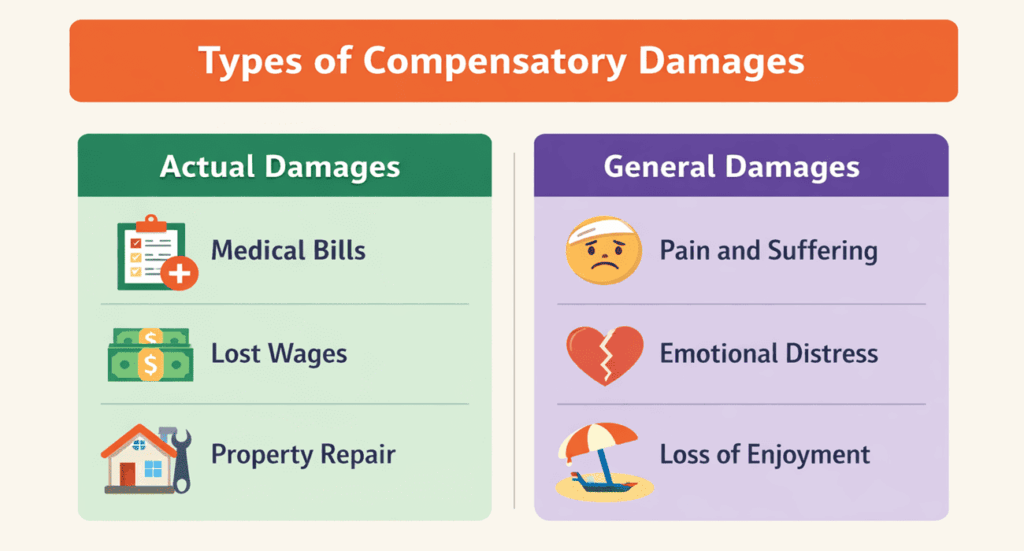
Courts often separate these damages into two categories: actual (or special) damages and general damages.
Actual Damages (Special Damages)
Actual damages cover measurable financial losses. They include medical bills, rehabilitation costs, lost wages, and property repair. For example, if a driver runs a red light and injures someone, the injured person may sue to recover hospital fees and lost income. The plaintiff must provide receipts or documentation showing the exact amounts.
General Damages
General damages compensate for non-monetary harms. These are harder to quantify because they relate to emotional or physical suffering. They include pain and suffering, emotional distress, loss of enjoyment of life, disfigurement, and loss of companionship. For instance, chronic pain after an accident or the mental anguish from losing a loved one in a wrongful death case may justify general damages. Courts may use multipliers or daily rates to estimate these losses (see Calculating Damages below).
Calculating Compensatory Damages
Courts require evidence to support both actual and general damages. Plaintiffs must collect medical records, bills, pay stubs, and expert testimony. Judges or juries then use different methods to assign a value.
Proof of Loss
- Receipts and bills. Hospital invoices, therapy bills, and proof of medication costs establish medical damages.
- Employment records. Pay stubs and employer statements demonstrate lost wages or reduced earnings capacity.
- Repair estimates. In property damage claims, receipts for car repairs or home restoration show out-of-pocket costs.
- Expert testimony. Doctors or vocational experts may testify about long-term care needs or the impact of injuries on future earnings.
Multiplier Method
Courts sometimes multiply actual damages by a number that reflects the severity of the injury. For example, if actual damages are $20,000 and the judge applies a multiplier of 2.5, the plaintiff would receive $50,000 in general damages. Factors influencing the multiplier include the seriousness of the injury, the likelihood of full recovery, and how clearly the defendant’s actions caused the harm. A higher multiplier signals more severe or permanent harm.
Per Diem Method
This method assigns a daily value to the injured person’s suffering and multiplies it by the number of days the person is expected to suffer. If a judge values pain at \$150 per day and the injured party is expected to experience pain for 365 days, general damages would equal $54,750. Courts consider age, occupation, and medical prognosis when determining the daily rate and duration.
Hybrid Approaches
Some jurisdictions blend the multiplier and per diem methods or adjust them based on statutory caps. Plaintiffs should consult an attorney familiar with local practices to understand how courts in their state calculate awards.
Trends in Damage Awards
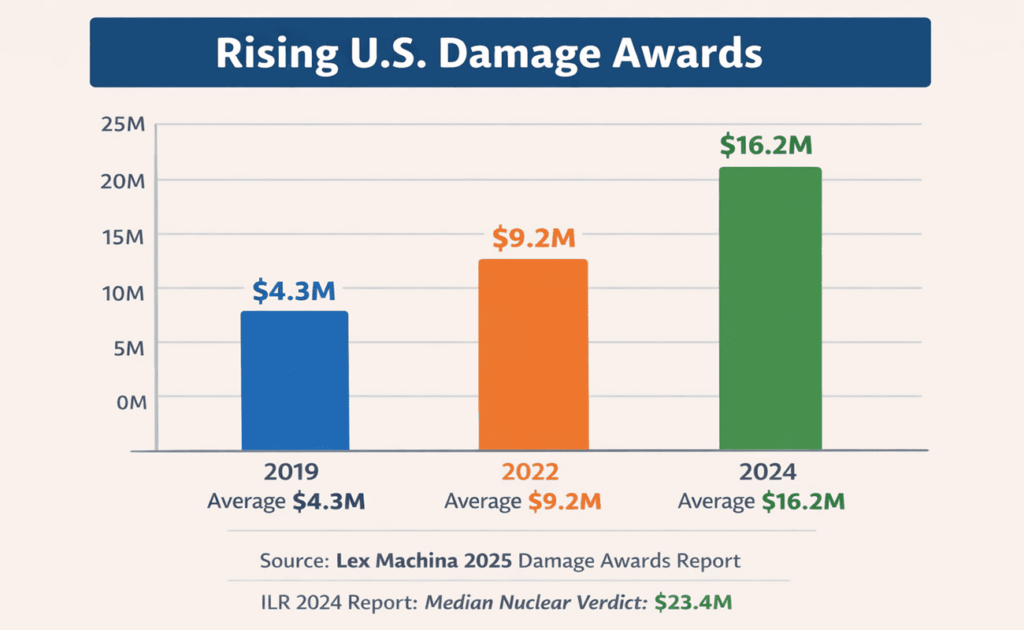
Damage awards have grown in recent years, especially when cases reach juries. According to the Lex Machina 2025 Damage Awards Report, the average jury verdict in favor of plaintiffs rose from $4.3 million in 2019 to $16.2 million in 2024. This trend highlights the potential size of compensatory damages in modern litigation. The chart below illustrates this rise, along with a median nuclear verdict figure from the U.S. Chamber of Commerce’s Institute for Legal Reform (ILR) for context.
The report attributes this growth to several factors:
- “Social inflation.” Plaintiffs’ attorneys use aggressive tactics and appealing narratives to persuade juries, leading to larger awards.
- Shift in case types. Patent infringement and insurance cases have seen particularly large increases in damages.
- Economic conditions. Inflation and rising medical costs may increase actual damages, which in turn raise general damages when courts apply multipliers.
These trends mean defendants face higher exposure, and plaintiffs might seek higher compensation. However, awards also vary widely by state and case type. Median nuclear verdicts for personal injury and wrongful death cases in 2022 stood at $23.4 million. Such data underscores the unpredictable nature of large verdicts.
Caps and Limitations
Some states limit the amount plaintiffs can recover for non-economic damages. These caps are usually imposed to control insurance costs and discourage excessive awards.
- Alaska. Alaska imposes a $250,000 cap on non-economic damages, with a $400,000 cap for wrongful death or severe permanent impairment.
- Colorado. A 2025 law gradually increases the cap on non-economic damages from $300,000 to $875,000 over five years, with adjustments occurring biennially thereafter.
- States without caps. Some states, such as Arizona, prohibit caps on recoverable damages because their constitutions protect the right to full compensation.
Caps apply only to general damages; actual damages are generally not limited. Plaintiffs should check local statutes since caps may differ for medical malpractice, wrongful death, and product liability cases.
Compensatory Vs Punitive and Treble Damages
It is important to distinguish compensatory damages from other forms of monetary awards.
- Punitive damages punish defendants for egregious or malicious conduct. They go beyond making the plaintiff whole and aim to deter similar behavior. Courts award them only when the defendant’s actions were reckless, willful, or fraudulent.
- Treble damages are statutory provisions that allow courts to triple the amount of actual damages when the defendant intentionally violates certain laws (such as antitrust statutes). For example, if actual damages are $100,000, a treble award would be $300,000.
Compensatory damages are the foundation; punitive and treble awards supplement them in exceptional cases. They serve different legal purposes and are subject to different standards and caps.
Real-World Examples
Car Accident Case
Imagine a pedestrian struck by a distracted driver. The victim suffers a broken leg, requiring surgery and physical therapy. The medical bills total $45,000, and they miss six weeks of work, resulting in $10,000 in lost wages. The plaintiff sues and provides hospital invoices, pay stubs, and surgeon testimony regarding future rehabilitation costs. The jury awards $55,000 in actual damages and multiplies general damages by 2 for chronic pain, resulting in an additional $110,000. The total compensatory damages in this case are $165,000.
Employment Discrimination Case
Compensatory damages also arise in civil rights cases. In fiscal year 2024, the U.S. Equal Employment Opportunity Commission (EEOC) secured almost $700 million in monetary relief for about 21,000 victims of workplace discrimination. This recovery included both back pay and compensatory damages for emotional harm. The EEOC’s ability to obtain large settlements illustrates how non-economic losses, such as emotional distress, are recognized under federal law.
Factors Affecting Damages
Several elements influence the size of compensatory awards:
- Severity and permanence of injuries. More serious or permanent injuries usually yield more serious general damages because they produce lasting pain or disability.
- Economic impact. High medical costs and significant lost income increase actual damages and may raise general damages if courts use multipliers.
- Jurisdiction. State laws, caps, and jury attitudes vary widely. A plaintiff in a state with no caps may receive more than someone with a similar case in a capped jurisdiction.
- Plaintiff’s credibility and documentation. Detailed medical records and reliable testimony strengthen a case. A lack of documentation may result in reduced awards or dismissal.
- Defendant’s conduct. Evidence that the defendant acted recklessly or maliciously can influence multipliers or open the door to punitive damages.
How to Pursue Compensatory Damages
If you believe you have a valid claim, consider these steps:
- Seek medical attention immediately. Health comes first. A prompt visit to a doctor also creates records of your injuries.
- Document everything. Keep copies of bills, receipts, prescriptions, and records of missed work. Maintain a journal describing your pain and emotional state.
- Consult a qualified attorney. Laws vary by state. An attorney can assess your case, explain caps and deadlines, and help gather evidence.
- File a claim within statutory limits. Most states impose strict deadlines (statutes of limitations) for filing lawsuits. Missing these deadlines could bar your claim.
- Consider alternative dispute resolution. Mediation or arbitration may result in faster, less costly resolutions than a full trial.
FAQs
Q1. What evidence do I need for compensatory damages?
Collect medical bills, pay stubs, repair invoices, and expert statements. Courts will not guess; they need proof of your losses.
Q2. Can I recover compensation for emotional distress?
Yes. General damages include emotional distress, mental anguish, and loss of enjoyment of life. Provide testimony and documentation to support these claims.
Q3. Are compensatory damages taxable?
Physical injury awards are generally not taxed, but damages for emotional harm without physical injury and punitive damage may be taxable. Consult a tax professional.
Q4. How long does it take to receive damages?
It depends on the case’s complexity and whether it settles or goes to trial. Simple claims may be resolved within months; others can take years.
Q5. What if the defendant cannot pay?
Collecting damages can be difficult if the defendant lacks insurance or assets. Your attorney may explore garnishment or settlement options.
Summary
Compensatory damages help restore fairness after a loss. They aim to return the injured party to the position they held before harm occurred. Courts award these damages based on clear proof, reasonable estimates, and legal limits. Understanding the difference between actual and general damages helps people set realistic expectations. It also helps businesses manage risk and plan insurance coverage. When disputes arise, clear records and expert advice often shape outcomes. Knowing how compensatory damages work leads to better decisions and stronger legal awareness.

I am Mohammad Fahad Usmani, B.E. PMP, PMI-RMP. I have been blogging on project management topics since 2011. To date, thousands of professionals have passed the PMP exam using my resources.