The Disciplined Agile Scrum Master (DASM) credential used to be the starting point for many agile practitioners. It introduced professionals to the Disciplined Agile (DA) toolkit, a set of lean and agile practices designed to help teams deliver value in complex environments.
In 2025, PMI retired the DASM certification and its related courses. As of 2026, the new Disciplined Agile Foundations (DAF) course is the primary entry path into the DA framework.
This blog post explains what Disciplined Agile is, why the retirement happened, how the Foundations course compares to DASM, and how you can succeed in the new agile landscape.
Let’s get started.
Understanding Disciplined Agile
Disciplined Agile is a process-decision toolkit that guides people, teams, and organizations in choosing and improving their way of working (WoW). Unlike one-size-fits-all frameworks, Disciplined Agile combines lean and flow principles with multiple agile and hybrid approaches to help teams adapt to their context. It looks beyond software delivery to include enterprise architecture, IT operations, portfolio management, security, and other domains.
By understanding these activities and the trade-offs among various options, teams can make better decisions and deliver value more quickly.
The DA mindset is built on three pillars:
- Principles – philosophical concepts based on lean and flow that encourage adaptability and value delivery.
- Promises – agreements that team members and stakeholders make with one another to ensure professional, respectful collaboration.
- Guidelines – practical advice that helps teams choose and continuously refine their WoW.
Why Was DASM Retired?
The Project Management Institute (PMI) retired the DASM, Disciplined Agile Senior Scrum Master (DASSM), Disciplined Agile Coach (DAC), and Disciplined Agile Value Stream Consultant (DAVSC) certifications in 2025. The goal was to simplify and modernize PMI’s agile offerings. PMI realized that having several entry-level DA courses created confusion for learners and training partners.
The new approach consolidates learning into a single foundational course that covers essential agile knowledge, then offers advanced paths for experienced practitioners.
According to PMI, Authorized Training Partners stopped delivering DASM, DASSM, DAC, and DAVSC courses by May 31, 2025, and the final date to sit for those certification exams was November 30 2025. Existing DASM certifications remain valid, but new students should enrol in the Disciplined Agile Foundations course.
Introducing Disciplined Agile Foundations
The Disciplined Agile Foundations (DAF) course is the new entry point into the DA framework. Instead of a two-day DASM course, DAF can be completed in a one-day or two-day format. Approved training providers deliver an interactive workshop that covers the DA toolkit, lean and agile principles, and how to tailor your team’s WoW to your unique context.
The Foundations course teaches participants to tailor agile practices to their context and improve decision-making. It also provides up to 8 hours of interactive learning, 8 Professional Development Units (PDUs) toward PMI certifications, and a 1-year PMI membership for participants.
The DAF course is an eight-hour workshop designed for project managers, team leaders, and consultants. It teaches participants to optimise workflows, accelerate delivery, and improve continuous improvement. Through real-world case studies and interactive exercises, learners learn to identify challenges, select the right agile or lean techniques, and develop an actionable improvement backlog.
DASM Vs DAF: Key Differences and Similarities
To visualise the shift from DASM to DAF, the following infographic compares key aspects of both programs.
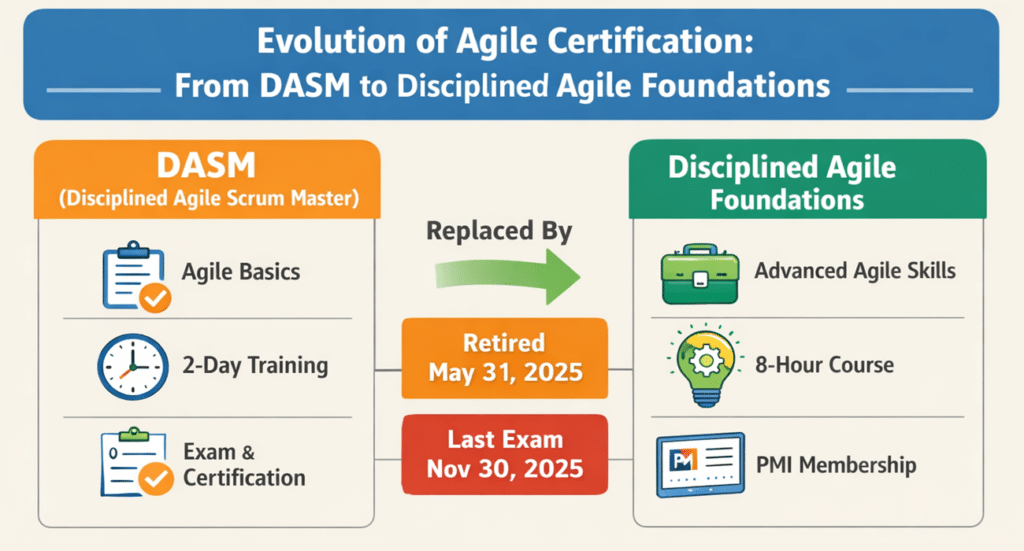
Key takeaways:
- Format – DASM was delivered as a two-day instructor-led course that covered several agile frameworks. DAF offers a shorter duration and focuses on tailoring practices rather than memorising a fixed set of methods.
- Schedule – The last DASM exam could be taken on November 30 2025. DAF classes are available in 2026 and beyond.
- Learning outcome – Both programs introduce agile and lean fundamentals, but DAF emphasises customising the WoW for each team and using the DA decision framework.
Salary and career impact
A major reason professionals pursue agile certifications is career growth. Scrum.org’s Scrum Master Salary Report 2024 reveals that the average salary for survey participants was about $87,800. The study surveyed 1,114 participants globally and found that advanced agile certifications lead to significant salary increases.
The median difference between having no certification and holding an advanced certification is about $16,000 per year, and additional qualifications can add up to $35,000 per year. Experience also matters; senior scrum masters earn roughly $22,000 more than junior peers.
While these figures are based on Scrum roles, they offer insight into the value employers place on agile skills. For professionals transitioning to Disciplined Agile, a combination of certifications and experience can lead to higher salaries, greater leadership opportunities, and the ability to work in high-paying sectors such as finance, technology, and insurance.
How to Earn Your Disciplined Agile Foundations Certification
Earning the DAF certification involves several steps. Following a structured approach will help you pass the exam and apply your skills immediately.
- Learn agile fundamentals. Start by reading the Agile Manifesto, the Scrum Guide, and PMI’s introductory materials. Understanding the values and principles of agile will make the DA toolkit easier to digest.
- Enroll in a PMI-authorized training. Choose a training provider that offers the DAF course in your preferred format (live virtual or in-person).
- Study and practice with the DA toolkit. Use the materials provided in your course to explore DA’s decision framework. Practice tailoring agile practices using sample scenarios and case studies.
- Take and pass the exam. After completing the course, register for the exam through PMI. It is a multiple-choice test that assesses your understanding of agile principles, the DA decision framework, and tailoring WoW to different contexts.
- Apply your skills and continue learning. After passing the exam, join a community of DA practitioners, apply your new skills to real projects, and consider advanced certifications or continuous improvement workshops.
Tips for Success
- Start with your why. Before enrolling, consider why you want to pursue Disciplined Agile. Do you want to lead teams more effectively, increase your marketability, or improve your organization’s delivery practices? Clarity will help you stay motivated.
- Choose the right training provider. Look for PMI Authorized Training Partners with experienced instructors. Read reviews and ask colleagues for recommendations. A good instructor can make complex concepts accessible.
- Leverage community resources. Join agile meetups, discussion forums, and professional networks. Engaging with peers helps you learn from real-world experiences and build a support network.
- Practice continuous improvement. Disciplined Agile encourages reflecting on what works and adjusting. After completing the course, regularly review your practices and experiment with new techniques. This mindset will serve you throughout your career.
FAQs
Q1. Is my existing DASM certification still valid?
Yes. PMI confirms that anyone who earned the DASM certification before its retirement retains a valid credential. The retirement only affects new students.
Q2. Will the new Foundations course cover the same content?
The Foundations course covers the essential agile knowledge of DASM, but in a refreshed structure. It is designed to offer a stronger starting point for both team-level and enterprise-level learners.
Q3. What if I need advanced DA training?
Advanced certifications such as DASSM, DAC, and DAVSC are being restructured. PMI plans to release updated versions soon. In the meantime, focus on mastering the fundamentals and watch for announcements on the PMI website.
Q4. How long does the DAF course take?
Most providers offer it as a one-day workshop or spread across two half-day sessions. You will earn eight PDUs upon completion.
Q5. Do I need agile experience to enrol?
No. The DAF course welcomes beginners. It covers agile and lean fundamentals and teaches you to tailor practices to your context.
Summary
The Disciplined Agile Scrum Master certification served many professionals well during its tenure, but PMI’s agile program has evolved. In 2026, the Disciplined Agile Foundations course is the essential starting point for anyone seeking to master agile ways of working. By understanding the reasons behind retirement, recognising the benefits of the new course, and following a clear path to certification, you can stay ahead in the ever-changing world of project management.

I am Mohammad Fahad Usmani, B.E. PMP, PMI-RMP. I have been blogging on project management topics since 2011. To date, thousands of professionals have passed the PMP exam using my resources.