
Customer relationship management remains a critical driver of business growth and customer success. The latest CRM statistics highlight how companies rely on data, automation, and AI to improve sales, marketing, and service performance. As the CRM market expands, organizations that invest in modern customer relationship management systems gain better visibility into customer needs and behavior.
These CRM statistics clearly show that CRM is no longer just a tool, but a strategic platform. Businesses that understand CRM trends and the evolving CRM market are better prepared to make informed decisions, improve customer retention, and achieve long-term, sustainable growth.
This blog post breaks down the latest statistics, explains why they matter, and offers guidance on how to use them.
What is CRM?
A CRM system helps you manage relationships with prospects and customers. It consolidates contact details, tracks conversations, and automates tasks such as follow-ups and data entry. Imagine you run a bakery. Instead of scribbling customer orders on sticky notes, a CRM logs each purchase, sends personalized birthday coupons, and reminds you to restock ingredients.
Good CRM tools also integrate with email, chat, and social media so that every customer interaction flows into one place. When data is centralized, your team can provide consistent service and tailor marketing messages to individual preferences.
Market Growth and Adoption Trends
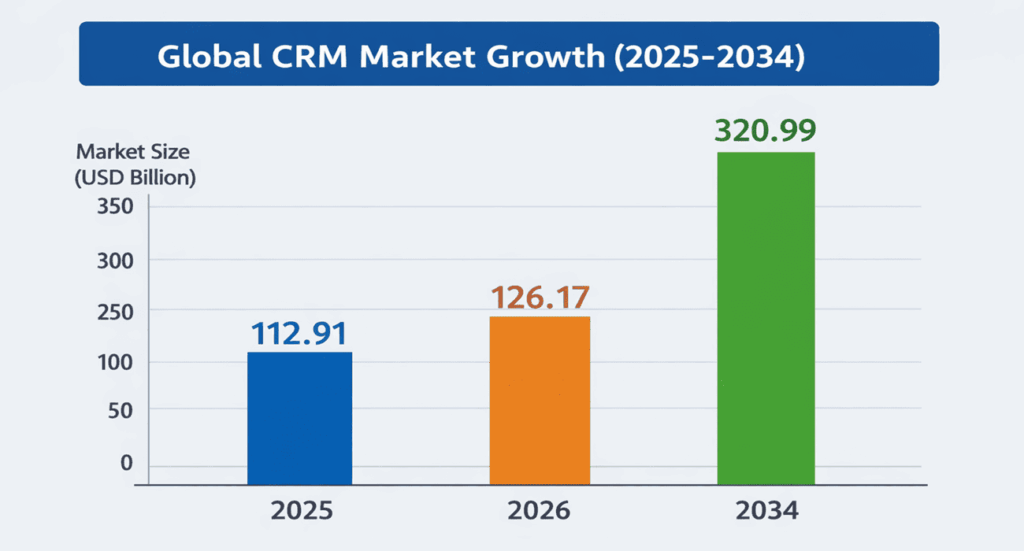
The CRM industry has expanded rapidly in recent years and shows no sign of slowing down. Fortune Business Insights reports that the global CRM market will grow from USD 126.17 billion in 2026 to USD 320.99 billion by 2034, yielding a compound annual growth rate of about 12.4%. The sheer scale of this projection underscores CRM’s importance across every sector. Companies see CRM not only as a sales tool but as a strategic platform for data-driven decision-making.
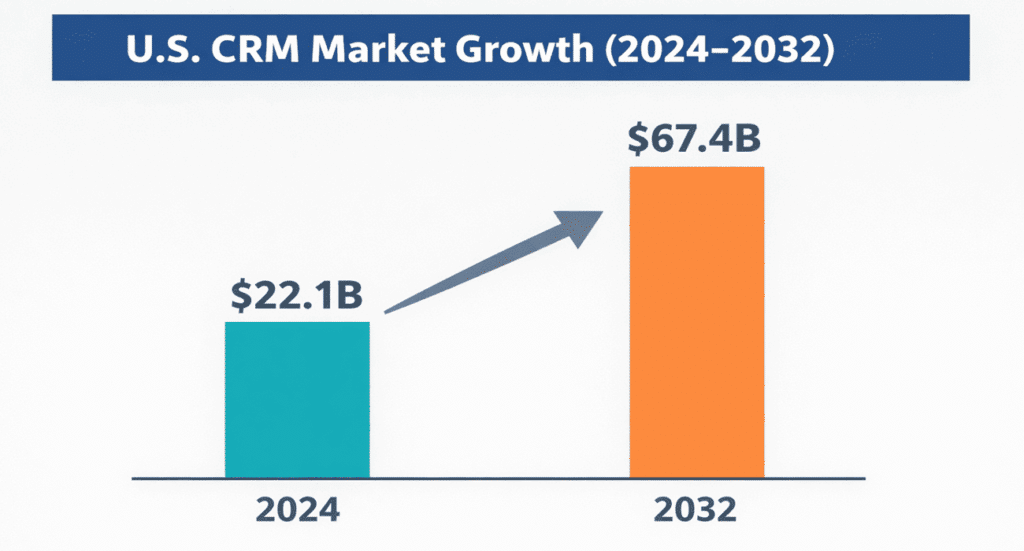
Growth isn’t limited to the global stage. In the United States, the CRM market was valued at USD 22.1 billion in 2024 and is projected to reach USD 67.4 billion by 2032, with an annual growth rate of 15.1%. Analysts attribute this surge to rising adoption of cloud-based solutions, integration of artificial intelligence (AI) and machine learning, and an emphasis on personalized customer experiences. Small and mid-sized enterprises are increasingly purchasing cloud-based CRM subscriptions because they eliminate upfront costs and enable teams to access data from any device.
The broader technology landscape also influences CRM adoption. A June 2024 report summarizing McKinsey’s global survey notes that 72% of organizations now use AI and 65% have incorporated generative AI into their operations. This shift toward AI doesn’t just apply to chatbots; it means predictive analytics, smarter recommendations, and automated workflows are becoming standard features in CRM systems. Businesses in energy, technology, and media have been especially quick to adopt AI, setting a precedent for other industries.
Benefits of CRM Implementation
Why invest in CRM software? The main advantage is a single source of truth for customer data. When all interactions and transactions live in one system, you gain a holistic view of each customer and can tailor offers that resonate.
For example, a fitness studio uses its CRM to track class attendance, purchase history, and membership renewals. The system automatically sends gentle reminders when a membership is about to expire and offers discounts on classes the member hasn’t tried yet. Clients feel appreciated and are more likely to stick around.
Other benefits include:
- Improved revenue and productivity. With automated task reminders, sales reps spend less time on manual data entry and more time speaking to prospects. Businesses often see double-digit increases in sales productivity and conversion rates after adopting a CRM.
- Better collaboration. Marketing, sales, and customer service teams can share notes and track progress in one place. That reduces duplication of effort and ensures consistent messaging.
- Data-driven insights. CRMs generate reports that highlight which marketing campaigns work and where customer churn occurs. You can then allocate resources wisely.
- Enhanced customer experience. Personalized emails and timely follow-ups make customers feel valued. A CRM can trigger automated surveys to capture feedback and quickly resolve issues.
Barriers and Challenges
Despite the benefits, some companies struggle with CRM implementation. Common barriers include:
- Lack of training: Users who don’t understand the system will revert to old habits. Ongoing education and support are essential.
- Data quality: A CRM is only as good as the information it contains. Encourage teams to enter accurate data and automate data collection where possible.
- Integration issues: When a CRM doesn’t integrate well with other software, users may end up duplicating work. Before purchasing a platform, verify that it connects to your existing tools.
- Resistance to change: Some employees view new software as extra work. Leadership should clearly explain the benefits and involve staff in selecting and configuring the system.
FAQs
Q1. What does CRM stand for, and what does it do?
A CRM (Customer Relationship Management) system organizes customer data, tracks interactions, and automates follow-ups. It helps teams improve sales and service by keeping everything in one place.
Q2. How can small businesses benefit from a CRM?
Small businesses gain structure and efficiency by using a CRM. It tracks leads and customers, sends reminders, and lets owners personalize marketing without additional staff.
Q3. Is artificial intelligence necessary for CRM?
AI isn’t mandatory, but it enhances CRM capabilities. Predictive analytics and automation can suggest next steps, personalize messages, and free your team to focus on relationship-building.
Q4. How do I choose the right CRM for my company?
List your must-have features, budget, and the size of your team. Look for a platform that integrates with your existing tools and offers training. Test a few options before committing.
Q5. Can CRM software help improve customer retention?
Yes. By providing insights into customer behavior and history, a CRM lets you personalize communications, identify at-risk clients, and respond quickly to concerns, all of which improve loyalty.
Summary
Customer relationship management continues to shape how modern businesses grow, compete, and serve customers. The latest CRM statistics show strong adoption, rising investment, and deeper integration with AI and analytics. These trends confirm that CRM is no longer optional but a core business system. Companies that use CRM data effectively can improve sales, marketing, and the customer experience simultaneously. Understanding these numbers helps leaders make smarter technology decisions and stay competitive in a fast-changing digital market.

I am Mohammad Fahad Usmani, B.E. PMP, PMI-RMP. I have been blogging on project management topics since 2011. To date, thousands of professionals have passed the PMP exam using my resources.