
Project estimation is one of the most important skills for any project manager. Choosing the right approach can determine whether a project stays on schedule and within budget. Two widely used techniques are parametric estimating and analogous estimating, each offering unique advantages depending on project complexity and available data.
Understanding parametric vs analogous estimating helps you create realistic forecasts, build stakeholder confidence, and avoid costly surprises. While analogous estimating provides quick, experience-based insights, parametric estimating delivers more precise results using mathematical relationships and historical metrics. Knowing when to apply each method is essential for accurate planning.
This blog post explains parametric vs analogous estimating with simple examples, benefits, and practical tips so you can select the most effective estimation strategy.
Why Good Estimating Matters
Cost and time overruns are more common than most people think. A study of construction projects in 2024 found that 98%spent more than planned or finished late. In 2022, almost nine out of ten jobs had cost overruns. The same survey reported that three-quarters of jobs went over budget by about 15%. When guesses are sloppy, teams miss deadlines and lose money. Clear and simple methods help you avoid headaches.
Three Ways to Make an Estimate
You can use a few tools to turn ideas into numbers. Analogous estimating compares a past job to your current one. Parametric estimating uses a mathematical rule to scale old numbers to new work. Three-point estimating uses a best-case, a worst-case, and a likely case to find the middle. Each tool has its own strengths.
Analogous Estimating
Analogous estimating is a top-down method. You start with the whole job and compare it to something you have done before. PMI defines it as estimating by using past data from a similar activity or project. Because it relies on your memory and not much math, it is fast but not very precise.
Try it at Home
Think about painting two bedrooms. Each room took one gallon of paint and about 2.5 days. Now you plan to paint a small office of the same size. You remember your past work and figure that one gallon and the same amount of time should be enough. That is an analogous guess. It starts at the top and uses similarities to get a number.
Why Use it? Why Avoid it?
- Quick: You don’t need much information. A fast comparison gives you a rough idea.
- Cheap: No special tools or long research are needed.
- Not precise: No two jobs are exactly alike. If the old job is too different, the guess can be wrong.
- Depends on experts: The quality of the result hinges on the experience of the person making it.
Parametric Estimating
Parametric estimating uses math to turn past numbers into a new guess. PMI says it is a way to calculate cost or time based on past data and project units. In simple terms, you figure out how much time or money it took per unit of work before and multiply that by the number of units in your new job.
A Simple Rule and Story
A basic parametric guess follows this rule:
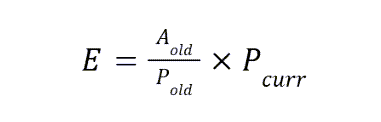
Where E is your new estimate, A_old is the actual cost or time from the old job, P_old is the number of units in the old job, and P_curr is the number of units in your new job. Planisware offers a clear example: it took 50 hours to paint 1,000 square feet. If your new job is 1,500 square feet, the rule says it will take 75 hours. The picture below shows this.

Pros and Cons
- Precise: A math rule usually gives a better number than a guess.
- Repeatable: Once you build the rule, you can reuse it on similar tasks. Planisware notes that these rules make numbers more consistent.
- Needs data: You must have good past numbers and clear units. Without them, the method fails.
- Setup takes time: Collecting numbers and building the rule takes effort. It pays off when tasks repeat, but not for rare ones.
Three-Point Estimating
Sometimes you face big unknowns. Three-point guessing addresses this by using three values: best case, likely case, and worst case. You find the average. For example, a new roof might cost $8,000 in the best case, $10,000 most of the time, and $12,000 in the worst case. The average is $10,000. This approach cuts the impact of extremes and works well when risk is high. You need three numbers for each task, so it takes more time.
Parametric Vs Analogous Estimating
Parametric and analogous estimation are both historical-data-based techniques, but they differ in how they use that data and in the level of accuracy they provide.
Parametric estimation uses statistical relationships between historical data and measurable project variables. A project manager identifies a cost or time rate (for example, cost per square meter or hours per unit) and multiplies it by the quantity required in the current project. This approach is data-driven, repeatable, and usually more accurate when reliable historical data and clearly measurable parameters exist.
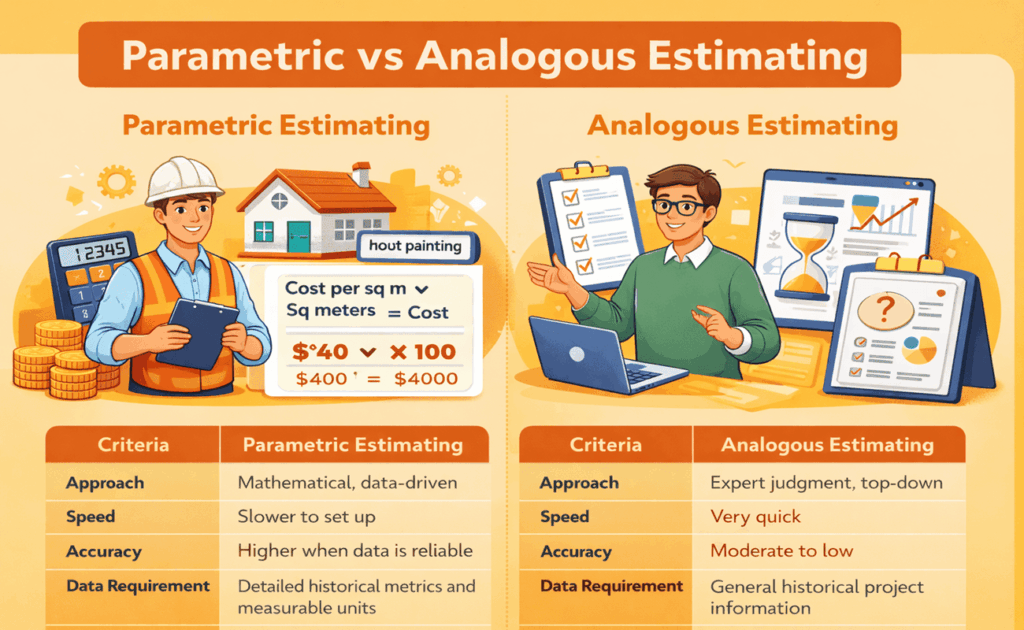
Analogous estimation, on the other hand, is a top-down approach that relies on expert judgement and comparison with similar past projects. Instead of calculations, the estimator reviews previous project outcomes and adjusts them to match the current project’s size and complexity. This method is faster and useful in early project phases, but accuracy depends heavily on the similarity of past work and the estimator’s experience.
In simple terms, parametric estimation focuses on mathematical scaling, while analogous estimation focuses on expert comparison.
Comparison Table
| Criteria | Parametric Estimation | Analogous Estimation |
| Approach | Mathematical, data-driven | Expert judgement, top-down |
| Speed | Slower to set up | Very quick |
| Accuracy | Higher when the data is reliable | Moderate to low |
| Data requirement | Detailed historical metrics and measurable units | General historical project information |
| Best used when | Repetitive tasks with measurable variables | Early planning or limited information |
| Effort | Higher initial effort | Low effort |
When to Use Each Tool
Use the right tool for your situation:
- Little information or early stage? Choose an analogous estimation for a quick idea. It’s great when you need speed and have similar work to compare it against.
- Repeating tasks with clear data? Choose parametric estimation. It shines when you have clear units and past time or cost data. It provides steady numbers and supports budgets and schedules.
- High uncertainty or risk? Choose three-point guessing. It looks at the best- and worst-case scenarios and helps you plan for variation.
Mix and Match
You can also blend these methods. You might start with a parametric rule to find a rate per unit. Then you plug that rate into a three-point approach by adding the best and worst ranges. You can also refine an analogous guess with parametric rules once you have more data. Mixing methods improves accuracy without slowing you down.
FAQs
Q1. How do I decide which method to start with?
Look at how much information you have. If there is very little, start with analogous guessing. As you gather data, switch to parametric or three-point methods.
Q2. Can I combine analogous and parametric methods?
Yes. Use analogous guessing for a quick figure, then apply parametric rules to parts of the work where you have clear units. Combining them improves accuracy.
Q3. Why does parametric guessing take more time to set up?
You must collect detailed numbers and build a rule. Once built, however, it speeds up future work and gives solid numbers.
Q4. What if my project is unique and there is no past data?
Rely on expert judgement and three-point guesses. Write down your assumptions, track real results, and improve your models over time.
Summary
Accurate estimation is essential for delivering projects on time and within budget. Understanding the differences between parametric and analogous estimating helps you select the right approach based on data availability, project complexity, and required accuracy. Analogous estimating offers speed and simplicity, while parametric estimating provides greater precision through data-driven calculations. By combining these techniques when appropriate, you can improve forecasting confidence, manage risks effectively, and support better decision-making throughout the project lifecycle.

I am Mohammad Fahad Usmani, B.E. PMP, PMI-RMP. I have been blogging on project management topics since 2011. To date, thousands of professionals have passed the PMP exam using my resources.