Contracts are the backbone of projects. Yet projects sometimes go off the rails, and one party fails to deliver. When that happens, courts use monetary awards to put the wronged party in the right place. Two main measures exist: expectation damages and reliance damages.
As a project manager, understanding how expectation and reliance damages differ and how they affect your budget can help you prepare for disputes. These legal concepts are not just for lawyers. They directly influence project risk, financial forecasting, and recovery strategy.
Knowing when profits may be claimed and when only wasted costs are recoverable helps you document evidence, manage stakeholders, and protect your project’s financial stability.
1. Understanding Damages in Contract Disputes
1.1 What are Expectation Damages?
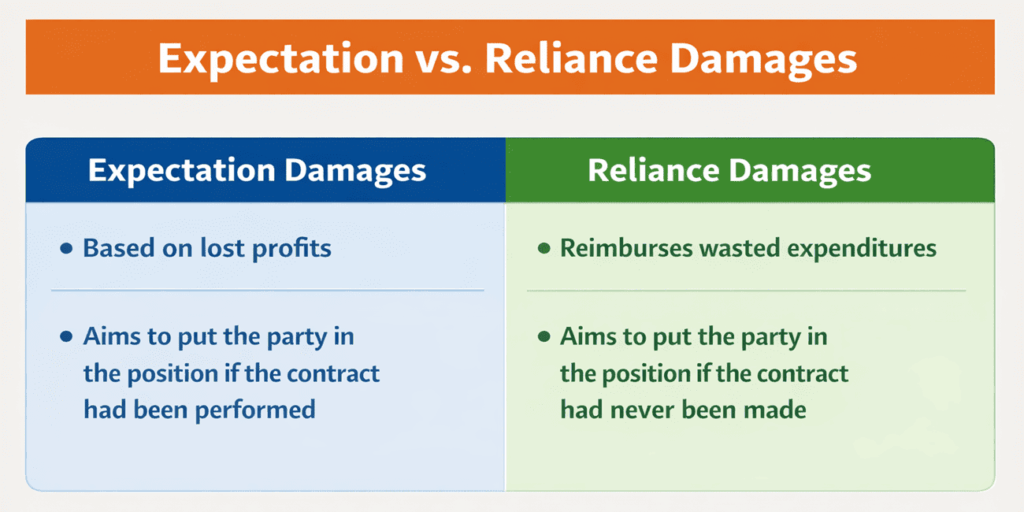
Expectation damages are a common remedy for breach of contract. They aim to put the injured party in the position it would have been in if the contract had been fully performed. In simple terms, expectation damages compensate for lost profits or benefits that the party reasonably expected to receive.
Courts calculate them by estimating the revenue that would have been earned and subtracting the costs incurred to generate it. The goal is not to punish the breaching party but to fulfill the original bargain. Strong financial records and realistic forecasts are essential to support an expectation damages claim.
1.2 What are Reliance Damages?
Reliance damages are monetary awards that reimburse a party for expenses incurred in reliance on a contract that was later breached. They are often called “wasted expenditures” because they compensate costs that would not have been spent if the party had known the contract would fail.
The goal is to place the injured party in the position it would have been in had the contract never been made. Unlike expectation damages, reliance damages do not focus on lost profits. Instead, they focus on actual out-of-pocket costs such as preparation expenses, equipment purchases, labor, and other investments made in anticipation of performance.
2. Key Differences: Expectation Vs Reliance Damages
- Basis of loss: Expectation damages focus on future profits; reliance damages focus on past costs.
- Objective: Expectation damages aim to place the plaintiff as if the contract was performed, while reliance damages aim to place the plaintiff as if the contract never existed.
- Evidence required: Expectation damages require robust forecasts of revenues and costs. Reliance damages require proof of expenditures with receipts or documentation.
- Speculation: Courts may reject expectation damages when future profits are too uncertain. In those cases, reliance damages become the default.
3. Choosing the Right Damages Approach
When a contract dispute arises, deciding whether to pursue expectation or reliance damages hinges on several factors:
- Uncertainty of profits: If forecasting future revenues is speculative due to volatile markets or unique circumstances (e.g., pandemic-related disruptions), reliance damages may be more appropriate.
- Availability of data: Robust historical and forward-looking information enables credible expectation damages. A lack of reliable data may prompt parties to assert reliance claims.
- Nature of the contract: Detailed pricing and quantity terms support expectation damages; vague or contingent terms may favor reliance damages.
- Documentation of costs: To claim reliance damages, plaintiffs must itemize expenditures with supporting evidence.
- Mitigation efforts: Courts expect parties to mitigate losses. Failure to do so may reduce damages or shift the analysis, as highlighted in FPS v. XTL.
Consider the project’s complexity, the quality of financial records, and the likelihood of proving lost profits. A project manager should consult legal and financial experts early to align strategy with these factors.
4. Calculating Expectation Damages: Steps By Step Process
Expectation damages require rigorous analysis. Follow these steps:
4.1 Determine the effective date of loss
Identify the date on which the breach occurred and the date the loss assessment should commence. In some cases, losses begin when the contract is terminated; in others, when a series of improper actions culminates.
4.2 Separate past and future losses
Past losses cover the period between the breach and the effective date; future losses cover the period after the assessment date. For example, if a contract was terminated in 2022, past losses may be assessed through 2024 and future losses through 2027.
4.3 Build forward-looking projections
Develop forecasts of what the project’s cash flows would have been “but for” the breach. Use contemporaneously prepared business plans where possible. Forecasts prepared solely for litigation require greater scrutiny. Consider industry data and consult subject-matter experts to support assumptions.
4.4 Examine historical performance
Analyze the duration, pattern, and stability of historical earnings. Assess how the business performed before and after the contract was formed, and identify factors that drove earnings volatility. Stable historical profits lend credibility to expectation damages, while erratic performance may undermine them.
4.5 Review contract terms and external events
Study the contract’s pricing, quantities, and contingencies. Identify any extensions or milestones that affect the loss period. Evaluate market and economic conditions that could influence profitability. Prepare scenarios or sensitivity analyses to show how key variables impact the damage conclusion.
4.6 Document mitigation efforts
Keep records of efforts to reduce losses: attempts to secure alternative suppliers, renegotiate terms, or minimize idle resources. Courts expect reasonable mitigation, and failure to demonstrate it can lower recoveries.
5. Calculating Reliance Damages: Steps By Step Process
Reliance damages centre on expenditures incurred in reliance on the contract. To prepare a claim:
5.1 Define the period of loss
Reliance losses typically cover costs incurred in preparing for performance. Future profits are generally excluded. Expenditures incurred before the contract was signed may not be recoverable, unless special circumstances show they were contemplated.
5.2 Itemize costs
List each cost with date, description, and amount. Categories may include equipment purchases, labour, marketing, leasehold improvements, and third-party services. Provide receipts, invoices, or other proof for each expense.
5.3 Distinguish truly wasted expenditures
Reliance damages are limited to expenses that are “truly wasted” and do not place the plaintiff in a better position than if the contract had been performed. Cash losses that overlap with expectation damages or unsubstantiated barter transactions may be excluded.
5.4 Consider broader expenses
Recent cases broaden the scope of recoverable assets. The Cessnock City Council case allows recovery of expenses reasonably incurred in reliance on the defendant’s promise, even if not mandated by the contract. The FPS v. XTL case confirms that, where there is no overlap in expected profits, expenses incurred and lost profits may both be recovered.
6. Hindsight Information and the Duty to Mitigate
Hindsight refers to information that was not known at the time of the breach. When the assessment date is current, experts may consider post-breach information. However, if the assessment date is the breach date, using hindsight is generally inappropriate. This distinction affects both expectation and reliance calculations. Courts also expect plaintiffs to mitigate their losses; the duty arises only once a contract is clearly repudiated. Document attempts to mitigate, such as seeking alternative clients or suppliers to maximize recoverable damages.
7. Best Practices for Project Managers
Project managers play a key role in preserving claims and limiting losses. Here are practical steps:
- Draft clear contracts: Include specific terms on pricing, quantity, milestones, and extensions. Ambiguity invites disputes and complicates damage calculations.
- Maintain thorough documentation: Keep invoices, receipts, emails, and meeting notes. Organized records support reliance claims and help prove mitigation efforts.
- Use realistic forecasts: Develop business plans and budgets at the project outset. Contemporaneous forecasts carry more weight than numbers prepared during litigation.
- Monitor market conditions: Track economic factors and industry trends. Document how changes affect your project to justify adjustments in profit projections.
- Consider alternative dispute resolution: Mediation or arbitration clauses can reduce costs and expedite resolution. Most contract disputes settle, and early negotiation may preserve relationships.
- Consult experts early: Engage financial experts to assess potential damages and legal counsel to craft a strategy. Expert opinions help courts understand complex financial issues and meet E-E-A-T standards.
8. FAQs
Q1. What’s the difference between expectation and reliance damages?
Expectation damages compensate for lost profits; reliance damages reimburse wasted expenditures.
Q2. Can I choose which damages to claim?
Yes. Courts allow plaintiffs to elect reliance damages even when expectation damages are calculable.
Q3. Do I have to pick one or the other?
Not always. If there is no overlap in claimed losses, plaintiffs may recover both lost profits and incurred expenses.
Q4. When will a court reject expectation damages?
When future profits are speculative or lack reliable evidence, courts may award reliance damages instead.
Q5. How can I strengthen my damages claim?
Keep contemporaneous records, prepare realistic forecasts, and document mitigation efforts to support your claim.
Summary
You cannot avoid every contract dispute, but you can prepare for the financial fallout. Knowing the difference between expectation and reliance damages helps you choose the right strategy and document the necessary information. Recent cases show that courts are willing to award reliance damages when profits are speculative, allow plaintiffs to elect reliance damages even when expectation damages are calculable, and permit both types of damages when there is no double recovery. By drafting clear contracts, maintaining records, forecasting accurately, and consulting experts, you can protect your project’s bottom line.

I am Mohammad Fahad Usmani, B.E. PMP, PMI-RMP. I have been blogging on project management topics since 2011. To date, thousands of professionals have passed the PMP exam using my resources.