Measuring an investment’s performance means more than just glancing at a spreadsheet. Some investors look at return on investment (ROI), while others prefer the internal rate of return (IRR). These metrics answer different questions, and using the wrong one can make a promising project look lackluster or vice versa.
In this blog post, I will explain IRR vs ROI and when to use each.
Let’s get started.
What Are ROI and IRR?
Return on investment (ROI) tells you how much an investment grew (or shrank) overall. It measures the total change from start to finish, without considering when cash flows occurred. ROI is popular because the math is straightforward: subtract the cost from the final value, divide by the cost, and express the result as a percentage. Because of its simplicity, ROI is widely used across personal finance and business projects.
Internal rate of return (IRR) answers a different question: “What average annual rate of return did this investment earn?” IRR finds the discount rate that makes the net present value (NPV) of future cash flows equal zero. In plain terms, it calculates how fast the investment grows each year, factoring in the time value of money and the timing of cash flows. Because IRR requires solving for a rate, it often involves software or spreadsheets, but it provides a more nuanced picture than a basic ROI.
Why Do You Compare IRR and ROI?
Imagine two projects: Project A costs $100,000 and returns $130,000 in five years. Project B costs $100,000 and returns $115,000 in two years. Both have a $15,000 profit, so their ROI is 15%. Yet Project B’s cash comes back sooner, freeing funds for other uses. IRR reveals that B’s annualized return is higher because money received sooner can be reinvested.
You compare ROI and IRR to:
- Rank projects. ROI shows the magnitude of profit, while IRR ranks how quickly profits arrive.
- Account for time. IRR considers the timing of cash flows and the time value of money. ROI does not.
- Set thresholds. Many organizations have a minimum acceptable IRR (a “hurdle rate”) to decide if a project proceeds. ROI alone might be misleading if funds are tied up for too long.
How to Calculate ROI
Calculating ROI is easy:

Suppose you buy shares of a startup for $10,000 and sell them three years later for $15,000. The gain is $5,000, so:
ROI=(5,000 / 10,000) X 100%=50%
ROI can be negative when the investment loses value. If the shares drop to $8,000, your ROI is –20%.
Advantages of ROI
- Simplicity. ROI uses a straightforward formula that anyone can compute with a calculator.
- Broad applicability. It can evaluate everything from real estate to marketing campaigns.
- Quick comparison. You can compare multiple investments by looking at their percentage gains.
Limitations of ROI
- Ignores time. ROI doesn’t care whether profits arrive in one year or five; it only looks at the total.
- Sensitive to inputs. Different definitions of “cost” and “gain” can alter ROI results.
- Can be misleading for long projects. A high ROI on a long-term project might be less attractive than a lower ROI on a short-term opportunity.
How to Calculate IRR
IRR is the discount rate that sets the net present value (NPV) of cash flows to zero. Because it’s an iterative calculation, investors often use spreadsheet functions (e.g., IRR in Excel) or financial calculators.
For a project with an initial outlay of $10,000 and cash inflows of $4,000 in each of the next three years, the IRR is the rate r that satisfies:

Using a spreadsheet, you would find r = 18%. This means the project’s cash flows are equivalent to an annual return of about 18%.
Advantages of IRR
- Considers the time value of money. IRR discounts future cash flows, providing a more realistic measure of profitability.
- Compares projects with different durations. You can use IRR to evaluate projects with uneven cash flows or varying timelines.
- Provides a hurdle rate. If your required return is 12%, and the IRR is 18%, the project looks attractive.
Limitations of IRR
- Complex calculation. Without software, solving for IRR can be time-consuming.
- Assumes reinvestment at the IRR. This may overestimate returns if you cannot reinvest future cash flows at that rate.
- Multiple IRRs. Projects with alternating positive and negative cash flows can yield multiple IRRs, which can confuse decision-making.
Key Differences Between ROI and IRR
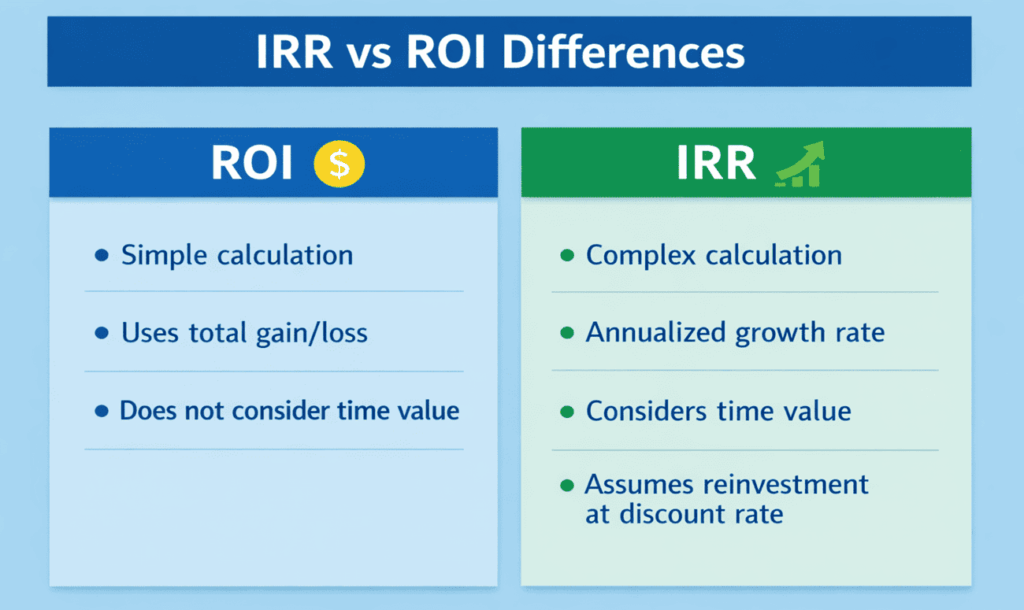
While both metrics measure investment performance, they differ in several ways. The Infographic below summarizes these contrasts:
Computation
ROI is calculated by dividing net gain by the cost of the investment. Anyone can compute it with basic arithmetic. IRR, by contrast, requires discounting cash flows and solving for the rate that makes the NPV zero. This complexity often necessitates software or spreadsheets.
Reinvestment Assumption
ROI assumes no reinvestment; it only measures the total gain or loss. IRR, however, assumes that interim cash flows are reinvested at the same rate as the IRR. If you cannot reinvest at that rate, IRR may overstate the project’s appeal.
Time Value of Money
ROI ignores timing. Whether profits arrive in year one or year five, ROI treats them equally. IRR discounts cash flows based on when they occur, so earlier returns carry more weight.
Use Cases
ROI is helpful for quick comparisons and for small or short-term projects. IRR is better for long-term investments, especially those with uneven cash flows, such as property developments or corporate projects.
Example Comparison
Let’s revisit the earlier project with a $10,000 initial cost and $4,000 inflows over three years.
- ROI: (4,000+4,000+4,000-10,000)/10,000=20%
- IRR: solves the NPV equation and yields = 18%.
Although the ROI is higher (20%), the IRR indicates the project’s annualized return is about 18%. If your required return is 15%, the project clears the hurdle.
Summary Chart
The next infographic visualizes this example with a simple bar chart:

When to Use ROI
A wide range of activities benefit from ROI analysis:
- Evaluating marketing campaigns. Marketers can compare spend and revenue generated to see which campaigns delivered the highest ROI.
- Comparing stock performances. When you sell shares, ROI quickly tells you the percentage gain (or loss).
- Assessing simple projects. If a project involves a single cash outlay and one inflow, ROI may suffice.
ROI works best when cash flows occur only at the beginning and end of a project. In these cases, IRR will produce the same result because there are no interim cash flows.
When to Use IRR
IRR is useful for projects with multiple cash flows over time. Real estate developments, private equity investments, or long-term infrastructure projects often involve periodic returns. IRR captures the time value of money and allows investors to:
- Compare projects of different lengths. A two-year project with a 15% IRR may be more attractive than a five-year project with a 20% ROI.
- Measure risk. If a project’s IRR exceeds your cost of capital, it adds value. Otherwise, it may destroy value.
- Inform financing decisions. Lenders and equity partners often require a minimum IRR to justify funding.
Real-World Applications
Real Estate Investments
In real estate development, investors commit significant capital upfront and receive cash flows over several years. A value-add apartment renovation might cost $2 million. If the investor expects annual cash flows of $500,000 for five years and a final sale that returns the principal, the ROI could appear high. However, IRR helps investors determine whether the cash flows meet their required return, given the project’s risk and timeline.
Private Equity
Venture capitalists and private equity managers commonly use IRR to compare investment opportunities. They often have hurdle rates of 15–20% to compensate for higher risk. A company that offers a 30% ROI over ten years may fail to meet the required IRR if cash flows are delayed.
Personal Finance
Individuals also rely on these metrics. If you’re deciding between a fixed annuity with a guaranteed 4% return and a diversified stock portfolio with an expected 7% return, IRR and ROI can help illustrate how compounding and timing affect your wealth. According to SoFi, a good return on investment is roughly 7% per year, based on the S&P 500’s historical performance. That benchmark can serve as a hurdle rate when evaluating long-term investments, such as retirement accounts.
Tips for Improving IRR and ROI
- Increase cash inflows. The most obvious way to improve both metrics is to boost earnings. In business projects, that might mean higher sales or cost savings.
- Reduce initial costs. Negotiating lower purchase prices or securing favorable financing terms increases both ROI and IRR.
- Accelerate returns. Bringing cash flows forward (e.g., by leasing properties sooner) increases IRR because earlier cash flows can be reinvested.
- Monitor reinvestment rates. Because IRR assumes reinvestment at the same rate, consider using the modified internal rate of return (MIRR) if you expect future returns to be lower.
FAQs
Q1. What’s the main difference between ROI and IRR?
ROI measures the total percentage gain or loss relative to the initial investment. IRR calculates the average annual return by discounting future cash flows.
Q2. Why is IRR more complex to calculate than ROI?
IRR involves solving for the discount rate that sets the net present value to zero. This iterative calculation typically requires a financial calculator or software, whereas ROI uses a simple formula.
Q3. Can ROI and IRR give conflicting signals?
Yes. A project can have a high ROI but a low IRR if its profits arrive late. Conversely, a project with a modest ROI may have a high IRR if it returns cash quickly.
Q4. What is considered a good ROI?
While personal circumstances vary, a long-term stock portfolio has historically earned about 7% per year, adjusted for inflation. Use this as a benchmark, but remember that risk, time horizon, and diversification also matter.
Summary
Understanding the difference between IRR and ROI helps you make better investment decisions. ROI shows the total gain from an investment, while IRR explains how fast that return grows over time. Each metric serves a different purpose and is most effective in specific situations. Using them together provides a clearer, more balanced view of performance. Before choosing an investment, consider your time horizon, cash flow patterns, and your financial goals to select the right evaluation method.
Further Reading:
- Internal Rate of Return (IRR): Simple Guide & PMP Tips
- Return on Investment in Project Management: Formula, Examples & PMP Exam Tips
- Net Present Value (NPV): Formula, Steps & Examples
- Discounted Payback Period: Definition, Formula & Examples
- Payback Period in Project Management: Definition, Formula, Examples, Pros & Cons

I am Mohammad Fahad Usmani, B.E. PMP, PMI-RMP. I have been blogging on project management topics since 2011. To date, thousands of professionals have passed the PMP exam using my resources.