Hybrid project management is becoming a preferred approach for organizations that need both structure and flexibility in today’s fast-changing environment. Instead of choosing between Agile and Waterfall, you combine the strengths of both methods to manage complex projects more effectively. This approach allows you to plan with clarity while still adapting to evolving requirements.
As projects grow in scope and uncertainty, relying on a single methodology often creates gaps in delivery and coordination. Hybrid project management helps bridge these gaps by aligning processes with real project needs. It supports better collaboration, improves risk management, and enhances overall project outcomes.
In this blog post, you will learn how hybrid project management works, why it matters, and how you can successfully implement it in your organization.
Key Takeaways
- Hybrid project management is a strategic blend of Agile and Waterfall that lets teams tailor their approach to each part of a project.
- Success depends on leadership, training, and coordination, not just process. Teams must communicate clearly and understand both methodologies.
- Continuous learning builds hybrid-ready teams. Developing fluency in Agile and Waterfall, along with the soft skills to move between them, is essential.
Why Hybrid Project Management Is on the Rise
Today’s business challenges rarely fit neatly into one framework. Speed and flexibility are vital for customer-facing features, while structure and predictability matter for compliance, safety, or infrastructure work. Relying solely on Agile or Waterfall can leave gaps that slow delivery or increase risk. Hybrid project management lets teams adapt by choosing the right methods for each task.
Recent research underscores this trend. A global survey of more than 1,100 professionals found that 89% use a mix of methodologies rather than a single approach. Nearly half of those respondents reported significant improvements in project success rates after adopting hybrid methods. Another study showed that 58% of organizations expect to increase their use of hybrid project management over the next five years. These findings suggest that hybrid approaches are no longer niche; they are becoming mainstream.
Understanding Agile and Waterfall
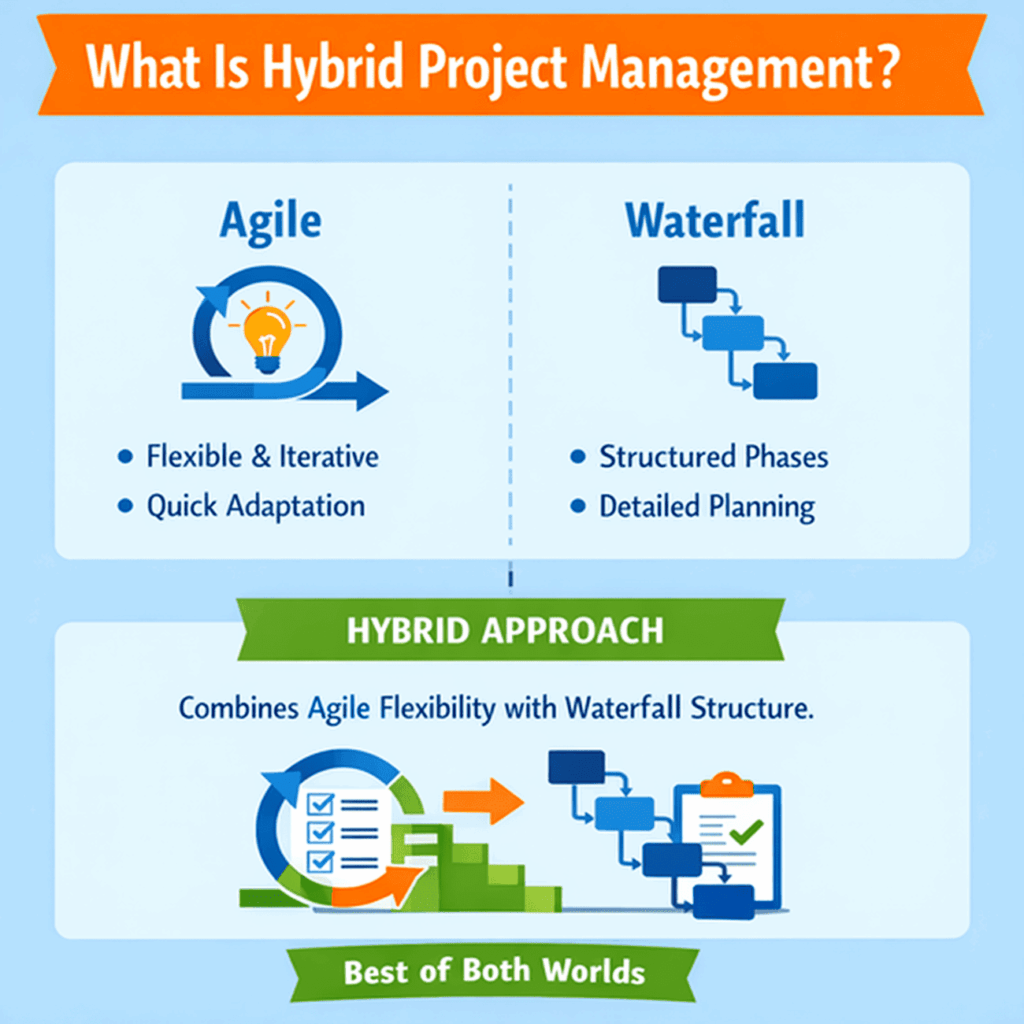
Before designing a hybrid model, it helps to recall what makes each methodology unique. Waterfall is a linear process where planning, execution, and delivery follow a sequence. Detailed documentation and upfront requirements provide certainty. This works well for projects with clear outcomes, fixed scope, or regulatory compliance.
Agile, by contrast, embraces iteration and continuous feedback. Work is delivered in short cycles or sprints, allowing teams to adapt as requirements evolve. Agile shines when customer needs change or when products must be brought to market quickly.
Hybrid project management marries these strengths. You might use a sequential hybrid model, planning in a Waterfall manner and executing in Agile, or a parallel hybrid model, where different teams use different methods concurrently. Choosing the right blend depends on project objectives, risk tolerance, and stakeholder expectations.
How to Make Hybrid Project Management Work
Designing a hybrid structure isn’t about randomly mixing methods. It’s about aligning the approach to the work. Start by mapping project components:
- Use Waterfall for infrastructure tasks, legal compliance, or other activities with fixed outcomes.
- Use Agile for customer-facing features, feedback-driven updates, or when requirements are likely to change.
Effective hybrid teams share three traits:
- Communication flows between technical and business roles, ensuring that handoffs don’t become black holes.
- Hybrid-fluent project managers understand both Agile and Waterfall and can explain why a particular approach is best for each component.
- Visibility is maintained through tools that show both short-term progress and long-term milestones. Without a shared view, teams lose track of how their work aligns with overall goals.
Challenges to Avoid
Hybrid projects fail more often because of people issues than technology problems. Watch for these common pitfalls:
- Methodology confusion – When teams don’t know which parts of a project follow Agile versus Waterfall, confusion stalls progress. A clear matrix helps everyone understand the plan.
- Handoff gaps – Work can be lost when transitioning between methods. Assign someone who understands both approaches to oversee transitions and build buffer time for integration.
- Conflicting metrics – Measuring progress differently across teams leads to reporting chaos. Establish unified metrics focused on business outcomes, not just activity.
- Culture clashes – An “us versus them” mentality between Agile and Waterfall teams hurts morale. Promote cross-training and shared goals to build trust.
Recognizing these patterns early helps teams respond before small issues grow into major risks. Documenting lessons learned and sharing them across the organization improves future hybrid projects.
Training and Continuous Learning
Adopting a hybrid model demands more than knowing how to run a sprint or draft a project charter. Project teams must move smoothly between frameworks, collaborate across departments, and use a variety of tools. In this global survey, nearly half of the respondents reported higher success rates after adopting hybrid methods, highlighting the link between proficiency and performance. Formal training helps build that proficiency.
Continuous learning keeps skills fresh. Consider offering courses that deepen Agile fluency, teach Waterfall planning techniques, and build soft skills like communication and negotiation. Encourage team members to rotate through different roles to understand how various parts of the project fit together. As artificial-intelligence tools mature, they may assist with workload forecasting and risk identification, but people will still need to interpret insights and make decisions.
Examples of Hybrid Project Management
Theory is useful, but examples show how hybrid models work in practice. Two diverse industries illustrate the flexibility and structure of hybrid approaches:
- Healthcare patient portal. A large health provider needed to launch a secure patient portal quickly without compromising privacy. Development teams used Agile sprints to build user-facing features and respond to feedback. Compliance teams followed a Waterfall process to ensure all documentation and approvals met HIPAA requirements. The hybrid approach cut launch time and delivered a portal that met both patient needs and regulatory standards.
- Financial services onboarding. A bank wanted to shorten its three-week customer-onboarding process. Compliance and risk-management teams mapped workflows and protocols using Waterfall methods, while product teams used Agile to redesign the interface and automate manual steps. The result was faster onboarding, higher customer satisfaction, and reduced costs.
Leading Hybrid Teams
Even with well-structured processes and modern tools, hybrid projects succeed only when leaders set the tone. Strong leaders provide a clear vision and connect the moving parts of the project. They build trust through honest communication and encourage accountability without micromanaging. Coaching teams to work across multiple delivery models is key; leaders must understand both the technical details and the human dynamics of project work.
Effective leaders also create psychological safety, so team members feel comfortable raising concerns about process issues or cross-team dependencies. When complexity rises, leadership helps keep everyone aligned.
Steps to Start Hybrid Project Management
Shifting to a hybrid model requires planning and iteration. Here are six actionable steps to get started:
- Start with a pilot. Choose a mid-risk project where you can experiment with hybrid methods without overwhelming your organization.
- Assign hybrid-fluent leaders. Select project managers who understand both Agile and Waterfall and can guide teams through transitions.
- Clarify workflows. Define which parts of the project follow Agile and which follow Waterfall. Document how these workflows intersect to avoid confusion.
- Invest in tools. Use platforms that provide visibility into sprints and milestones. Integrated dashboards help teams see both short-term progress and long-term goals.
- Train continuously. Offer learning paths that build skills in both methodologies and emphasize communication and negotiation.
- Capture lessons learned. Document insights from your pilot and use them to refine the approach for future projects.
Hybrid Project Management is a Mindset
Hybrid project management isn’t a halfway point between two methods; it’s a mindset. It acknowledges that modern work is messy and requires both flexibility and structure. When backed by strong leadership, clear coordination, and a commitment to ongoing learning, a hybrid approach helps teams stay aligned and deliver real value. Investing in training and creating a culture of openness prepares your people to shift between frameworks as needed.
Summary
Hybrid project management offers a practical way to balance structure and flexibility in modern projects. By combining Agile adaptability with Waterfall discipline, project teams can respond to change while maintaining control and clarity. Success depends on clear processes, strong communication, and continuous learning. Organizations that adopt this approach can improve collaboration, reduce risks, and deliver better outcomes. As project environments grow more complex, hybrid project management provides a reliable framework to achieve consistent and sustainable success.

I am Mohammad Fahad Usmani, B.E. PMP, PMI-RMP. I have been blogging on project management topics since 2011. To date, thousands of professionals have passed the PMP exam using my resources.