Have you ever walked into a meeting and wondered why nothing gets done? People talk over each other, side conversations start, and the session drifts off-topic. These frustrating experiences are all too common. Yet they don’t have to be. Meeting ground rules can transform chaotic gatherings into focused, respectful conversations.
Ground rules are simple guidelines that everyone agrees to follow. The term comes from baseball: each ballpark has its own rules for what happens when a ball hits a unique part of the stadium. Similarly, each team or project may need its own rules to handle different situations. When you set clear expectations, you create a shared understanding of what good behavior looks like.
Recent research shows that meetings are evolving. Flowtrace’s analysis of 1.3 million meetings found that nearly 64% included 6 or fewer participants. Smaller groups are more common, but without clear guidelines, they can still waste time. At the same time, psychologists emphasize the link between clear expectations and psychological safety. A study cited by Teamraderie found that team members involved in decision-making are 21% more likely to feel psychologically safe. When people feel safe to speak up, meetings become more productive and inclusive.
In this blog post, you’ll learn why ground rules matter, when to use them, and how to introduce them. We’ll explore eight practical examples, and you’ll find answers to common questions so you can apply these ideas in your own workplace.
Let’s get started.
Why Meeting Ground Rules Are Important
Ground rules create a baseline of expected behavior. They tell participants what is encouraged (listening, respect, participation) and what is discouraged (interruptions, side conversations). This clarity reduces misunderstandings and helps meetings get off to a strong start.
They Improve Focus and Efficiency
According to Flowtrace, nearly two-thirds of meetings have six or fewer participants. Even small groups can drift off course without clear guidelines. By agreeing to rules such as “stay on topic” or using time-boxing, groups spend less time on tangents. Clear expectations also support short, purposeful meetings. Flowtrace found that almost half of recurring meetings last under thirty minutes.
They Build Psychological Safety
Psychological safety is the belief that you won’t be punished or humiliated for speaking up. Researchers have found that when team members are involved in decision-making, they are 21% more likely to feel psychologically safe. Offering inclusive social opportunities raises that likelihood by 12%, and positive leader–coworker relationships increase it by 22%. Ground rules such as “explore interests, not positions” and “tackle problems, not people” support these practices by encouraging respectful dialogue.
They Reduce Attrition and Increase Engagement
Boston Consulting Group’s research shows that when psychological safety is high, the risk of employees quitting within a year drops from 12% to 3%. Ground rules help leaders create conditions in which people feel safe to participate, making retention and engagement easier. In inclusive meetings, participants feel heard and valued, which strengthens loyalty and motivation.
They Clarify Purpose and Roles
Many meetings fail because participants don’t know why they are there. Ground rules can address this by requiring a clear agenda and outcome. For example, agreeing to ask, “What’s our goal?” at the start of each meeting ensures that everyone shares the same purpose. When roles and expectations are clear, decisions happen faster, and people walk away with action items.
When Should You Use Ground Rules?
Ground rules are most effective when the meeting involves collaboration, debate, or decision-making. If you’re simply sharing information, formal rules may feel like overkill. Consider adopting ground rules when:
- Brainstorming: Creative sessions benefit from rules such as the Add & Alternatives Rule (see below), which encourage building on ideas rather than judging them.
- Long meetings: The longer the meeting, the more likely participants will drift. Rules for staying on time and taking breaks help maintain energy.
- High-stakes conversations: When discussing sensitive topics or making important decisions, rules about listening and respect help maintain civility.
- Mixed groups: If participants come from different departments or cultures, ground rules provide a shared framework that transcends backgrounds.
As a facilitator, you can adjust the number of rules based on the situation. A short weekly check-in may require only one or two guidelines. A half-day workshop could benefit from four or five. The key is to make them relevant and purposeful so people follow them willingly.
Eight Meeting Ground Rules (With Examples)
Below are eight practical ground rules you can introduce in your next meeting. These rules are based on facilitation practice and feedback from countless sessions. Use them as a starting point and adapt them to your team’s needs.

1. Explore Interests, Not Positions
Arguments often happen because people lock into positions (“We must choose option A”). Instead, invite participants to share the interests behind their positions (“I want a solution that is affordable”). When you explore interests, it becomes easier to find solutions that satisfy everyone’s needs. A simple facilitation tip is to ask, “What outcome is most important to you?” when discussions stall.
2. Add & Alternatives Rule
During brainstorming sessions, judgment can kill momentum. The Add & Alternatives Rule asks participants to either add to an idea or suggest an alternative rather than dismissing it. Remind the group to use phrases like “Yes, and…” or “What if we tried…?” This keeps energy positive and encourages creativity.
3. The 3-Before-Me Rule
In group conversations, a few voices can dominate. The 3-Before-Me Rule requires everyone to wait until three others have spoken (or three minutes have passed) before speaking again. Adjust the numbers for your group size (e.g., 2×2 or 4×4). Facilitators can gently point to a simple counter or colored cards to remind participants when it’s time for someone else to contribute.
4. Agree to Disagree
Sometimes a group cannot reach a consensus. Rather than arguing endlessly, agree to disagree and move on. Capture both viewpoints, note them for future review, and refocus on areas where progress is possible. This Rule preserves relationships and keeps meetings from getting stuck.
5. Be Present or Be Elsewhere
Multitasking undermines meetings. Phones and laptops lure participants away and reduce engagement. Set a rule requiring everyone to be fully present, or excuse themselves if they need to handle other tasks. A quick “pulse check,” closing eyes, and taking a deep breath together helps participants refocus after breaks.
6. ELMO (Enough, Let’s Move On)
Long debates sap energy. Establish a rule that allows any participant to say “ELMO” to signal that the discussion has gone on long enough. Each person might get one token to spend on calling ELMO, encouraging them to use it judiciously. When the tokens are gone, the group knows it’s time to move on to the next agenda item.
7. Tackle Problems, Not People
When feedback feels personal, people shut down. This Rule reminds everyone to focus on the issue rather than the individual. Replace “You always…” with “The issue I see is…” or “The challenge we face is…”. Rephrasing criticisms helps maintain respect and reduces defensiveness.
8. Vegas Rule
What happens in the meeting stays in the meeting. The Vegas Rule encourages openness by assuring participants that discussions won’t be shared outside the room. For sensitive topics, you may ask attendees to sign a one-sentence confidentiality commitment and remind them to do so at the end of the session.
How to Introduce Ground Rules
Ground rules are most powerful when participants feel ownership over them. Rather than dictating a list, involve the group in creating or refining the rules.
You can follow the following three approaches:
- Collect and prioritize: Ask participants to propose rules, then vote on which to adopt. This works well for longer workshops or when you want to encourage broad buy-in.
- Present a long list and choose: Share a library of possible ground rules (for example, those listed above) and let the group decide which ones fit the session. This saves time but still gives participants a voice.
- Propose a short list and ask for agreement: For regular meetings, come prepared with 2 or 3 rules you consider most relevant. Ask the group if they agree and if they want to add or adjust anything.
No matter which method you use, introduce the rules early, ideally right after explaining the meeting’s purpose. Make them visible by writing them on a whiteboard or shared document. When someone breaks a rule, gently remind the group of the agreement rather than singling out individuals.
Psychological Safety and Ground Rules
Meeting ground rules do more than keep meetings orderly; they also contribute to a culture of psychological safety. The American Psychological Association found that team members involved in decision-making are 21% more likely to feel psychologically safe; inclusive social opportunities increase that likelihood by 12%; and leaders who build positive relationships with coworkers raise it by 22%. By encouraging collaboration, equal participation, and respect, ground rules help leaders practice these behaviors.
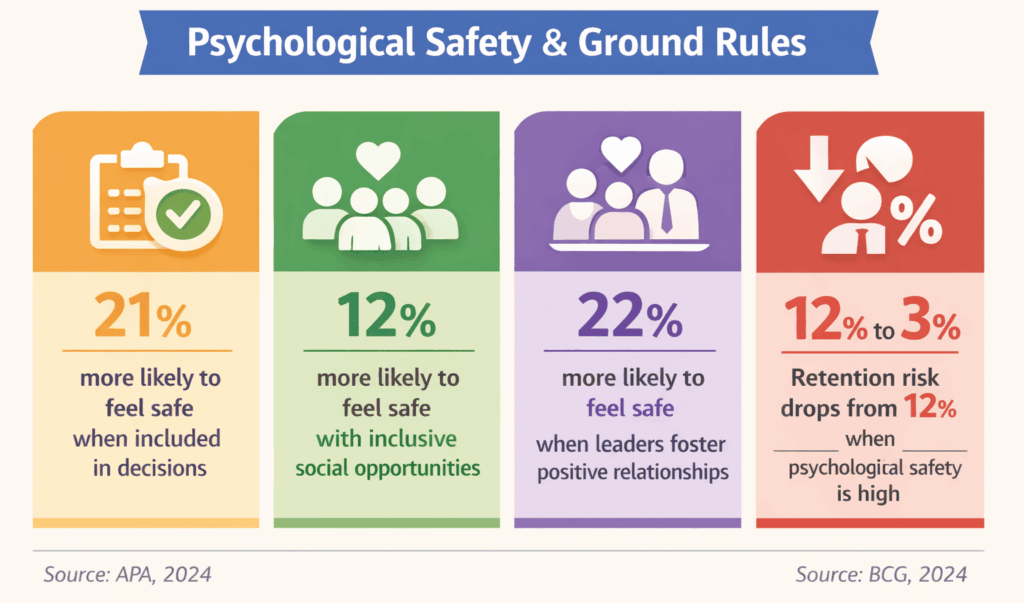
Boston Consulting Group’s research illustrates the benefits. In environments with low psychological safety, 12% of employees are likely to quit within a year. In teams with high psychological safety, only 3% say they’re likely to leave. Ground rules that encourage inclusion and fairness can make a tangible difference in retention and morale.
FAQs
Q1. What if someone breaks a ground rule?
Instead of calling them out, gently remind the group of the Rule and restate why it matters. This keeps the tone positive and reinforces shared responsibility.
Q2. How many meeting ground rules should we have?
Aim for a handful, two to four for short meetings, and up to six for longer workshops. Too many rules become hard to remember and enforce.
Q3. Do ground rules work for remote meetings?
Yes. For virtual sessions, include rules on microphone muting, appropriate use of chat, and turn-taking. Visible reminders in the shared document help participants stay on track.
Q4. How can we enforce ground rules without being controlled?
Involve participants in setting the rules, remind everyone they can call out violations politely, and model the behaviors yourself. Reinforce positive adherence with thanks and recognition.
Summary
Strong meeting ground rules turn wasted time into meaningful progress. They set clear expectations, encourage respect, and help everyone stay focused. When team members agree on how they work together, people feel safer speaking up and sharing ideas. This leads to better decisions and stronger collaboration. The eight examples in this guide give you a practical starting point. Try a few in your next meeting and observe the change. Small rules, applied consistently, can make a big difference.

I am Mohammad Fahad Usmani, B.E. PMP, PMI-RMP. I have been blogging on project management topics since 2011. To date, thousands of professionals have passed the PMP exam using my resources.