Choosing between PMP and Lean Six Sigma can shape both your career path and your income. Both certifications offer strong returns. PMP-certified professionals earn a median salary of about $130,000, while Lean Six Sigma Black Belts earn around $125,000.
The key question is which certification aligns better with your career goals.
Certifications matter more than ever. Even with better tools and processes, nearly 70% of projects still fail worldwide, costing organizations billions each year. Credentials such as PMP and Lean Six Sigma help professionals build proven skills and demonstrate to employers that they can deliver consistent, measurable results.
This blog post compares PMP and Lean Six Sigma in a clear, practical way. It explains each certification, where it is used, and the career paths it supports.
By the end, you will understand the main differences and be able to choose the certification that best fits your background and plans.
Let’s get started.
Understanding the PMP Certification
The PMP certification, issued by the Project Management Institute (PMI), validates your ability to lead projects across industries. Candidates must meet education and experience requirements and complete 35 hours of project management training before taking an exam.
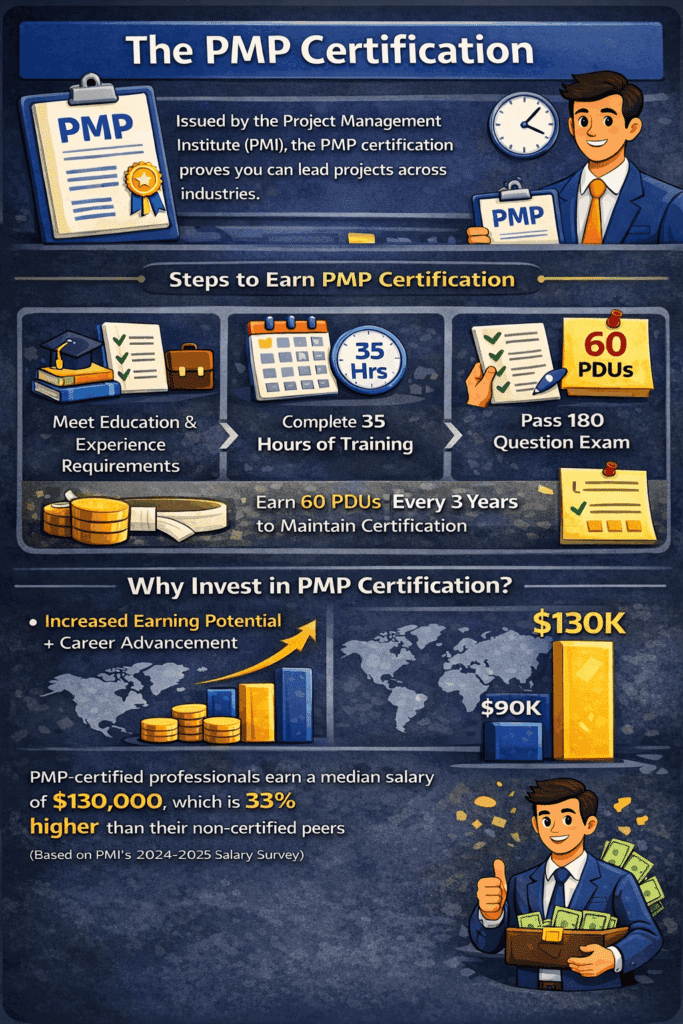
In the PMP exam, you’ll answer 180 questions covering people management, process management, and business environment scenarios. Once certified, you must earn 60 professional development units every three years to maintain your credential.
Why invest in PMP certification? PMP holders earn a median salary that is 33% higher than that of non-certified peers across 21 countries. In the United States, the median salary for PMP-certified professionals is about $130,000, while the median salary for non-PMP professionals is $90,000. Early-career project managers (three years’ experience or less) see salary increases of around 30% after earning their PMP.
These figures come from PMI’s 2024–2025 salary survey and illustrate how certification translates into tangible earning power.
PMP Certification Benefits: Beyond Salary
While the salary advantage is significant, PMP certification offers additional career benefits:
- Global Recognition: PMP is recognized in virtually every industry and country worldwide
- Career Advancement: 85% of PMP holders report increased job opportunities post-certification
- Network Access: Gain entry to PMI’s global community of project professionals
- Skill Validation: Standardized framework ensures comprehensive project management competency
Understanding Lean Six Sigma Certification
Lean Six Sigma combines two methodologies: Lean, which focuses on eliminating waste, and Six Sigma, which uses statistical techniques to reduce process variation. Rather than a single credential, Lean Six Sigma employs a belt system similar to martial arts.
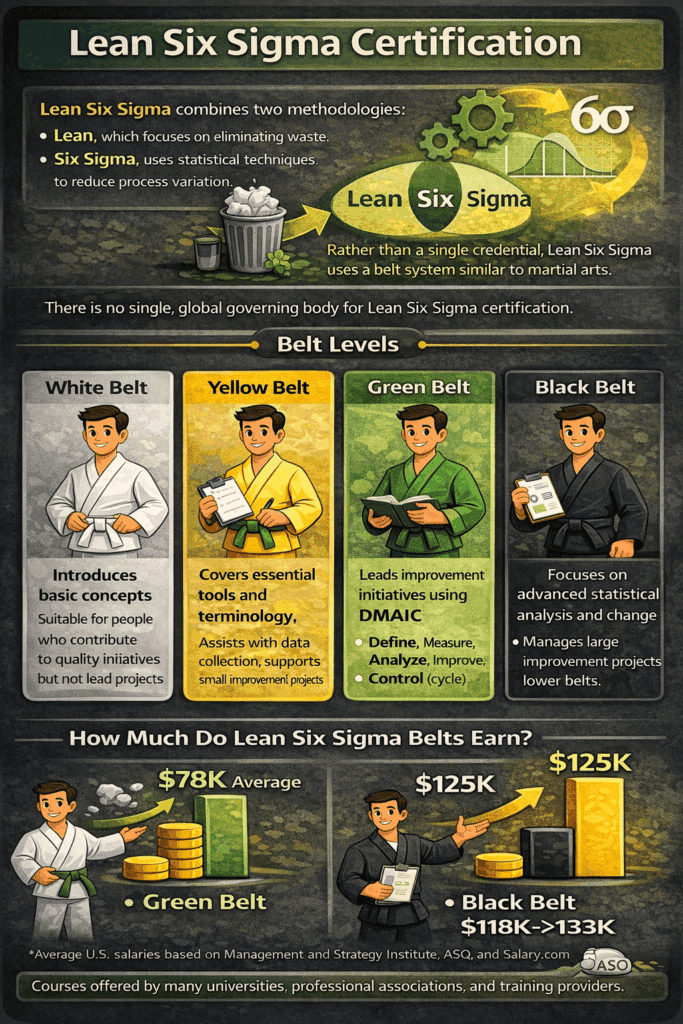
The most common levels are:
- White Belt: Introduces basic concepts. Suitable for people who contribute to quality initiatives but do not lead projects.
- Yellow Belt: Covers essential tools and terminology. Yellow Belts assist with data collection and support small improvement projects.
- Green Belt: Prepares participants to run improvement initiatives using the DMAIC (Define, Measure, Analyze, Improve, Control) cycle. Green Belts often lead projects part-time while continuing other duties.
- Black Belt: Focuses on advanced statistical analysis, change leadership, and mentoring. Black Belts manage large improvement projects and coach lower belts.
While there is no single governing body for Lean Six Sigma, many universities, professional associations, and training providers offer belt certifications. What’s the payoff? This survey by the Management and Strategy Institute reports that Black Belts earn an average of $125,000, while Green Belts average around $78,000.
External benchmarks such as ASQ and Salary.com show that U.S. Black Belt salaries typically range between $119,000 and $133,000, and Salary.com’s snapshot lists national averages of $131,119 for Black Belts and $118,330 for Green Belts.
Lean Six Sigma Industry Applications: Where Belts Are Valued Most
While originally manufacturing-focused, Lean Six Sigma now delivers value across sectors:
- Healthcare: Reducing medical errors and improving patient flow
- Finance: Streamlining loan processing and reducing transaction errors
- Technology: Improving software development processes and reducing defects
- Retail: Optimizing supply chain and inventory management
- Government: Enhancing service delivery and reducing processing times
PMP Vs Lean Six Sigma: Key Differences
The two certifications complement each other but serve distinct purposes. PMP training teaches you to deliver projects that meet scope, schedule, and budget goals. Lean Six Sigma focuses on process refinement and error reduction.
The table below highlights critical differences.
| Feature | PMP Certification | Lean Six Sigma Certification |
| Primary Focus | Managing the project from initiation through closing | Improving processes within a project or operation |
| Approach | Uses a standardized framework (PMBOK Guide) covering people, process, and business domains | Employs data-driven cycles such as DMAIC and DMADV to remove waste and variation |
| Structure | One-tiered credential; experience and education prerequisites are clearly defined | Multi-belt system (White, Yellow, Green, Black) with varying prerequisites depending on the provider |
| Time Frame | Projects have finite schedules and clear deadlines | Improvement cycles repeat until targets are met and become part of ongoing operations |
| Salary Impact | Median salary about 33% higher than non-PMP peers; U.S. median about $130k | Average salary varies by belt; Black Belt about $125k, Green Belt about$78k |
Shared Benefits and Similarities of PMP and Lean Six Sigma
Despite their differences, PMP and Lean Six Sigma share several strengths:
- Higher Employability: Employers value credentials that demonstrate discipline and specialized knowledge. Both certifications are recognized worldwide.
- Improved Project Outcomes: Formal training helps mitigate the high failure rates observed across industries. Mature project management practices make success 2.5 times more likely, yet roughly 70% of projects still fail globally.
- Cross-Functional Relevance: PMP covers broad leadership skills applicable across construction, software, healthcare, and more. Lean Six Sigma originated in manufacturing but now influences finance, healthcare, and even service industries.
- Complementary Use: Many organizations adopt both frameworks: PMP for project planning and execution, and Lean Six Sigma for process optimization within those projects.
Eligibility and Certification Paths
Earning the PMP:
- Meet the Prerequisites: If you hold a four-year degree, you need at least 36 months of project management experience and 35 hours of formal training. With a high school diploma or associate degree, you need 60 months of experience plus the exact training requirement.
- Submit Your Application: Apply through PMI, document your education and experience, and pay the exam fee.
- Prepare and Pass the PMP Exam: Study using PMI’s materials, take practice tests, and schedule your 180-question exam. Once you pass, maintain your certification by earning 60 PDUs every three years.
Earning Lean Six Sigma Belts:
- Choose a Training Provider: Universities, professional associations, and private training firms offer belt courses. Review prerequisites; most programs have no experience requirement for White or Yellow Belts.
- Complete Coursework and Project Work: Courses combine classroom learning with real or simulated improvement projects, especially at the Green and Black Belt levels.
- Pass the Assessment: Exams may include multiple-choice tests and project evaluations. Some organizations require periodic recertification or continuing education.
Deciding Which Certification Fits You
When deciding between PMP and Lean Six Sigma, consider your career goals:
- Do you want to manage entire projects or optimize existing processes? If you enjoy planning schedules, coordinating teams, and delivering products or services, PMP may be your first step. If you thrive on data analysis and continuous improvement, a Lean Six Sigma belt could suit you better.
- Which industries interest you? Lean Six Sigma is indispensable in manufacturing and healthcare, where reducing errors can save money and lives. PMP is widely applicable across industries, including technology, construction, finance, and government.
- How much experience do you have? Newcomers may start with a Lean Six Sigma White or Yellow Belt to understand process improvement basics. Those with several years of project experience should pursue PMP to validate their leadership skills.
Of course, you don’t have to choose one or the other. Many professionals earn both certifications to enhance effectiveness and efficiency. By combining project leadership with process-optimization skills, you can maximize your impact and earning potential.
Latest Salary and Job-Growth Insights
- Global Pay Premium for PMP Holders: According to PMI’s salary survey, PMP-certified professionals earn 33 % more than non-certified peers across 21 countries.
- U.S. Median Salaries: PMP holders in the U.S. report a median salary of $130,000, compared with $90,000 for those without the credential.
- Entry-Level Boost: U.S. project managers with three years’ experience or less see salary increases of about 30% after earning the PMP.
- Lean Six Sigma Averages: Surveyed Black Belts average $125,000, and Green Belts average $78,000. Salary.com’s snapshot lists national averages of $131,119 for Black Belts and $118,330 for Green Belts.
- Cost of Project Failure: High failure rates translate into enormous waste; U.S. companies collectively lose between $50 billion and $150 billion annually on failed projects, and worldwide waste is estimated at $2 trillion.
FAQs
Q1. Can I earn both PMP and Lean Six Sigma certifications?
Absolutely. Many professionals pursue both to combine project leadership skills with process-improvement expertise. Earning both credentials can make you more versatile and increase your earning potential.
Q2. How long does it take to earn the PMP certification?
Most candidates spend two to three months preparing for the exam after meeting the experience and training requirements. Preparation time varies based on prior knowledge and study commitment.
Q3. What does DMAIC stand for?
DMAIC is the core Lean Six Sigma cycle: Define the problem, Measure current performance, Analyze root causes, Improve processes, and Control to sustain gains.
Q4. Is Lean Six Sigma only for manufacturing?
No. While it started in manufacturing, Lean Six Sigma is now widely used in healthcare, finance, software development, and service industries to reduce errors and streamline processes.
Q5. Do these certifications expire?
Yes. PMP holders must earn 60 PDUs every three years to stay certified. Lean Six Sigma renewal requirements vary; some providers issue lifetime certificates, while others require periodic renewal or continuing education.
Summary
Professional certifications represent one of the most valuable investments you can make in your career. The PMP certification establishes you as a skilled project leader capable of delivering results within scope, schedule, and budget constraints. Lean Six Sigma positions you as a process optimization expert who can drive efficiency, reduce costs, and enhance quality.
Both credentials deliver substantial returns:
- PMP holders earn approximately 33% more than non-certified peers globally
- Lean Six Sigma Black Belts command salaries averaging $125,000-$131,000 in the U.S.
- Both certifications significantly enhance employability and career advancement potential
Rather than viewing PMP and Lean Six Sigma as competing options, consider them complementary skill sets that create a powerful professional profile. Many successful leaders begin with one certification and add others as their career progresses.
Final Recommendation: If your primary focus is leading projects and teams, start with PMP. If you’re passionate about process improvement and data-driven decision making, begin with Lean Six Sigma Green Belt. Whichever path you choose, you’re taking a proven step toward higher earnings, greater responsibility, and career satisfaction.
Further Readings:
References:

I am Mohammad Fahad Usmani, B.E. PMP, PMI-RMP. I have been blogging on project management topics since 2011. To date, thousands of professionals have passed the PMP exam using my resources.