Thinking about becoming a Project Management Professional? You’re not the only one. Every year, tens of thousands of managers decide to pursue the PMP credential because it opens doors to higher pay and better projects. Yet the question at the top of most people’s minds is simple: how long does it take? The answer depends on your background, study habits, and the way you plan your journey.
In this blog post, you’ll learn why the PMP is worth the effort, the PMP certification timeline, what the process looks like step-by-step, and how long each stage usually takes. I’ll also share some data to help you decide if it’s the right move for your career.
PMP Certification Timeline at a Glance
From the moment you decide to pursue your PMP to the day you sit for the exam, you should plan for six to eight months. This period covers everything from gathering your work experience and education details to studying the material and scheduling the test. Some highly focused candidates compress the process into as little as eight weeks, but that requires full-time preparation. Most professionals spread the workload over several months to balance work, family, and study.
To visualize the process, look at the infographic below. It shows five main stages and the approximate time you might spend on each.

Stage 1: Confirm that PMP is right for you (about 1 week)
Before you invest time and money, make sure the PMP® aligns with your career goals. The certification is ideal for project leaders who want to validate their skills. It may not be the best fit if you’re just starting out or if your role is purely technical.
Stage 2: Gather documentation and submit your application (2–3 weeks)
Gather proof of your education, hours of project leadership, and project management training. Completing the application takes patience, but you can save your progress as you go. PMI usually reviews applications within five business days.
Stage 3: Prepare for the exam (6 weeks to 6 months)
This is where most of your time goes. The Project Management Academy recommends 30–40 hours of focused study, though many candidates spend more. A structured study plan, practice exams, and a study group help you stay on track. Some candidates enrol in a boot camp or an online course for structured guidance.
Stage 4: Schedule and take the exam (1–2 weeks)
After your application is approved, you’ll receive an eligibility ID. Pay the exam fee and schedule a test date within your one-year eligibility window. Seats fill quickly, so schedule at least three months before your eligibility period ends. The exam itself is 230 minutes long and consists of 180 questions.
Stage 5: Maintain your certification (ongoing)
Passing the exam isn’t the end of the journey. You must earn 60 professional development units (PDUs) every three years to maintain your credential. Many practitioners use free PMI webinars, professional courses, and volunteering to meet the requirement.
Why Earning the PMP is Worth It?
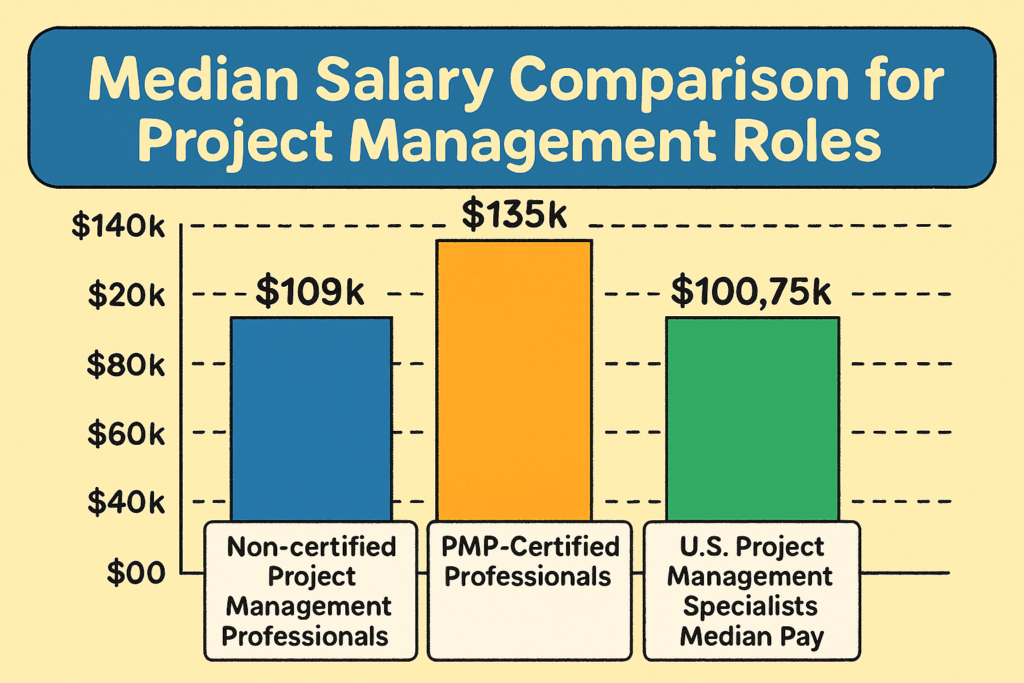
Earning the PMP® isn’t just about adding letters after your name. It can have a tangible impact on your earnings and career growth. According to PMI’s 2025 salary survey, PMP certified professionals in the United States reported a median salary of $135,000, compared with $109,157 for those without the certification. That’s nearly a 24% pay difference. Globally, certification holders earn 17 % more than non-certified peers. The benefits grow over time; U.S. respondents with more than ten years of certification reported a median salary of $173,000.
The demand for project managers is also rising. PMI’s Global Project Management Talent Gap report notes that there are currently about 39.6 million project professionals worldwide and that demand could grow by 64 % between 2025 and 2035. Without more qualified project managers, the world could face a shortfall of nearly 30 million professionals. At the same time, the U.S. Bureau of Labor Statistics reports that project management specialists earned a median annual wage of $100,750 in May 2024, and employment is projected to grow 6% from 2024 to 2034.
To illustrate earning potential, the following bar chart compares the median salaries of PMP holders, non-certified professionals, and project management specialists. While numbers vary by industry and region, the trend is clear: certification pays.
PMP Exam Overview
The PMP exam measures your ability to apply project management principles in real situations, not just memorize definitions.
The following are the key facts:
- Length and Structure: You have 230 minutes to complete 180 questions. Five of those questions are unscored pretest questions. You may take two optional 10-minute breaks during the computer-based exam.
- Content Domains: The exam covers three domains—People (42%), Process (50%), and Business environment (8%). Questions include multiple-choice, multiple-response, matching, hotspot, and limited-fill-in-the-blank formats.
- Languages: The test is available in sixteen languages.
- Difficulty: There is no official pass rate, but most candidates agree the exam is challenging due to its scenario-based questions. Real-world experience and thoughtful study are essential.
PMP Eligibility Requirements
PMI offers three pathways to qualify for the exam. You must choose the track that matches your education and experience. The table below summarizes the requirements.
| Option | Education | Project Leadership Experience | Project Management Training |
| 1. High school diploma or equivalent | Secondary or high school diploma | 60 months (five years) leading and managing projects within the past eight years | 35 hours of project management education or a CAPM certification |
| 2. Bachelor’s degree or higher | Bachelor’s degree or equivalent | 36 months (three years) leading and managing projects within the past eight years | 35 hours of project management education or a CAPM certification |
| 3. GAC-accredited program | Bachelor’s degree or higher from a GAC-accredited program | 24 months (two years) of leading and managing projects within the past eight years | 35 hours of project management education (core coursework qualifies) |
If you’re unsure which path fits your background, take a moment to map your work history and education against these requirements. Many candidates qualify under Option 2. Also note that PMI may audit a sample of applications; if selected, you’ll need to provide documentation to verify your experience
How to Apply for the Exam
The application process is straightforward but detailed. Think of it as your first project:
- Create a PMI Account: Register at PMI.org and complete your personal profile.
- Document Your Experience: For each project you’ve led, record the project name, duration, hours of leadership, and your role. Be honest and thorough.
- List Your Education and Training: Document your highest degree and any project management courses you’ve completed. You’ll need at least 35 hours of project management training unless you hold the CAPM.
- Submit the Application: Upload your information and wait for PMI to review it. Approval typically takes five business days.
- Pay the Exam Fee: After approval, you’ll pay the exam fee. According to training provider KnowledgeHut, the fee is $655 for non-members and $405 for PMI members. PMI membership costs $139 per year plus a $10 one-time application fee, so joining can save you money if you plan to pursue additional PMI certifications or use PMI resources.
If PMI selects your application for an audit, you’ll need to provide copies of your degree, supervisor-verified experience, and proof of training. Don’t worry—this process helps maintain the certification’s credibility and usually adds only a couple of weeks to the timeline.
Preparing for the PMP Exam
Your study plan should reflect your learning style, schedule, and experience. Here are some proven tips:
- Set a realistic schedule: Block out study time each week. Many successful candidates spend eight to twelve hours per week for two to six months.
- Use PMI-approved materials: Study resources from PMI and Authorized Training Partners align with the latest exam blueprint.
- Take a prep course: A live or online course provides structure, expert instruction, and practice questions. Boot camps condense the material into a short time frame, while self-paced courses offer flexibility.
- Practice with sample exams: Simulated exams build confidence and improve time management. The PMI exam simulator offers 175 practice questions.
- Join a study group: Discussing questions with peers helps you grasp complex topics. Many local PMI chapters host study groups.
- Focus on understanding, not memorization: The exam emphasizes situational judgment. Knowing why a practice guide recommends a certain approach will serve you better than memorizing page numbers.
I remember preparing for my own PMP exam. Breaking down the material into small chunks and teaching concepts to colleagues helped me internalize key ideas. Don’t hesitate to adapt your plan as you go—learning is personal.
Scheduling and Taking the PMP Exam
Once you pay the fee, you’ll receive instructions for scheduling the exam. Keep these points in mind:
- One-year Eligibility Window: Your eligibility period starts when PMI approves your application. You may take the exam up to 3 times this year.
- Book Early: Schedule your exam at least three months before your eligibility period ends to ensure available dates. Seats at testing centers and online sessions fill quickly.
- Choose Your Delivery Method: You can take the exam at a Pearson VUE testing center or online with a proctor. Online exams require a quiet space, a reliable internet connection, and proper identification.
- Know What to Expect: Arrive early, bring a valid ID, and follow the exam rules. You’ll have two optional breaks during the 230-minute session.
When the exam ends, you’ll see a preliminary pass or fail result. Within 10 business days, PMI will email your official report and, if you pass, ship your certificate.
Post-Exam Steps and Maintaining Your Credential
After celebrating your success, you must plan to maintain your credential’s active status. The PMP certification is valid for three years. To renew it, you need to earn 60 PDUs across the PMI Talent Triangle (Technical, Leadership, and Strategic Management) and pay a renewal fee. The renewal costs $60 for PMI members and $150 for non-members. Many PDUs are free through webinars, volunteering, and on-the-job learning.
Average Timeframe and Sample PMP Study Plan
Because everyone’s starting point is different, your timeline may differ. Here’s an example of how the process could unfold for a working professional:
| Phase | Duration | Notes |
| Complete any missing education or project hours | Varies | Some candidates must complete a degree or accrue additional leadership hours before applying. |
| Prepare and submit the application | 2–3 weeks | Gather documentation and fill out PMI’s forms. |
| PMI application review | About 1 week | PMI typically approves applications within five business days. |
| Study and prepare for the exam | 6 weeks – 6 months | Commit 30–40 hours of focused study |
| Schedule and take the exam | 1–2 weeks | Schedule early to secure a seat; the exam itself is 230 minutes. |
| Maintain your credential | Ongoing | Earn 60 PDUs every three years and renew your certification. |
This plan totals roughly six to eight months from decision to certification. If you are highly motivated and have flexible time, you might compress the study period to eight weeks, but that requires intense focus.
FAQs
Q1. How long does it take to earn the PMP certification?
The process typically takes six to eight months, from application to exam pass. Highly focused candidates can finish in about eight weeks.
Q2. Do I need a degree to get the PMP?
No. You can qualify with a high school diploma, 5 years of project leadership experience, and 35 hours of project management training.
Q3. How much does the PMP exam cost?
As of December 2025, the exam fee is $655 for non-members and $405 for PMI members.
Q4. How long is the PMP exam?
The computer-based exam lasts 230 minutes and includes 180 questions.
Q5. What happens after I pass?
You’ll receive a digital congratulatory message immediately and a certificate within about ten business days. To keep your credential, you must earn 60 PDUs every three years.
Summary
Becoming a PMP isn’t easy, but the reward is worth it. The certification validates your skills, expands your career options, and increases your earning power. With a clear plan, consistent study, and the right resources, you can complete the PMP certification timeline in a matter of months. Are you ready to take the next step? Consider enrolling in an online PMP certification training program from a trusted provider. Your future projects—and your future self—will thank you.
References:
Ready to start your journey to become a PMP? Enroll in PM Sprout’s top-rated online PMP training today and take the first step toward advancing your career.

I am Mohammad Fahad Usmani, B.E. PMP, PMI-RMP. I have been blogging on project management topics since 2011. To date, thousands of professionals have passed the PMP exam using my resources.